Synthesis vs Syntheses: which one belongs in your sentence? The two words look almost identical, and that is exactly why writers hesitate. The reason is simple: they are the same noun in different numbers. “Synthesis” is the singular form, and “syntheses” is the plural. Use “synthesis” for one and “syntheses” for more than one. Once you see the pattern, Synthesis vs Syntheses stops being a puzzle.
Synthesis vs Syntheses: What Is the Difference?
“Synthesis” means one combination of parts into a whole. “Syntheses” means more than one. The words differ only in number, not in meaning.
Compare these two sentences:
- “The report offers a synthesis of the research.” (one)
- “The report offers three syntheses of the research.” (more than one)
Neither form is incorrect. Each one is right when it matches the number you mean.
What Does Synthesis Mean?
“Synthesis” is a noun. It describes the act or result of combining separate parts, ideas, or substances into a unified whole.
It has three common uses:
- General: combining ideas into something new. “Her essay is a synthesis of two competing theories.”
- Science: building a compound from simpler ones. “The synthesis of aspirin takes several steps.”
- Academic writing: pulling together information from several sources into one argument.
The word is more than a simple summary. A summary shortens one source, while a synthesis connects several.
How Do You Form the Plural of Synthesis?
The plural is syntheses. It does not follow the usual add-s rule. Instead, the -is ending changes to -es.
| Singular | Plural |
| synthesis | syntheses |
| analysis | analyses |
| thesis | theses |
| hypothesis | hypotheses |
| diagnosis | diagnoses |
| crisis | crises |
These words came into English from Greek, and they keep their original plural pattern. That is why “synthesises” is not standard.
How Do You Pronounce Synthesis and Syntheses?
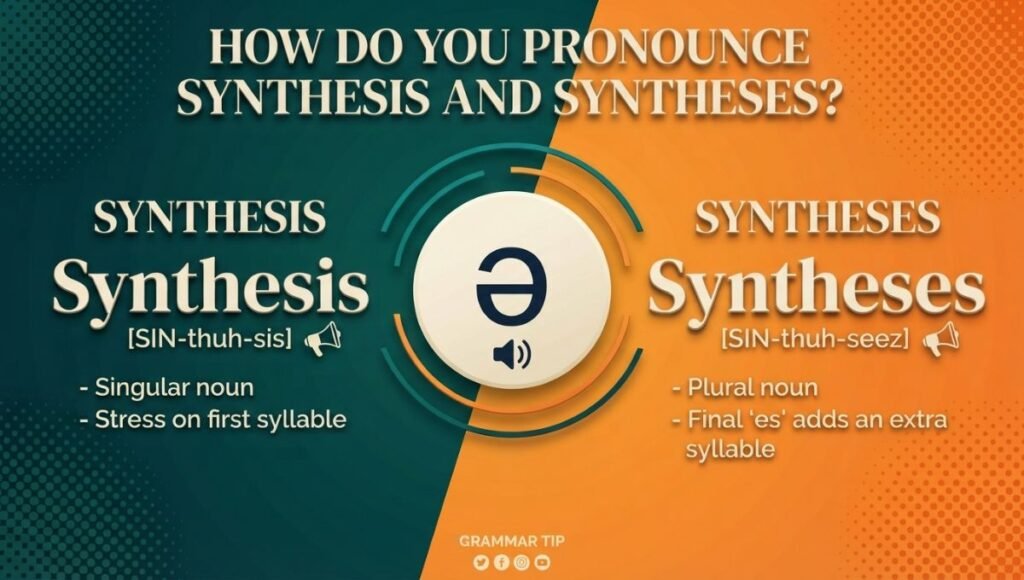
The two words look alike, but the endings sound different.
- Synthesis: SIN-thuh-sis (/ˈsɪnθəsɪs/). The last syllable sounds like “sis.”
- Syntheses: SIN-thuh-seez (/ˈsɪnθəsiːz/). The last syllable sounds like “sees.”
The stress falls on the first syllable in both. Listen for the final sound if you want to tell them apart in conversation.
Where Do Synthesis and Syntheses Come From?
“Synthesis” comes from Greek synthesis, meaning a putting together or composition. The Greek word is built from syn- (together) and tithenai (to place). Latin carried it into English.
The plural pattern also comes from Greek. That explains why the ending changes to -es instead of adding -s, just like “analysis” and “analyses.”
More related Post: Proove or Prove: Which Is Correct? 7 Easy Ways to Get It Right https://feastinsidar.com/proove-or-prove/
Synthesis vs Syntheses at a Glance
Here is how the main forms compare:
| Term | Correct? | Meaning | Use |
| synthesis | Yes | One combination of parts | Singular noun |
| syntheses | Yes | More than one combination | Plural noun |
| synthesises | No | Not a standard plural | Avoid |
| synthesize | Yes | Verb: to combine (US) | “We synthesize the data.” |
| synthesise | Yes | Verb: to combine (UK) | British spelling of the verb |
The takeaway: one synthesis, two syntheses, and never “synthesises” as a plural.
What Are the Related Forms of Synthesis?
The word has a full family:
| Part of speech | Word | Example |
| Noun (singular) | synthesis | A synthesis of ideas |
| Noun (plural) | syntheses | Several syntheses |
| Verb (US) | synthesize | To synthesize findings |
| Verb (UK) | synthesise | To synthesise findings |
| Adjective | synthetic | A synthetic fabric |
| Adjective (less common) | synthetical | Formal, rare |
| Adverb | synthetically | Made synthetically |
| Person or tool | synthesizer | A music synthesizer |
Note that “synthesises” does exist, but only as the third person singular of the British verb: “She synthesises the data.” It is never the plural noun.
How Do You Use Synthesis and Syntheses in Sentences?
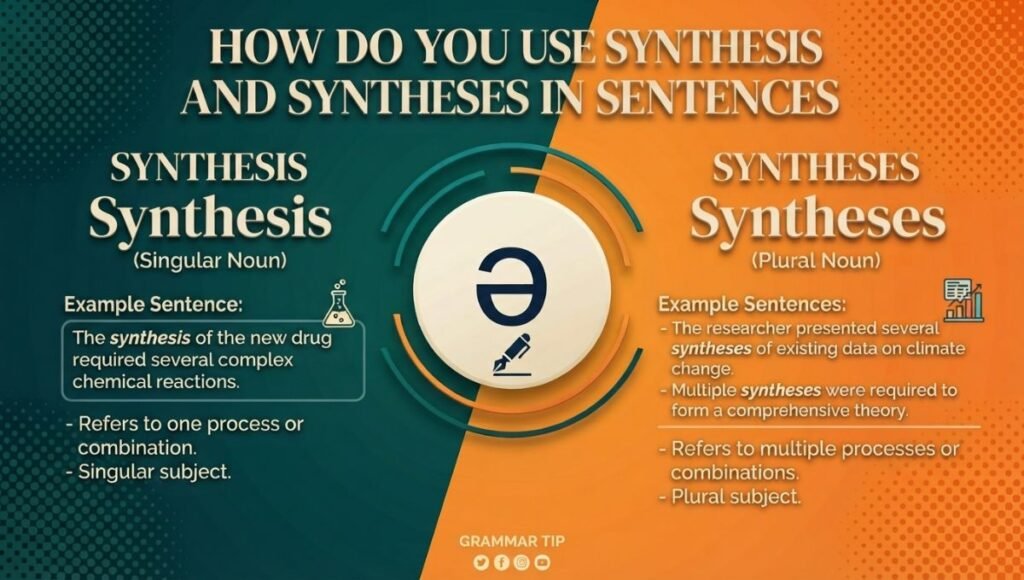
Here are natural examples for different contexts.
Everyday conversation: “Her cooking is a synthesis of Thai and Italian flavors.”
Workplace communication: “Please send me a synthesis of the customer feedback by Friday.”
Email: “I’ve attached two syntheses, one for each region.”
Academic writing: “This chapter presents a synthesis of recent studies on sleep and memory.”
Business writing: “The consultants delivered three syntheses of the market data.”
Formal writing: “The committee’s final report is a synthesis of testimony from twelve experts.”
Casual writing: “That album is a synthesis of everything I loved in the nineties.”
Science: “Researchers compared two syntheses of the same compound.”
In the email and science examples, the words “two” and “each” signal more than one, so the plural is correct. In the academic example, “a” signals a single item, so the singular fits.
What Mistakes Do People Make With Synthesis and Syntheses?
These slips are normal, even for experienced writers.
Incorrect: The paper includes two synthesis of the data.
Correct: The paper includes two syntheses of the data.
“Two” means more than one, so the plural is needed.
Incorrect: The report offers several synthesises.
Correct: The report offers several syntheses.
The plural follows the Greek pattern. Do not add -es to the whole word.
Incorrect: We need a syntheses of the findings.
Correct: We need a synthesis of the findings.
“A” signals one item, so use the singular.
Incorrect: The synthesis are ready for review.
Correct: The syntheses are ready for review.
The verb “are” is plural, so the subject must be plural too.
Synthesis vs Syntheses errors usually come from speed, not confusion. A quick check of the number word before the noun usually fixes them.
What Related Words and Terms Should You Know?
These terms sit close to “synthesis”:
- Synonyms: combination, blend, fusion, integration, union, merger
- Antonyms: analysis, separation, division, breakdown
- Common phrases: photosynthesis, protein synthesis, literature synthesis, synthesis essay
- Related terms: synthetic, synthesizer, synthesist (a person who synthesizes)
Analysis and synthesis often appear together. Analysis breaks something into parts, and synthesis puts parts together. That is why they work as opposites in many fields.
How Do You Choose Between Synthesis and Syntheses?
Use this short guide:
- Count the items. One item takes “synthesis.” More than one takes “syntheses.”
- Check the signal words. “A,” “one,” and “this” point to singular. “Several,” “two,” and “these” point to plural.
- Match the verb. “Is” goes with synthesis, and “are” goes with syntheses.
- Listen for the ending. SIS is singular, and SEEZ is plural.
When you are unsure about Synthesis vs Syntheses, reread the sentence and ask, “How many are there?” The answer tells you which form to use.
Quick Answers About Synthesis and Syntheses
What is the plural of synthesis?
The plural is syntheses. Example: “The journal published three syntheses of the same topic.”
Is syntheses a real word?
Yes. “Syntheses” is the standard plural of “synthesis.” It appears in major dictionaries.
What does synthesis mean in writing?
In writing, synthesis means combining ideas from several sources into one clear point. It goes beyond summary by showing how the sources connect.
Is synthesises correct?
Not as a plural noun. “Synthesises” is only the British third person singular verb, as in “She synthesises the findings.”
The One Rule to Remember
Synthesis vs Syntheses is a question of number, not meaning. Use “synthesis” for one and “syntheses” for more than one, and match your verb to the noun. The takeaway: one synthesis, many synthen.











1 thought on “Synthesis vs Syntheses: 2 Forms, 1 Plural Rule, and 8 Examples”