Combating vs Combatting trips up many writers because English often doubles a final consonant before -ing, and the rule is hard to remember. The short answer: both spellings are accepted, but combating is the standard choice in American English. Combatting is a listed variant, and at least one American dictionary labels it especially British. If you are choosing between Combating vs Combatting for an email, essay, or article, use the single t.
Combating vs Combatting: Which Spelling Should You Use?
Use combating. It is the standard spelling in American English and the safest default for any audience.
Combatting is not an error. Merriam-Webster lists both combating and combatting as forms of the verb combat. You will see the doubled version in published writing, and you do not need to “correct” it in someone else’s work.
The same pattern applies to the past tense: combated is the standard form, and combatted is the variant.
What Does Combat Mean as a Verb?
As a verb, combat means to fight against something, especially to work hard to reduce or eliminate it. People combat crime, disease, pollution, misinformation, and poverty.
It is a transitive verb in most uses, which means it takes a direct object. You combat something. The thing you fight sits right after the verb.
The word also works as a noun (combat is a fight) and as an adjective (combat boots). The spelling question only affects the verb forms.
Why Are There Two Spellings?
The two spellings come from a common English spelling rule. When a word ends in one vowel plus one consonant, and the stress falls on the last syllable, you usually double the consonant before a suffix. That is why begin becomes beginning and occur becomes occurring.
When the stress falls on the first syllable, you usually do not double it. That is why visit becomes visiting and offer becomes offering.
Combat is a mixed case. Merriam-Webster gives two pronunciations for the verb: one stressed on the second syllable (kuhm-BAT) and one stressed on the first (KOM-bat). The first-syllable stress points toward combating, while the second-syllable stress points toward combatting.
That stress pattern is a likely reason both spellings survived. Dictionaries simply record both.
How Do You Pronounce Combat and Combating?
Both spellings sound the same. Most Americans say kuhm-BAT-ing for either one, and some say KOM-bat-ing.
The single t in combating does not make the a long. Do not read it like dating or skating. The vowel stays short, as in bat.
For the noun and adjective, Americans say KOM-bat, with stress on the first syllable.
Are Both Spellings Correct in American and British English?
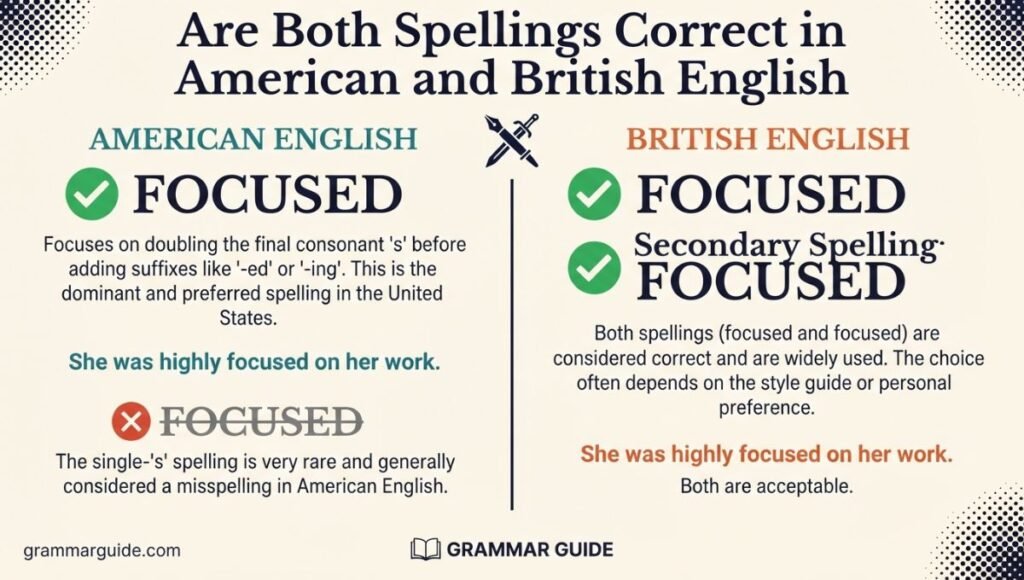
Yes, with a difference in preference. Merriam-Webster lists combated or combatted and combating or combatting without regional labels. A Random House dictionary lists combated and combating first, then adds that the doubled forms are especially British.
For Combating vs Combatting in US writing, default to the single t. British writers may use either, though many style guides and publications choose one spelling for consistency.
This matches a wider pattern. British English often doubles consonants where American English does not (travelled and traveled is the classic example). Doubled forms can therefore feel more British, even when a dictionary accepts them everywhere.
Where Does the Word Combat Come From?
Combat entered English from French combattre. That French verb goes back to Latin elements meaning “with” and “to beat.” The same Latin root gave English the word battle.
The history does not settle the spelling question. It only explains why the word carries the sense of a fight at close quarters.
More related Post: Costed vs Cost: 2 Meanings, 1 Irregular Verb, and 5 Real Examples (2026) https://feastinsidar.com/costed-vs-cost/
Combating vs Combatting at a Glance
This table shows each form, its status, and when to use it.
| Form | Correct? | Notes | Use |
| combating | Yes | Standard spelling in American English | Default choice |
| combatting | Yes (variant) | Listed in dictionaries; labeled especially British in one | Acceptable, less common as a default |
| combated | Yes | Standard past tense | Default choice |
| combatted | Yes (variant) | Variant past tense | Acceptable |
| combatating | No | Not a word | Never use |
How Do You Use Combating in a Sentence?
These realistic examples cover common situations. Each uses the standard spelling.
- Everyday: “Our town is combating litter with weekend cleanup crews.”
- Workplace email: “The team is combating burnout by limiting after-hours messages.”
- Academic writing: “The study examines how public health agencies are combating misinformation.”
- Business writing: “The company is combating fraud with stronger identity checks.”
- Formal writing: “The committee remains committed to combating discrimination.”
- Casual: “I’m combating my sweet tooth with fruit this week.”
In the academic example, combating is a present participle in a continuous verb phrase (are combating). Writers also use it as a gerund, which is a verb form that works as a noun: “Combating climate change requires cooperation.” Here the whole phrase acts as the subject.
Which Verb Forms and Related Words Come From Combat?
Here is the full verb pattern, with variants noted.
| Form | Example |
| combat (base) | “They combat pollution.” |
| combats (third person) | “She combats stress with exercise.” |
| combating (participle) | “We are combating spam.” |
| combated (past) | “The city combated flooding last spring.” |
Related words include combatant (a person who fights), combative (eager to argue or fight), and noncombatant. Common synonyms for the verb include fight, battle, counter, tackle, and oppose. Phrases like “combat boots” and “in combat” use the noun and adjective.
Combat differs slightly from resist. Combat suggests forceful, active countering, while resisting can be more defensive.
What Mistakes Do Writers Make With Combat?
Most errors in Combating vs Combatting discussions come from inconsistency or overcorrection. These are normal mistakes, and each is easy to fix.
Incorrect: We are combating fraud and combatting waste.
Correct: We are combating fraud and waste.
Pick one spelling and keep it throughout a document. Mixing them looks careless.
Incorrect: The nonprofit is combating against poverty.
Correct: The nonprofit is combating poverty.
Combat already means to fight against something, so against is redundant.
Incorrect: The group is combatating hunger.
Correct: The group is combating hunger.
There is no extra syllable. Just add -ing to combat.
Incorrect: Combatting is wrong.
Correct: Combatting is a less common variant, not an error.
Dictionaries list it, so labeling it a mistake is inaccurate.
What Are the 7 Quick Rules for Choosing?
For Combating vs Combatting, these seven rules cover nearly every situation:
- Default to combating and combated.
- Accept combatting and combatted as legitimate variants.
- Keep one spelling throughout a document.
- Follow your publication’s or client’s style guide if it has one.
- Do not add against after the verb.
- Pronounce both spellings the same way.
- Remember the shortcut: combat + ing = combating.
That last rule is the easiest memory trick. If you simply add -ing to the base word, the way you do with visit or offer, you get the standard spelling.
Frequently Asked Questions
Is combating or combatting correct?
Both are accepted. Combating is the standard spelling, especially in American English, and combatting is a variant.
Is Combating vs Combatting a US versus UK difference?
Partly. One American dictionary labels the doubled forms especially British, while Merriam-Webster lists both without a regional label. In US writing, combating is the safer choice.
What is the past tense of combat?
The standard past tense is combated. The variant combatted is also listed in dictionaries.
How do you use combating in a sentence?
Use it with an object that names the problem: “The school is combating absenteeism with a new attendance program.”
What to Remember When Choosing a Spelling
Combating vs Combatting is a choice between a standard spelling and an accepted variant, not between right and wrong. Use combating, keep it consistent, and do not mark combatting as an error in other people’s writing.











1 thought on “Combating vs Combatting: Which one to Use (7 Quick Rules)”