Tomorrow vs Tommorow trips up writers because the word has a doubled letter, and it is easy to put it in the wrong place. The reason is sound: the stressed middle syllable makes an extra m feel natural. Here is the answer: tomorrow is the only correct spelling, with one m and two r’s. Whenever you face Tomorrow vs Tommorow, remember that the double letter is r.
Tomorrow vs Tommorow: Which Spelling Is Correct?
Tomorrow is correct. “Tommorow” is a misspelling. The correct word has one m and two r’s: t-o-m-o-r-r-o-w.
Does “tommorow” have any legitimate use? No. It is not an accepted variant. If you see it in writing, it is a typo or a spelling slip.
Spell the word the same way in American and British English.
What Does Tomorrow Mean?
Tomorrow means the day after today. It answers the question “when?” for plans, deadlines, and forecasts.
It also has a broader meaning in the noun sense: the future in general. People talk about “a better tomorrow” or “the leaders of tomorrow.”
Both meanings use the same spelling, so the rule never changes.
Why Do People Spell It “Tommorow”?
The Tomorrow vs Tommorow mix-up is a sound problem, not a knowledge problem. When you say the word, the stress falls on the second syllable (tuh-MAR-oh). A stressed syllable can make the letter before it feel doubled.
Many familiar English words double a consonant in the middle, so the brain looks for a pattern and picks the wrong letter. The doubling in this word belongs to the r, not the m.
Other common slips include dropping one r (tomorow), doubling both letters (tommorrow), or adding a third r (tomorrrow).
How Do You Pronounce Tomorrow?
In American English, tomorrow is pronounced tuh-MAR-oh. Merriam-Webster lists the stress on the second syllable.
The first syllable is weak and sounds like tuh. The second sounds like mar (as in marry), and the last syllable ends in a long oh.
The spelling has three syllables: to-mor-row. Saying it slowly and spelling each syllable helps you avoid the extra m.
Where Does the Word Tomorrow Come From?
Tomorrow comes from the Old English phrase tō morgenne, which meant “on the morrow” or “on the next morning.” The word tō meant “to” or “at,” and morgen meant “morning” or “the following day.”
By Middle English, the phrase had fused into a single word. Merriam-Webster dates the first known use of tomorrow to the 13th century.
The same pattern gave English two sister words: today (from Old English tō dæge, “on this day”) and tonight (from tō niht, “on this night”). All three combine to with a time word.
Is Tomorrow a Noun or an Adverb?
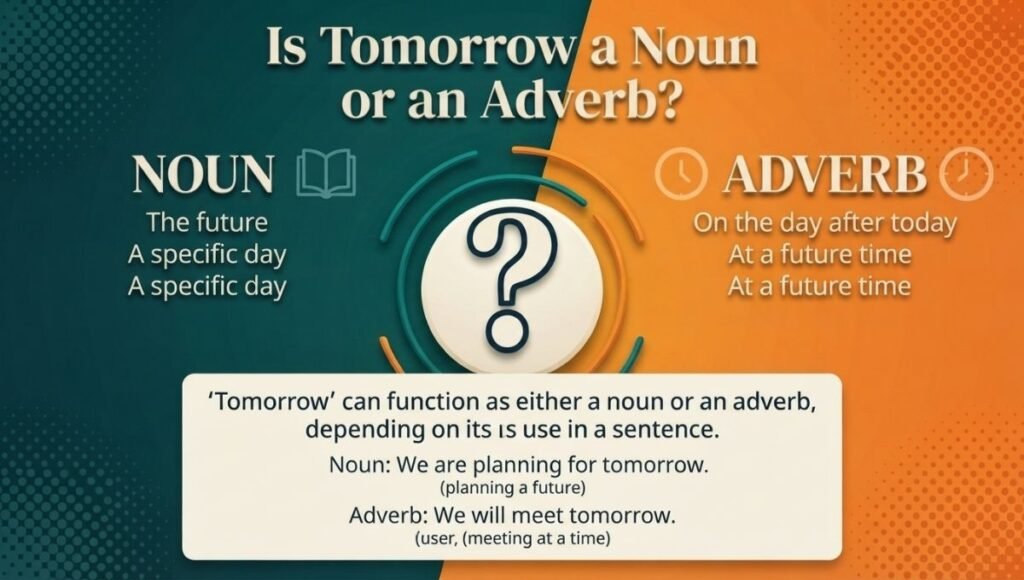
Tomorrow works as both a noun and an adverb. Merriam-Webster advises against using it as an adjective or a verb.
As an adverb, it tells when something happens: “I’ll call you tomorrow.” An adverb needs no preposition before it, so do not write “on tomorrow.”
As a noun, it names a day or the future: “Tomorrow is Friday.” It can take a possessive: tomorrow’s meeting, tomorrow’s weather.
It combines easily with the future tense (“I will leave tomorrow”) and with the present progressive for plans (“I’m leaving tomorrow”).
More related Post: Family’s or Families: What’s the Difference and How to Use Them Correctly (2026) https://feastinsidar.com/familys-or-families/
Tomorrow vs Tommorow at a Glance
This table shows the correct spelling next to the common wrong ones.
| Form | Correct? | What goes wrong | Fix |
| tomorrow | Yes | Nothing | Standard spelling |
| tommorow | No | Extra m, only one r | One m, two r’s |
| tomorow | No | Only one r | Double the r |
| tommorrow | No | Doubles m and r | Only the r doubles |
| tomorrrow | No | Three r’s | Two r’s |
| tmrw, 2morrow | Informal | Texting shorthand | Avoid in formal writing |
How Do You Use Tomorrow in Real Sentences?
These examples cover common situations. Each uses the correct spelling.
- Everyday: “I’ll call you tomorrow.”
- Casual: “Tomorrow is Friday, thank goodness.”
- Workplace email: “Please send the report by noon tomorrow.”
- Business writing: “The board meets tomorrow at 9 a.m.”
- Academic writing: “The syllabus lists tomorrow’s reading.”
- Formal writing: “The hearing is scheduled for tomorrow morning.”
- Noun, in a broader sense: “She volunteers to build a better tomorrow.”
Notice that in “by noon tomorrow,” the word is an adverb, so no preposition comes before it. In “tomorrow’s reading,” the possessive turns the noun into a modifier.
What Mistakes Do Writers Make With Tomorrow?
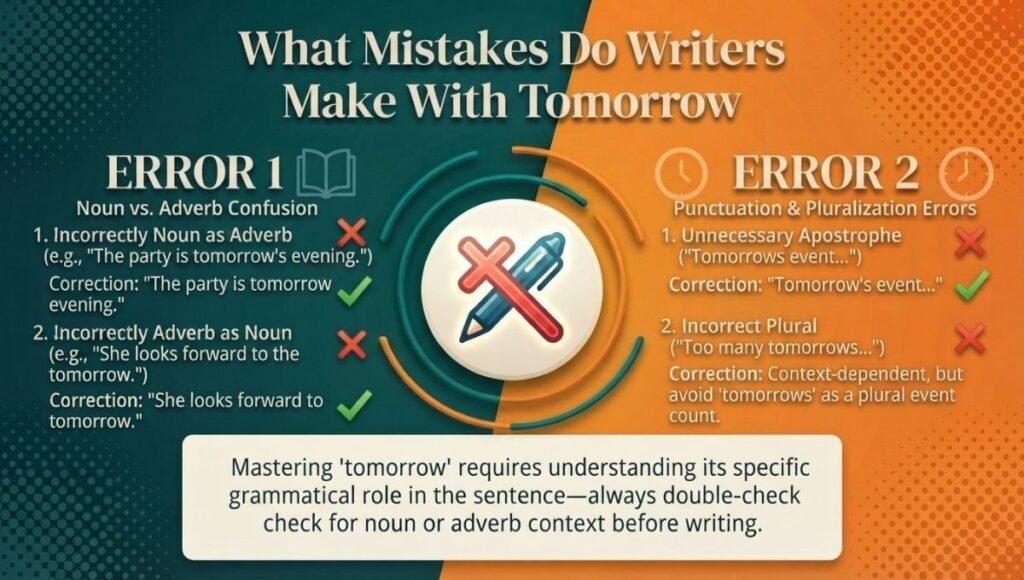
Most errors in Tomorrow vs Tommorow come from spelling by sound or adding extra words. These are normal mistakes, and each has a quick fix.
Incorrect: I’ll see you tommorow.
Correct: I’ll see you tomorrow.
Only the r doubles. The m stays single.
Incorrect: I’ll call you on tomorrow.
Correct: I’ll call you tomorrow.
Tomorrow works as an adverb here, so it does not need a preposition.
Incorrect: Please attend the tomorrow meeting.
Correct: Please attend tomorrow’s meeting.
Use the possessive form, since tomorrow works as a noun or an adverb, not as an adjective.
Incorrect: Tomorrow will be rain.
Correct: It will rain tomorrow.
English needs it as the subject for weather statements.
Which Words and Phrases Go With Tomorrow?
Several related terms help you use the word naturally.
- Time words: today, tonight, yesterday, morning, morrow
- Time phrases: tomorrow morning, tomorrow afternoon, tomorrow evening, tomorrow night, the day after tomorrow
- Idioms: “here today, gone tomorrow,” “tomorrow is another day”
- British idiom: “jam tomorrow,” a promise of future reward that never arrives
- Rare noun: tomorrowness, which Merriam-Webster lists for “the quality of being tomorrow”
Writers sometimes use texting shorthand like 2morrow or tmrw. Keep those for casual messages, not formal writing.
How Can You Remember the Spelling?
For Tomorrow vs Tommorow, use these three quick tricks:
- Break it into three syllables: to + mor + row. The m appears once, in the middle syllable.
- Link it to its sister words: today and tonight start with to, so tomorrow does too.
- Count the letters: the word has eight letters. If you wrote nine, the extra one is the second m.
A final memory aid: the double letter is in the second half of the word, with the r’s.
Frequently Asked Questions
Is Tomorrow vs Tommorow a real spelling difference?
No. Tomorrow is the only correct spelling. Tommorow is a misspelling, not a variant.
How do you spell tomorrow?
Spell it t-o-m-o-r-r-o-w, with one m and two r’s.
What does tomorrow mean?
It means the day after today. As a noun, it can also mean the future.
Where does the word tomorrow come from?
It comes from Old English tō morgenne, meaning “on the morrow” or “on the next morning.”
What to Remember About Spelling Tomorrow
Tomorrow vs Tommorow has a simple answer: write tomorrow, with one m and two r’s. The extra m is a common sound-based mistake that many writers make. Say tuh-MAR-oh, spell it letter by letter, and remember that the double letter belongs to the r. One m, two r’s, every time.











1 thought on “Tomorrow vs Tommorow: 7 Ways to Spell It Right Every Time”