What Happen or What Happened? Many writers pause here because the two questions sound nearly identical in fast speech. The final -d is soft and easy to miss, so the mistake slips into writing. Here is the answer: “What happened?” is correct for a past event, and “What happen” is not standard English by itself. If you are torn between What Happen or What Happened, add -ed.
What Happen or What Happened: Which Form Is Correct?
Use “What happened?” to ask about something that already occurred. “What happen” has no tense marker, so it is not standard English on its own.
The verb happen needs a form that shows time. For a finished event, that form is happened.
- What happened to the report? (correct)
- What happen to the report? (not standard)
Plain happen is still correct in other situations, such as after a helper verb. The next sections explain when.
What Does “What Happened” Mean?
“What happened?” asks for an explanation of a past event. It means “What occurred?” or “What took place?”
What is an interrogative pronoun here. It stands in for the unknown thing, and it works as the subject of the question. Happened is the simple past tense of the verb happen.
In a subject question like this one, English does not add did. Say “What happened?” and not “What did happened?”
Why Is “What Happen” Incorrect on Its Own?
Standard English needs the verb to show tense when no helper verb is present. Happen alone shows neither past nor present. In the present, it needs an -s: “What happens?” In the past, it needs -ed: “What happened?”
You will hear “what happen” in fast speech and in text messages. Some English dialects, including African American English, may drop the past-tense ending in speech, following their own consistent patterns. Learners whose first language has no past-tense endings may also leave it off.
In standard written English, however, the past event needs happened.
When Is “Happen” Correct in a Question?
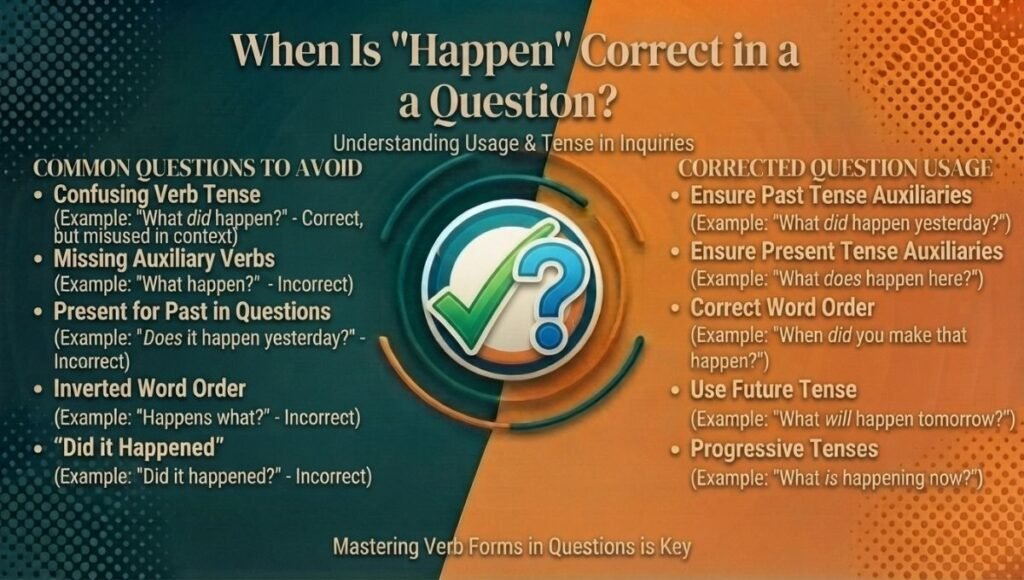
Plain happen is correct after a helper verb (also called an auxiliary verb). Helper verbs include will, would, can, could, should, might, may, must, and do/does/did. After a helper, the main verb stays in its base form.
- What will happen next?
- What might happen if the deadline moves?
- What should happen after approval?
- What did happen at the meeting? (emphatic)
The last example stresses that something really occurred. Without the emphasis, say “What happened at the meeting?”
How Do You Form, Spell, and Pronounce Happen?
Happen is a regular verb. It follows the usual pattern.
| Form | Example | Use |
| happen | It may happen again. | Base form, after helpers |
| happens | It happens often. | Third person singular, present |
| happened | It happened yesterday. | Simple past and past participle |
| happening | It is happening now. | Present participle |
Spelling: Keep the double p and add -ed. Do not double the n. The word is happened, never happenned. The stress falls on the first syllable (HAP-un), so the consonant stays single.
Pronunciation: American English says HAP-und for happened. The ending sounds like a soft d, which is why it gets lost in fast speech.
British and American English use the same spelling and the same grammar here.
More related Post: Tomorrow vs Tommorow: 7 Ways to Spell It Right Every Time https://feastinsidar.com/tomorrow-vs-tommorow/
What Happen or What Happened at a Glance
This table compares the common question forms and when each fits.
| Question | Tense | What it asks | Correct? |
| What happened? | Simple past | A finished event | Yes |
| What happens? | Simple present | A general pattern or fixed plan | Yes |
| What is happening? | Present continuous | What is going on right now | Yes |
| What has happened? | Present perfect | A past event with current relevance | Yes |
| What will happen? | Future | A future event | Yes |
| What did happen? | Emphatic past | Stresses that something occurred | Yes |
| What happen? | None | No tense marker | Not standard |
Where Does the Word Happen Come From?
Happen comes from Middle English happenen, meaning “to occur by chance.” It grew out of the noun hap, which meant chance or luck.
Merriam-Webster dates the first known use of happen to the 14th century. The noun hap goes back to Old Norse happ, meaning good luck.
That family tree explains several related words: happy (originally “lucky”), mishap, and perhaps all come from the same root.
How Do You Use “What Happened” in Real Sentences?
These examples cover common situations. Each uses the standard form.
- Everyday: “What happened to your phone?”
- Casual: “Wait, what happened at the end of that show?”
- Workplace email: “Can you tell me what happened with the shipment?”
- Business writing: “The report explains what happened during the system outage.”
- Academic writing: “Historians still debate what happened after the treaty was signed.”
- Formal writing: “The committee will review what happened on the night of the incident.”
- Future: “What will happen if the deadline moves?”
In the shipment example, happened fits because the event is over. In the future example, plain happen follows the helper will.
What Mistakes Do Writers Make With Happen?
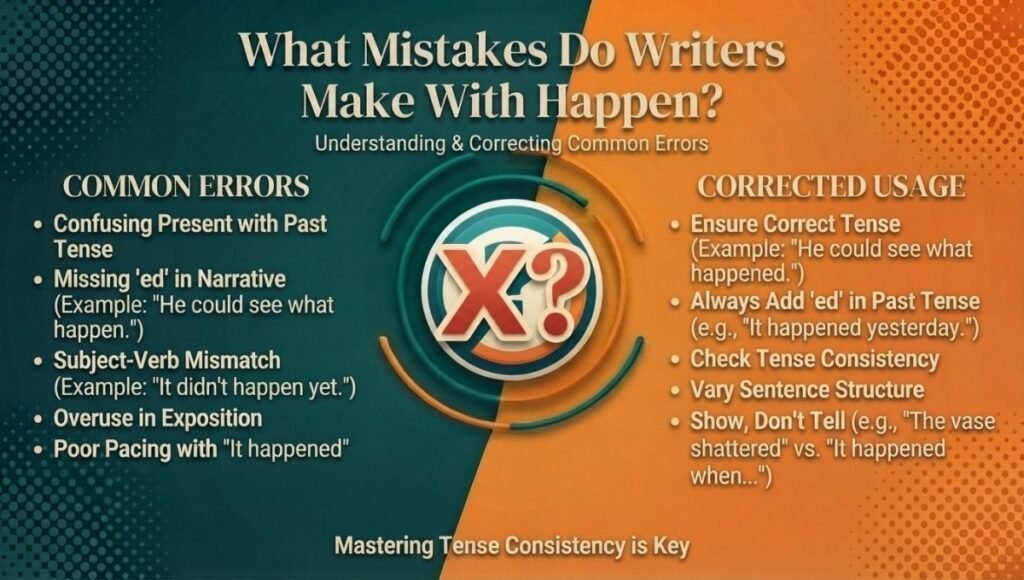
Most errors in What Happen or What Happened come from missing tense or doubled tense. These are normal mistakes, and each has a quick fix.
Incorrect: What happen to the report?
Correct: What happened to the report?
The event is finished, so the verb needs the past-tense ending.
Incorrect: What did happened?
Correct: What happened? (or, for emphasis, What did happen?)
Did already shows the past, so the main verb returns to its base form.
Incorrect: What will happened next?
Correct: What will happen next?
After will, use the base form.
Incorrect: What is happened?
Correct: What has happened? (or What is happening?)
Match the helper with the right verb form: has with happened, is with happening.
Incorrect: What happenned?
Correct: What happened?
Do not double the n.
What Related Phrases Should You Know?
When you study What Happen or What Happened, learn the phrases that travel with it:
- Common phrases: what happened next, what happened to, whatever happened to, what’s going on, what went wrong
- Synonyms: occur, take place, come about
- Pattern: happen to plus a verb, as in “I happened to see her yesterday”
- Phrasal use: happen upon means to find by chance
- Related nouns: happening, happenstance (a blend of happen and circumstance)
- Idiom: “these things happen,” said to ease a mistake
Happen is intransitive, which means it does not take a direct object. You do not “happen” something. Things simply happen.
How Can You Remember the Rule?
For What Happen or What Happened, use this two-step check:
- Look for a helper verb. If you see did, will, can, should, or similar, keep happen plain.
- If there is no helper, look at the time. For a finished event, add -ed.
A quick memory aid: no helper, add -ed.
Another easy test: swap in occurred. If “What occurred?” sounds right for the past, then “What happened?” is the matching form.
Frequently Asked Questions
Which is correct: What Happen or What Happened?
“What happened?” is correct for a past event. “What happen” is not standard English by itself.
Is “what happen” ever correct?
Yes, plain happen is correct after a helper verb, as in “What will happen?” or “What did happen?” Standard writing does not use it alone for a past event.
What is the past tense of happen?
The past tense is happened. It is also the past participle, used after has or have.
Can you say “what did happen”?
Yes. It is correct when you want to stress that something truly occurred: “What did happen after I left?”
What to Remember About Happen and Happened
What Happen or What Happened has a clear answer: use happened for a finished past event, and use plain happen only after helper verbs like did, will, can, or should. Check for a time clue first, and add -ed when nothing else marks the past. Remember: no helper, add -ed.











1 thought on “What Happen or What Happened? 7 Simple Rules for the Correct Form”