Proove or prove: which one is right? Because the word sounds like “groove,” many people add an extra o. Prove is the only correct spelling. “Proove” is a misspelling with no standard use in English. Below you will find the meaning, grammar, and simple memory tricks to settle proove or prove for good.
Proove or Prove: What Is the Correct Spelling?
The correct spelling is “prove.” It has one o, one v, and a silent e at the end. Major dictionaries do not list “proove” as a variant, and you will not find it in edited writing.
Sound is the reason proove or prove trips people up. The word rhymes with “move” and “groove,” and English speakers often assume a long “oo” sound needs two o’s. That guess makes sense, but English spelling does not always follow pronunciation.
The good news is that this is one of the easiest spelling errors to fix. Use prove every time, whether you mean to show that something is true, test something, or turn out a certain way.
What Does Prove Mean?
Prove is a verb with three main meanings:
- To show that something is true with evidence or logic: “The lab results proved the water was safe.”
- To turn out to be: “The shortcut proved slower than the main road.”
- To test or try out: “Bakers prove dough” (let it rise), and a “proving ground” is a place where ideas or equipment are tested.
The verb also works with a person as the object. When you “prove yourself,” you show that you are capable. When you “prove someone wrong,” you show that their claim was mistaken.
What Is the Difference Between Proove and Prove?
There is no difference in meaning, because “proove” is not a real word. The only difference is spelling status: prove is correct, and proove is an error. Here is proove or prove at a glance, along with the related forms people often mix up:
| Term | Correct? | Meaning | Use |
| prove | Yes | To show as true, test, or turn out | Base form of the verb |
| proved | Yes | Past tense and past participle | “She proved her point.” |
| proven | Yes | Past participle and adjective | “A proven method” |
| proof | Yes | Noun: evidence | “Do you have proof?” |
| proove | No | Misspelling of prove | Avoid |
| prooved | No | Misspelling of proved | Avoid |
Does “proove” have any legitimate use? Not in standard English. The only time you might see it is in a brand name, a username, or a stylized title, where someone chose it on purpose. In ordinary writing, treat it as a typo.
How Do You Pronounce Prove?
Prove is one syllable, pronounced /pruːv/. It rhymes with “move,” “groove,” and “remove.”
The silent e at the end matters. English words almost never end in a plain v, so a silent e follows it. That final e does not change the vowel sound here, but it is still required.
Other words with the same “ove” pattern and the same sound include “approve,” “improve,” and “remove.” None of them has a double o, and neither does prove.
More related Post: Fetus vs Foetus: What’s the Difference? A 2-Minute Guide https://feastinsidar.com/fetus-vs-foetus/
What Are the Forms of Prove (Verb, Noun, Adjective)?
Prove is mainly a verb. Here are its forms:
- prove (base form): “I can prove it.”
- proves (third person singular): “The data proves the point.”
- proving (present participle): “She is proving her skills.”
- proved (past tense): “He proved the theory last year.”
- proved or proven (past participle): “It has been proved” or “It has been proven.”
Related forms include the noun proof, the adjective provable, and the adverb provably. The adjective “proven” is very common before a noun: “a proven strategy” or “a proven track record.”
Should you use proved or proven? In American English, both are accepted as the past participle. Many writers choose “proven” before a noun and “proved” for the simple past: “The study proved her right.”
Where Does the Word Prove Come From?
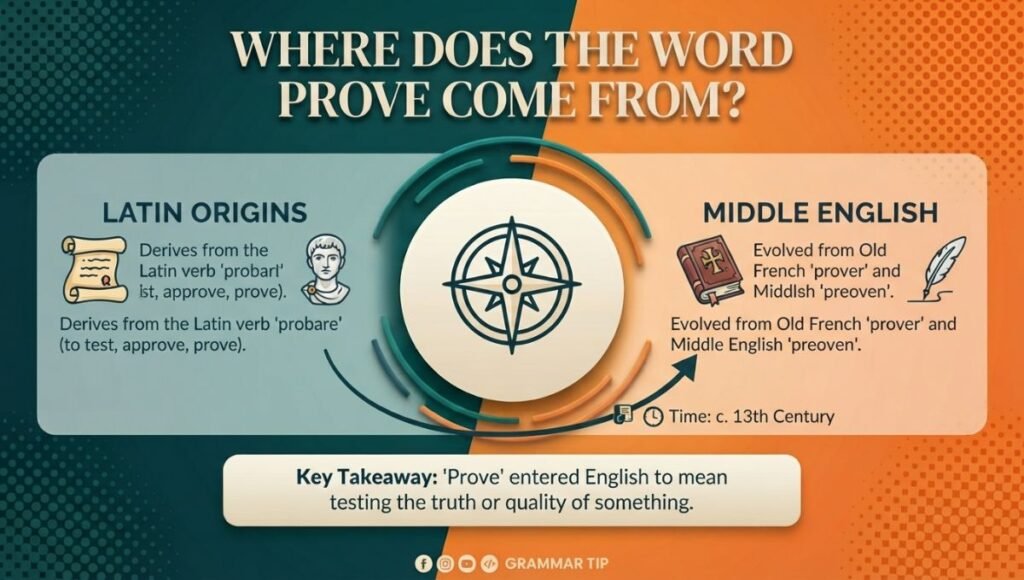
Prove came into English through Old French (prover) from the Latin verb probare, which meant “to test, approve, or show to be good.” The Latin root is connected to probus, meaning “good” or “upright.”
That history explains why prove has a testing sense. The same root gave English “probe,” “probable,” “approve,” and “probate.” Each word carries some idea of checking whether something holds up.
The old testing meaning survives in familiar phrases. The saying “the proof of the pudding is in the eating” means you learn the quality of something by trying it. In the same spirit, “the exception proves the rule” is often explained as “the exception tests the rule.”
How Do You Use Prove in a Sentence?
Here are natural examples for different situations:
- Everyday conversation: “Prove it! I bet you can’t solve that puzzle in ten minutes.”
- Workplace: “Our third-quarter numbers prove that the new onboarding process is working.”
- Email: “Could you send the receipt so I can prove the purchase date?”
- Academic writing: “The study does not prove that coffee improves memory. It only shows a link.”
- Formal writing: “Applicants must prove residency with a lease or a utility bill.”
- Casual writing: “He proved everyone wrong and finished the marathon.”
Why does the academic example use “does not prove”? In research, “prove” means the evidence leaves no reasonable doubt. Because a single study rarely does that, careful writers often choose softer verbs such as “suggest” or “indicate.”
In the email example, “prove” is a verb after “can,” so it stays in the base form. No ending is needed.
What Are the Most Common Mistakes With Prove?
These errors are normal, and they are easy to fix. Anyone who has stopped to check proove or prove is in good company, since spellcheck and speed-typing cause many of them.
Mistake 1: Adding a second o
Incorrect: Can you proove that you paid?
Correct: Can you prove that you paid?
The verb has only one o.
Mistake 2: Misspelling the past tense
Incorrect: The results prooved our theory.
Correct: The results proved our theory.
Add only a d to prove. The double o never appears in any form of the verb.
Mistake 3: Using “provened”
Incorrect: She has provened her skill.
Correct: She has proved (or proven) her skill.
“Proven” already works as the past participle, so it does not take another ending.
Mistake 4: Using the verb as a noun
Incorrect: Hard evidence is the best prove.
Correct: Hard evidence is the best proof.
When you need a noun that means “evidence,” use proof.
Mistake 5: Doubling the o in the adjective
Incorrect: This is a prooven method.
Correct: This is a proven method.
Again, the vowel stays as a single o.
How Can You Remember Proove or Prove?
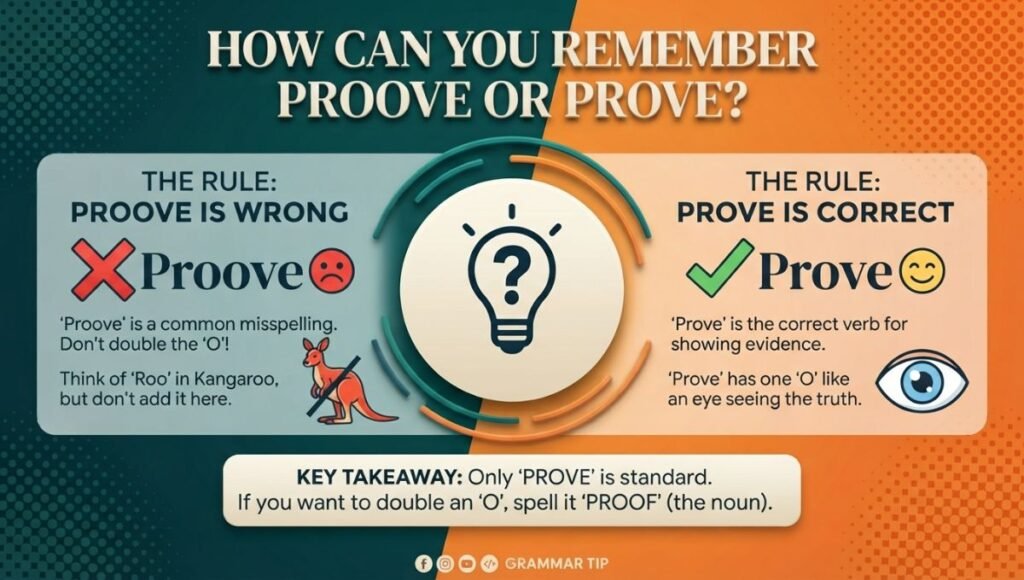
Here are a few simple tricks:
- Match it with similar words. Move, remove, approve, and improve all end in “ove” with a single o. Prove follows the same pattern.
- Save the double o for the noun. The noun proof has two o’s, while the verb prove has one. This mix-up is likely why “proove” looks tempting.
- Spell it in two chunks. Think “pro” plus “ve.” If you notice a third o sneaking in, delete it.
- Slow down on proofreading. Search your document for “proov” before you send it. It takes seconds and catches every variant.
Which Related Words and Phrases Should You Know?
Knowing the family of words around prove makes it easier to use correctly:
- Synonyms: demonstrate, verify, confirm, establish, show
- Antonyms: disprove, refute
- Related words: proof, proven, provable, unprovable, disproven
- Common phrases: prove a point, prove someone wrong, prove yourself, proof of concept, burden of proof, innocent until proven guilty, proving ground
Notice how prove is stronger than “suggest” or “indicate.” Choose it when the evidence is solid, and choose a softer verb when the evidence is partial.
Is Prove Spelled Differently in American and British English?
No. Prove is spelled the same in American and British English, so the spelling question has one answer everywhere.
The differences are small. American writers accept both “proved” and “proven” as the past participle, and many prefer “proven” before nouns. British writers often use “proved” for the verb and reserve “proven” for the adjective, though both forms appear on both sides of the Atlantic.
In the kitchen, British bakers often say they “prove” dough, while American bakers usually say they “proof” it. The meaning is the same: letting the dough rise before baking.
Frequently Asked Questions About Prove
Is proove or prove the correct spelling?
The correct spelling is prove. “Proove” is a common misspelling and is not accepted in standard English.
What is the past tense of prove?
The past tense is proved: “The test proved the design was safe.” The past participle can be either “proved” or “proven.”
Should I use proved or proven?
Both are correct as past participles in American English. Use “proven” before a noun (“a proven approach”) and “proved” for the simple past (“she proved her point”). If you are unsure, “proved” is safe in most verb positions.
What is the difference between prove and proof?
Prove is a verb meaning to show something is true. Proof is a noun meaning the evidence itself. You prove a claim by giving proof.
What Is the One Rule to Remember?
The proove or prove question has a short answer: spell it prove, with one o and a silent e. The same goes for every verb form: proved, proven, and proving.











1 thought on “Proove or Prove: Which Is Correct? 7 Easy Ways to Get It Right”