Explicit vs Implicit: which word fits your sentence? Both describe how a message gets across, and both start with a similar sound, so they are easy to swap by accident. “Explicit” means stated clearly and directly. “Implicit” means suggested or understood without being stated. If you say it out loud, it is explicit. If the listener has to read between the lines, it is implicit. That one test settles Explicit vs Implicit in most sentences.
Explicit vs Implicit: What Is the Difference?
Explicit means clearly stated, with nothing left to guess. Implicit means hinted at or understood, but not said directly.
Here is the difference in two sentences:
- “The manager said, ‘You must finish this by Friday.'” (explicit)
- “The manager looked at the clock and sighed.” (implicit, the deadline is suggested)
Both words describe real, useful ways to communicate. Neither is better. The choice depends on whether the message was spoken outright or only suggested.
What Does Explicit Mean?
“Explicit” is an adjective. It describes something that is stated fully and clearly, so the reader or listener does not have to infer anything.
It has three common uses:
- Clearly stated: “The contract gives explicit instructions for returns.”
- Direct and detailed: “She gave me explicit directions to the office.”
- Adult content: “The song has explicit lyrics.” In this sense, the word describes content that is graphically frank.
The adverb is explicitly, as in “He explicitly asked us not to call.” The noun is explicitness.
What Does Implicit Mean?
“Implicit” is also an adjective. It describes something that is suggested or understood without being directly stated.
It has two main uses:
- Suggested, not stated: “There was an implicit warning in her tone.”
- Complete or unquestioning: “He has implicit trust in his team.” Here the word means absolute, with no doubts.
The adverb is implicitly, as in “She implicitly agreed by staying silent.” The noun is implication, though “implicitness” also exists and is rarely used.
How Can You Tell Explicit and Implicit Apart Quickly?
Use this three-second test: Was it said, or was it suggested?
- If someone said it or wrote it plainly, use “explicit.”
- If it is only understood from tone, context, or common sense, use “implicit.”
A memory hook helps too. The “ex” in explicit points outward, like something put out into the open. The “im” in implicit points inward, like something folded inside. That picture matches the meaning well.
Where Do Explicit and Implicit Come From?
Both words come from Latin, and they share a root. Explicit traces to Latin explicare, meaning to unfold or explain. Implicit traces to Latin implicare, meaning to enfold or involve.
Both come from the same verb family, built on plicare (to fold). That shared root explains the picture: explicit ideas are unfolded and laid out, while implicit ideas remain folded up inside the message.
How Do You Pronounce Explicit and Implicit?
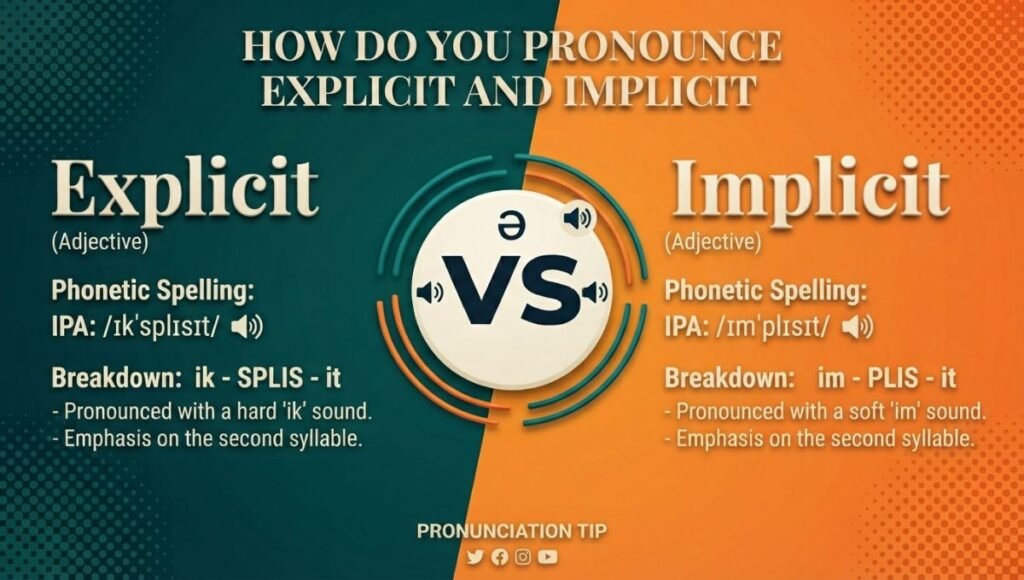
The two words differ only in their first syllable.
- Explicit: ik-SPLIS-it (/ɪkˈsplɪsɪt/)
- Implicit: im-PLIS-it (/ɪmˈplɪsɪt/)
The stress falls on the second syllable in both. Because the endings sound the same, speakers sometimes mishear one for the other. Emphasize the first syllable when clarity matters, especially on a phone call.
More related Post: Synthesis vs Syntheses: 2 Forms, 1 Plural Rule, and 8 Examples https://feastinsidar.com/synthesis-vs-syntheses/
Explicit vs Implicit at a Glance
Here is how the two words compare:
| Term | Correct? | Meaning | Use |
| explicit | Yes | Stated clearly and directly | Instructions, rules, contracts, direct statements |
| implicit | Yes | Suggested or understood, not stated | Tone, assumptions, unspoken expectations |
| explicitly | Yes | In a clear, direct way | “He explicitly said no.” |
| implicitly | Yes | In an unstated way | “She implicitly agreed.” |
| implied | Yes, related | Suggested by the speaker | Often paired with “implicit” |
The takeaway: explicit is spoken out loud, and implicit is understood without a word.
How Do the Word Forms of Explicit and Implicit Change?
Each word has a small family. Here are the standard forms:
| Part of speech | Explicit family | Implicit family |
| Adjective | explicit | implicit |
| Adverb | explicitly | implicitly |
| Noun | explicitness | implication (main noun) |
| Opposite | implicit, vague | explicit, stated |
Both adjectives can take comparisons: “more explicit,” “most implicit.” The spelling is the same in American and British English.
The two words are natural opposites, so each one can serve as the antonym of the other.
How Do You Use Explicit and Implicit in Sentences?
Here are eight examples that show the Explicit vs Implicit split in real situations.
Everyday conversation: “She never said sorry, but the flowers were an implicit apology.”
Workplace communication: “Please give me explicit feedback so I know exactly what to fix.”
Email: “To be explicit, the deadline is Friday at 5 p.m., not Monday.”
Academic writing: “The author makes an implicit argument that education shapes identity.”
Business writing: “The policy explicitly prohibits sharing client data.”
Formal writing: “The agreement contains an implicit assumption of good faith.”
Casual writing: “There was an implicit rule that nobody touches the last slice.”
Trust: “The team has implicit confidence in its leader.”
In the email example, “to be explicit” signals that the writer is removing any doubt. In the academic example, the author never states the argument directly, so “implicit” is correct. In the final example, “implicit” means complete, not merely suggested.
What Mistakes Do People Make With Explicit and Implicit?
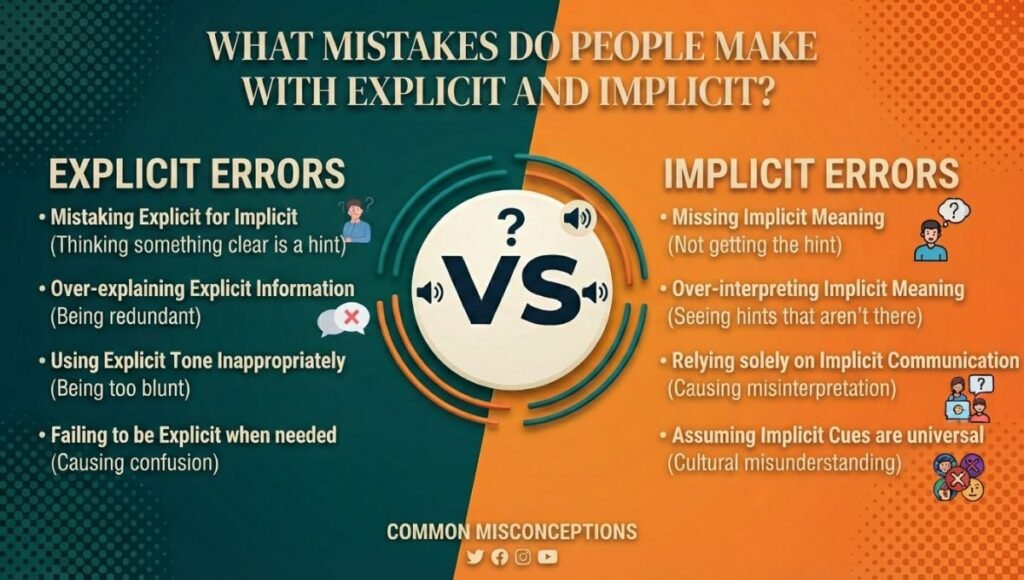
These slips are normal, and each has a quick fix.
Incorrect: The rules were implicit written in the handbook.
Correct: The rules were explicitly written in the handbook.
“Written in the handbook” means the rules were stated. Also, the word needs the adverb form, “explicitly,” to modify the verb.
Incorrect: She made an explicit hint about the raise.
Correct: She made an implicit hint about the raise.
A hint is suggested by nature, so “explicit hint” clashes.
Incorrect: The film is not implicit for children.
Correct: The film is not suitable for children because of explicit content.
“Explicit” is the word for graphic material. Use it directly.
Incorrect: He implicated that he was unhappy.
Correct: He implied that he was unhappy.
The verb for suggesting something is “imply.” “Implicate” means to show someone is involved in wrongdoing.
Explicit vs Implicit slips are easy to make, even for fluent speakers, because both words describe how meaning travels.
What Related Words and Phrases Should You Know?
These terms sit close to explicit and implicit:
- Synonyms for explicit: clear, direct, specific, plain, stated, unambiguous
- Synonyms for implicit: implied, unspoken, understood, tacit, indirect
- Antonyms for explicit: vague, unclear, hidden, ambiguous
- Antonyms for implicit: stated, spoken, outright, declared
- Common phrases: explicit content, explicit permission, implicit bias, implicit trust, implicit understanding
Tacit is a close cousin of implicit, meaning understood without words, as in “tacit approval.” Implicit bias is a common phrase in psychology and workplace training, referring to attitudes people hold without awareness.
How Do You Choose Between Explicit and Implicit?
Use this short guide:
- Ask if it was stated. Yes points to “explicit.” No points to “implicit.”
- Check for inference. If the reader must read between the lines, choose “implicit.”
- Check the meaning of “complete.” For total, unquestioning trust or faith, “implicit” fits.
- Use “explicit” for detail and clarity. Rules, instructions, and contracts usually call for it.
When you are stuck on Explicit vs Implicit, ask one question: “Did anyone actually say it?” If yes, it is explicit. If not, it is implicit.
Quick Answers About Explicit and Implicit
What is the difference between explicit and implicit?
“Explicit” means clearly stated. “Implicit” means suggested or understood without being said. An explicit request is spoken, and an implicit request is hinted at.
What is an example of explicit vs implicit?
“Please close the window” is explicit. “It’s getting cold in here” can be an implicit request to close it.
What does implicit trust mean?
It means complete, unquestioning trust. Example: “She has implicit faith in her doctor.”
What is the opposite of explicit?
The opposite is “implicit,” or words such as vague and indirect. Example: “The rule was implicit, so nobody wrote it down.”
The One Rule to Remember
Explicit vs Implicit comes down to one question: was it stated or only suggested? Use “explicit” for what is said plainly and “implicit” for what is understood without words. The takeaway: explicit is said, implicit is implied.









1 thought on “Explicit vs Implicit: 2 Meanings, 1 Simple Test, and 8 Examples”