You just copied someone on an email, and now you need to describe it in a sentence. Do you write CC’ed or CC’d? Here is the direct answer: both forms are used, but “CC’d” is the more standard and widely recognized spelling. CC’ed or CC’d both function as the past tense of the verb “CC,” meaning to send someone a copy of an email or document. The confusion happens because CC is an abbreviation, not a regular word, so normal past tense rules do not apply cleanly.
The Quick Answer: CC’ed or CC’d in One Sentence
CC’d is the form recognized by major dictionaries, including Merriam-Webster, as the standard past tense of “CC.” CC’ed is also widely used and understood, especially in casual business writing, but it is treated as a secondary or informal variant rather than the primary dictionary form. If you want the safest, most professional choice, use CC’d.
What Does CC Mean as a Verb?
Before looking at the past tense, it helps to understand CC itself. CC stands for “carbon copy,” a term that originated with carbon paper used to make duplicate copies of typed or handwritten documents.
- Part of speech: verb (when used as “to CC someone”)
- Meaning: to send a copy of an email, letter, or document to someone in addition to the primary recipient
- Example: “Please CC me on that email.”
Over time, CC shifted from a noun describing the copy itself to a verb describing the action of sending that copy, which is why people now need a past tense form at all.
CC’ed or CC’d: The Core Difference
Since CC is an abbreviation rather than a standard verb, English speakers had to improvise a past tense. Two forms emerged, and both are attested in real usage.
| Form | Standard? | Common Context | Example |
| CC’d | Yes (dictionary recognized) | Formal and informal writing | “I CC’d the manager on the update.” |
| CC’ed | Informal, widely used | Casual emails and conversation | “I CC’ed the manager on the update.” |
Both sentences mean exactly the same thing. The difference is one of formality and dictionary recognition, not meaning.
Why “CC’d” Is Considered More Standard
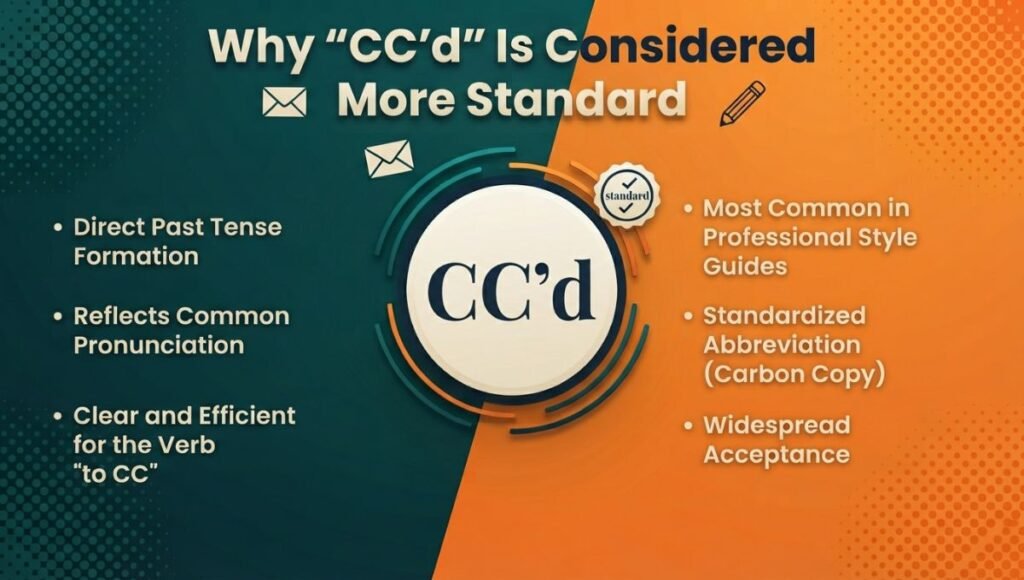
Dictionaries that include an entry for CC as a verb, such as Merriam-Webster, list cc’d as the past tense form. The apostrophe replaces the missing letters that a fully spelled out verb would normally include, similar to contractions like “don’t” or “can’t.” Since “CC” already ends in a consonant sound, adding just “‘d” mirrors how English typically forms the past tense of borrowed or abbreviated terms.
CC’ed, by contrast, treats “CC” more like a regular verb and adds a full “-ed” ending. This form is common in everyday writing and completely understandable, but it has not been adopted as the primary form in most style guides or dictionaries.
More related Post : Myself vs My Self: 7 Rules to Choose the Right Form https://feastinsidar.com/myself-vs-my-self/
Grammar and Spelling Notes
A few grammar details are worth knowing when using CC as a verb.
- Verb forms: CC, CC’d (past tense and past participle), CC’ing (present participle)
- Capitalization: Both “CC” and “cc” are acceptable, though many style guides prefer lowercase “cc” in running text and reserve capital “CC” for email interface labels
- Apostrophe placement: The apostrophe always comes directly after the second C, never inside or before it (“CC’d,” not “C’Cd” or “CCed'”)
- Formal versus informal usage: CC’d works in both formal business writing and casual correspondence, making it the more versatile choice
Real Life Examples in Different Contexts
Seeing CC’ed or CC’d in natural sentences makes the distinction easier to remember.
Workplace email: “I’ve CC’d the whole team so everyone stays in the loop.”
Casual conversation: “Did you get my message? I CC’ed you on it earlier.”
Business writing: “The client was CC’d on all correspondence related to the contract.”
Formal writing: “All department heads were CC’d on the policy update memo.”
Academic or professional emails: “Please note that HR has been CC’d for record keeping purposes.”
Across these examples, CC’d appears more often in polished or professional contexts, while CC’ed shows up naturally in relaxed, conversational writing.
Common Mistakes with CC’ed or CC’d
A few consistent errors show up when people write this term.
Incorrect: I CCed him on the report. Correct: I CC’d him on the report. Reason: Leaving out the apostrophe makes the word harder to read and is not the standard written form.
Incorrect: I CC’d’ed the whole team. Correct: I CC’d the whole team. Reason: Only one past tense ending is needed. Combining both forms creates a nonstandard, doubled ending.
Incorrect: Please CC’d me on future emails. Correct: Please CC me on future emails. Reason: CC’d is past tense. When making a request about future action, use the base form CC, not the past tense.
Related Terms Worth Knowing
A few related terms often come up alongside CC’ed or CC’d:
- BCC: blind carbon copy, used when the sender wants to copy someone without other recipients seeing that they were included
- Reply all: responding to every recipient on an email thread, including anyone who was CC’d
- Carbon copy: the original full phrase that CC abbreviates
- CC’ing: the present participle form, as in “I am CC’ing you on this thread”
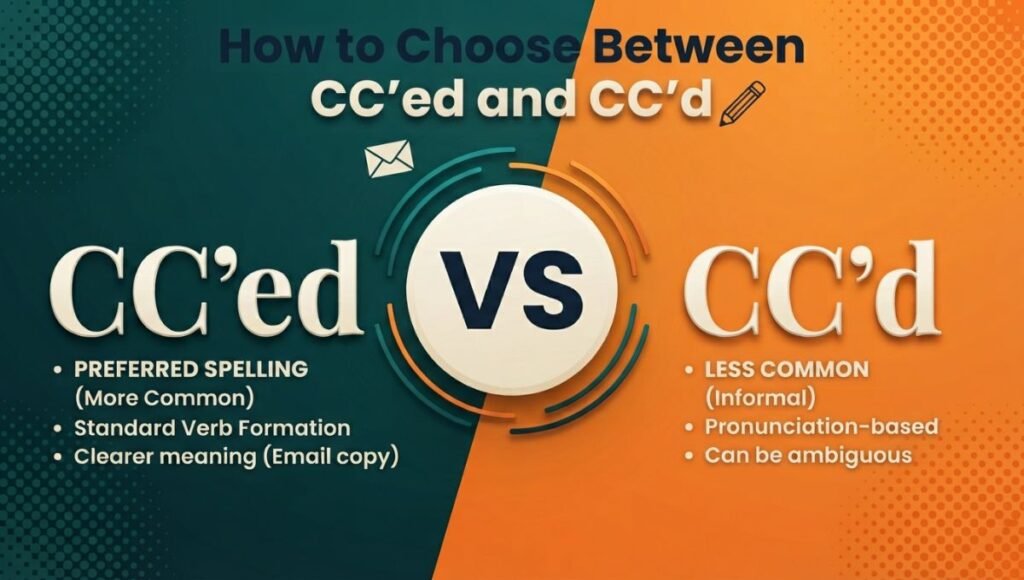
How to Choose Between CC’ed and CC’d
Use this simple guide when deciding which form fits your writing:
- For formal business emails, professional documents, or anything you want to sound polished, use CC’d.
- For casual internal messages or informal conversation, either CC’d or CC’ed will be understood without issue.
- Check your company style guide if one exists, since some organizations specify a preferred form.
- Stay consistent within the same document or email thread rather than switching between the two forms.
- When in doubt, default to CC’d, since it matches the form recognized in dictionaries.
Is CC’ed Actually Wrong?
No. CC’ed is not incorrect, and using it will not confuse your reader or damage your credibility in casual settings. It simply has not achieved the same level of dictionary recognition as CC’d. Think of it the way you might think of “learned” versus “learnt”: both exist, one is more standard in certain contexts, but neither causes a genuine misunderstanding.
Frequently Asked Questions
Is “CC’d” or “CC’ed” more correct?
CC’d is generally considered the more standard form, since it appears in major dictionary entries for the verb CC. CC’ed is a widely used but more informal alternative.
How do you use CC’d in a sentence?
Use CC’d to describe someone who received a copy of an email or document. Example: “I CC’d the finance team on the invoice.”
What does CC’ing mean?
CC’ing is the present participle form of CC, used for ongoing action. Example: “I am CC’ing you on this email chain for visibility.”
Should I write “cc” in lowercase or capital letters?
Both are accepted. Many style guides prefer lowercase “cc” in body text, while capital “CC” often appears because it matches the email interface label.
The Bottom Line
Whether you choose CC’ed or CC’d, your meaning will come through clearly. For the most polished and widely recognized choice, stick with CC’d, and save CC’ed for casual, low stakes writing where either form works just fine.











1 thought on “CC’ed or CC’d: 5 Rules for Getting the Past Tense Right”