Costed vs Cost: which one do you write when something had a price? Many people add -ed out of habit, since most English verbs form the past tense that way. But cost is an irregular verb. For price, the past tense is “cost,” not “costed.” The word “costed” has a narrower job: it means someone estimated a price. Once you see that split, Costed vs Cost stops being confusing.
Costed vs Cost: Which Is the Correct Past Tense?
The past tense of “cost” is “cost.” Use “costed” only when you mean someone calculated or estimated what something would cost.
If a price was charged, use “cost”: “The repair cost $200.” If a person worked out a price in advance, use “costed”: “The team costed the repair at $200.”
So “costed” is not a mistake in every sentence. It is a mistake when you use it to mean “had a price.”
What Does Cost Mean as a Verb?
“Cost” has two verb meanings, and each one has its own past tense.
Meaning 1: to have a price. This is the everyday sense. It is an irregular verb, and the past tense and past participle are both “cost.”
- “The tickets cost $45 each.”
- “That decision has cost us three clients.”
Meaning 2: to estimate the price of something. This sense is regular, so it takes -ed.
- “Finance costed the new office at $1.2 million.”
The word also works figuratively for losses that are not money. “The delay cost him his promotion” means he lost something because of the delay.
When Is Costed Correct?
“Costed” is correct when a person is the one doing the calculating. Someone examines the parts of a project, adds them up, and produces a figure. That process is “costing,” and the result is a “costed” plan.
You will see it most in business, government, and project planning:
- “The proposal was fully costed before the board meeting.”
- “We costed three vendor options and picked the cheapest.”
- “Each policy in the manifesto has been costed.”
Dictionaries list “costed” for this sense, and it is more common in British English. It still appears in American business writing, though less often than in British writing.
How Do You Tell the Difference Between Costed and Cost?
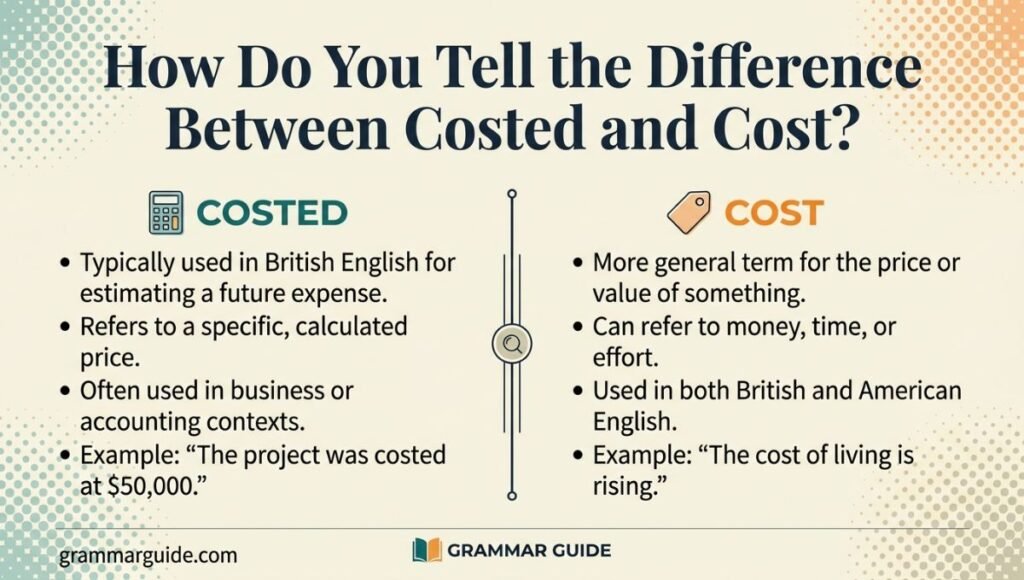
Costed vs Cost comes down to one question: did something have a price, or did someone work out a price?
Ask yourself who or what is the subject:
- If the subject is the thing being bought, lost, or paid for, use “cost.” (The trip cost $500.)
- If the subject is a person or team doing the math, use “costed.” (The team costed the trip.)
A quick test: replace the verb with “estimated.” If the sentence still makes sense, “costed” is probably right. If it sounds odd, use “cost.”
Why Is Cost an Irregular Verb?
The Costed vs Cost confusion happens because most English verbs add -ed for the past tense. “Cost” belongs to a small group whose forms do not change at all, like “put,” “set,” “cut,” “hit,” and “shut.”
Here are the forms of “cost” in the price sense:
| Form | Word | Example |
| Base form | cost | It will cost $50. |
| Third person singular | costs | It costs $50. |
| Past tense | cost | It cost $50 last year. |
| Past participle | cost | It has cost $50 every year. |
| Present participle | costing | It is costing $50 a month. |
Only the third person singular (“costs”) and the -ing form (“costing”) look different. The past tense and past participle match the base form exactly.
The noun is also “cost,” with the plural “costs.” Related adjectives include costly (expensive) and cost-effective (good value for the price).
More related Post: Summarize vs Summarise: 2 Spellings, 1 Meaning, and a Rule to Choose https://feastinsidar.com/summarize-vs-summarise/
Where Does Cost Come From and How Is It Pronounced?
The verb traces back to Old French coster, which comes from Latin constare. The Latin word is built from con- (together) and stare (to stand). That history explains the “price” idea: something stands at a certain value.
Pronunciation depends on accent. “Cost” is KAWST or KAHST, and both are normal in American English. “Costed” adds a short second syllable: KAW-stid.
The past tense “cost” sounds exactly like the present tense, so context tells listeners which one you mean. “It cost me $20” is past tense, and “It’ll cost me $20” is future.
Costed vs Cost at a Glance
Here is how the forms compare:
| Term | Correct? | Meaning | Use |
| cost (past tense) | Yes | Had a price | Everyday past tense of price |
| cost (participle) | Yes | Has had a price | “It has cost a lot” |
| costed | Yes, in one sense | Estimated the price of | Business, planning, budgeting |
| costed (for price) | No | Not the past tense of “had a price” | Avoid: “The car costed $20,000” |
| costing | Yes | Present participle, or the act of estimating | “It is costing us,” “a detailed costing” |
The takeaway: “cost” covers the price, and “costed” covers the estimate.
How Do You Use Cost and Costed in Sentences?
Here are natural examples for different situations.
Everyday conversation: “That coffee cost me six dollars. I’m never going back.”
Workplace communication: “The software upgrade cost more than we planned.”
Email: “I’ve costed both options and attached the comparison below.”
Academic writing: “The study costed each intervention over a five-year period.”
Business writing: “The pilot program cost $80,000 and saved twice that amount.”
Formal writing: “The committee reviewed a fully costed proposal before approving the budget.”
Casual writing: “That one mistake has cost me so much sleep.”
Notice the difference in the email and academic examples. In both, a person did the calculating, so “costed” fits. In the everyday and business examples, the price simply existed, so “cost” is correct.
What Mistakes Do People Make With Costed and Cost?
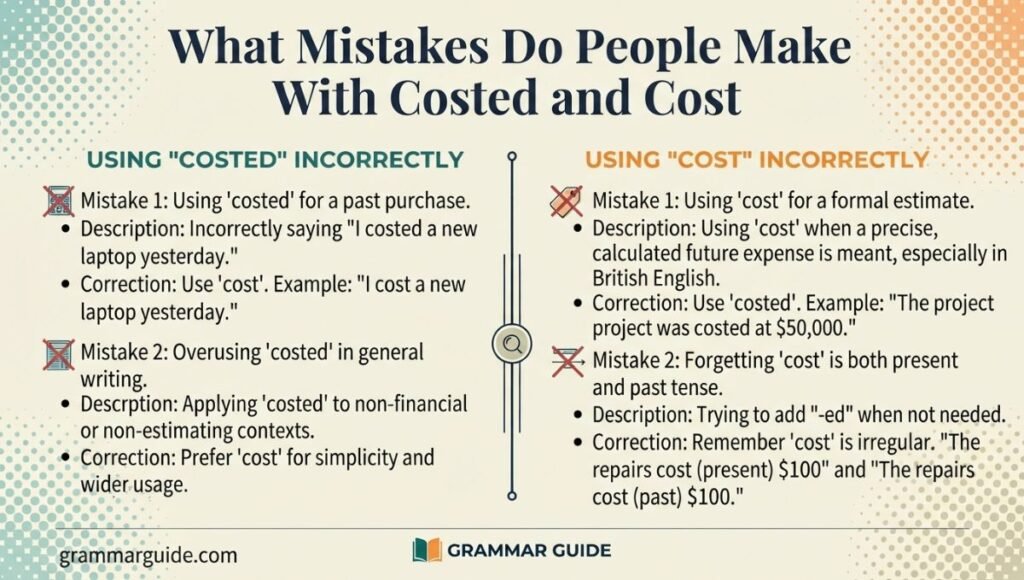
These slips are common, even among fluent speakers.
Incorrect: The trip costed us $500.
Correct: The trip cost us $500.
“Cost” is irregular, so the past tense does not take -ed when it means “had a price.”
Incorrect: It has costed a lot of money.
Correct: It has cost a lot of money.
The past participle is also “cost.” Both forms match the base word.
Incorrect: The team cost the project last week and came up with $80,000.
Correct: The team costed the project last week and came up with $80,000.
Here a person calculated the price, so the regular past tense “costed” is correct.
Incorrect: That mistake costs me the job last year.
Correct: That mistake cost me the job last year.
“Last year” signals past tense, so “cost” is needed, not “costs.”
The Costed vs Cost rule is small, but it is easy to miss when you are writing quickly.
What Related Words and Forms Should You Know?
These terms often appear near “cost” and “costed”:
- Synonyms for the price sense: sell for, go for, run (as in “it ran $300”), set back (informal)
- Synonyms for the estimate sense: price out, calculate, budget, quote, tally
- Related nouns: cost, price, expense, charge, costing
- Related adjectives: costly, costless, cost-effective, uncosted
- Common phrases: at all costs, cost of living, cost me dearly, cost an arm and a leg
- Antonyms: free, cheap, complimentary
Uncosted describes a plan with no price worked out yet: “The uncosted proposals were sent back to the committee.”
Which Form Should You Choose in Your Writing?
Use this simple guide:
- Ask what happened. If something had a price, write “cost.“
- Ask who did the math. If a person estimated the price, write “costed.”
- Check the tense. “Cost” works for past, present, and participle uses, so read the sentence for time clues.
- Avoid “costed” in casual writing. In everyday messages, “cost” is almost always what you want.
When in doubt, use “cost.” The Costed vs Cost decision is rarely a problem if you default to the irregular form and reserve “costed” for planning and budgeting contexts.
Quick Answers About Cost and Costed
Is it costed or cost?
For “had a price,” the correct past tense is “cost.” “Costed” is correct only when it means “estimated the price of.”
What is the past tense of cost?
The past tense of “cost” is “cost.” Example: “The dinner cost $60.”
Is costed a real word?
Yes. “Costed” is a real word meaning “estimated the cost of.” It is not the past tense of the price sense of “cost.”
Is costed used in American English?
It appears in American business writing, though it is more common in British English. Most Americans use “cost” in nearly every situation.
How do you use costed in a sentence?
Use it when someone has calculated a price. Example: “The contractor costed the project at $15,000.”
The One Rule to Remember
Costed vs Cost is simple once you know the split. Use “cost” for something that had a price, and use “costed” only when someone estimated a price. The takeaway: “cost” is the past tense of price, and “costed” is the past tense of estimate.











1 thought on “Costed vs Cost: 2 Meanings, 1 Irregular Verb, and 5 Real Examples (2026)”