Myself vs My Self confuses writers because the two forms look almost identical but do different jobs. One is a pronoun, and the other is a possessive plus a noun. Here is the quick answer: use “myself” (one word) to refer back to yourself or add emphasis, and use “my self” (two words) only for your identity. When weighing Myself vs My Self, choose the one-word form in nearly every sentence.
Myself vs My Self: Which One Is Correct?
Both are correct, but they are not interchangeable. Each has its own grammar and its own meaning.
Myself is one word. It is a reflexive or intensive pronoun. My self is two words: the possessive my plus the noun self.
- I made dinner myself. (pronoun)
- I want to understand my true self. (noun with a possessive)
Most writers need the one-word form far more often than the two-word phrase.
What Does Myself Mean?
Myself is a singular pronoun. It does three jobs.
First, it works as a reflexive pronoun, which refers back to the subject of the sentence: “I taught myself guitar.”
Second, it works as an intensive pronoun, which adds emphasis: “I myself saw the accident.”
Third, it can describe your normal state: “I’m not feeling myself today.” The phrase by myself means alone or without help.
The plural form is ourselves.
What Does “My Self” Mean?
My self means your own identity, inner person, or sense of who you are. My is a possessive determiner, and self is a noun.
In practice, an adjective usually sits between the two words: my true self, my former self, my best self, my younger self. The bare two-word form with nothing in between is rare in everyday writing. It appears mostly in philosophy, psychology, and spiritual writing, where the self itself is the topic.
Here is a quick test. If you can replace self with identity or personality and the sentence still works, two words may be right.
- “I barely recognize my younger self in these photos.”
- “She is finally becoming her best self.”
Myself vs My Self at a Glance
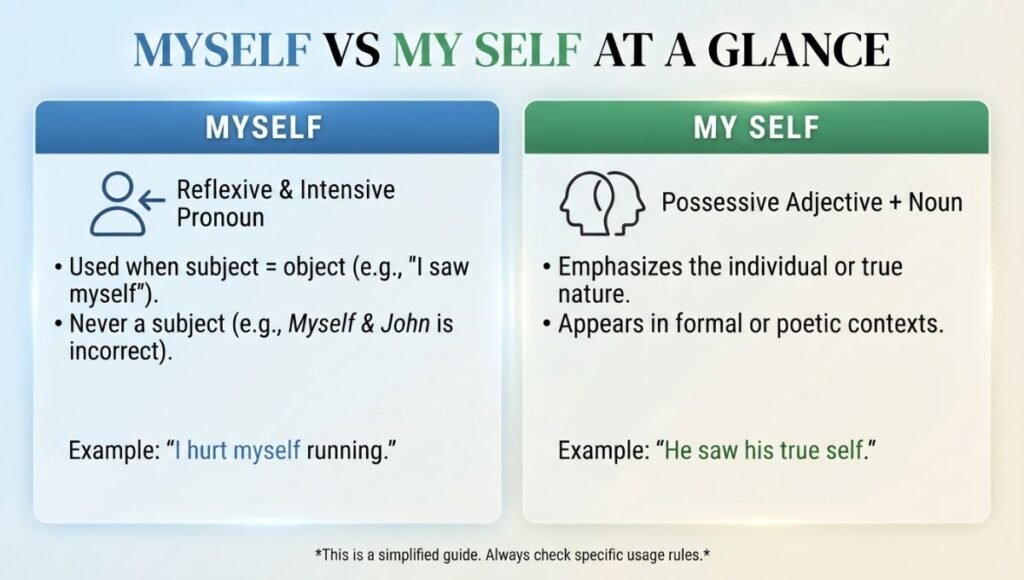
This table compares the forms side by side, including the two pronouns people often swap in.
| Form | Correct? | Type | Meaning | Example |
| myself | Yes | Reflexive or intensive pronoun | Refers back to I or adds emphasis | I wrote it myself. |
| my self | Yes, in specific cases | Possessive plus noun | Your identity or inner person | I trust my true self. |
| me | Yes | Object pronoun | The receiver of someone else’s action | She called me. |
| I | Yes | Subject pronoun | The person doing the action | I called her. |
When Do You Use Myself?
Use myself only when it connects back to I or when you add emphasis. These are the main cases.
- Reflexive: The subject and object are the same person. “I reminded myself to call.” “I bought myself a coffee.”
- After a preposition: “I kept the news to myself.”
- Intensive: You stress that you personally did something. “I myself will review the contract.”
- Alone: “I finished the project by myself.”
Notice that I appears in the sentence in most of these examples. If there is no I (or other reference to the speaker) to refer back to, myself usually does not belong.
More related Post: Chello or Cello? 7 Facts to Spell It Correctly Every Time https://feastinsidar.com/chello-or-cello/
Why Do Myself, Yourself, and Himself Follow Different Patterns?
Readers often notice that the reflexive pronouns do not follow one tidy pattern. Myself, yourself, ourselves, and yourselves are built from possessive words (my, your, our). Himself, itself, and themselves are built from object words (him, it, them). Herself could come from either.
This pattern is historical, so you do not need to memorize a rule. Just learn the standard forms.
The nonstandard forms hisself and theirselves appear in some dialects but are not accepted in formal writing. The word self itself is a noun, and its plural is selves.
How Do You Pronounce Myself and My Self?
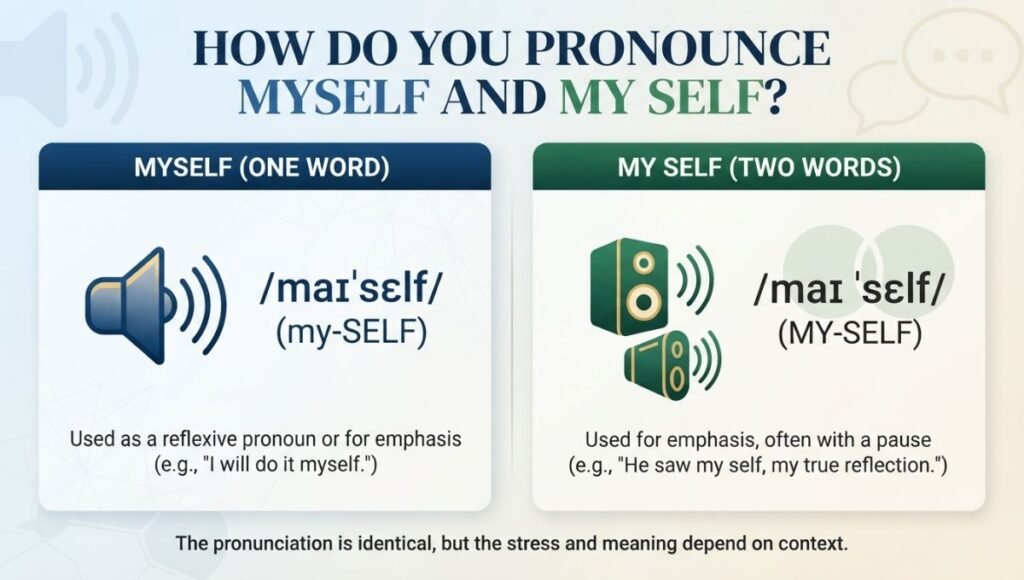
Myself is pronounced my-SELF, with the stress on the second syllable (/maɪˈsɛlf/). The one-word form flows as a single unit.
When you say my self, both words are distinct, and self usually carries the stress: my SELF. In speech, listeners rely on context to tell the forms apart.
American and British English spell and pronounce both forms the same way.
How Do You Use Both Forms in Real Sentences?
These natural examples cover common situations.
- Everyday: “I made the cake myself.”
- Casual: “I’m not myself before my first cup of coffee.”
- Workplace email: “I will send the update to the team myself.”
- Business writing: “Please send questions to Maria or me.”
- Academic or memoir: “In this essay, I try to understand my younger self.”
- Formal: “I myself will review the final agreement.”
In the business example, me is correct because the pronoun is the object of the preposition to and does not refer back to a subject. Myself would sound polite but would be incorrect.
What Mistakes Do Writers Make With Myself?
Most errors in Myself vs My Self come from using myself to sound more formal. These are normal mistakes, and each has a quick fix.
Incorrect: Please send the report to John and myself.
Correct: Please send the report to John and me.
Use me for the object of an action. Myself needs to refer back to the subject.
Incorrect: Myself and Dana will present.
Correct: Dana and I will present.
The subject position needs I, not myself.
Incorrect: Please contact myself for details.
Correct: Please contact me for details.
No I appears in the sentence, so there is nothing for myself to refer back to.
Incorrect: I hurt my self while cooking.
Correct: I hurt myself while cooking.
Here the pronoun is reflexive, so write one word.
Incorrect: She rediscovered her true myself.
Correct: She rediscovered her true self.
After a possessive and an adjective, you need the noun self, not the pronoun.
Many editors treat myself in place of I or me as an error in formal writing, so check before you send.
What Related Words Should You Know?
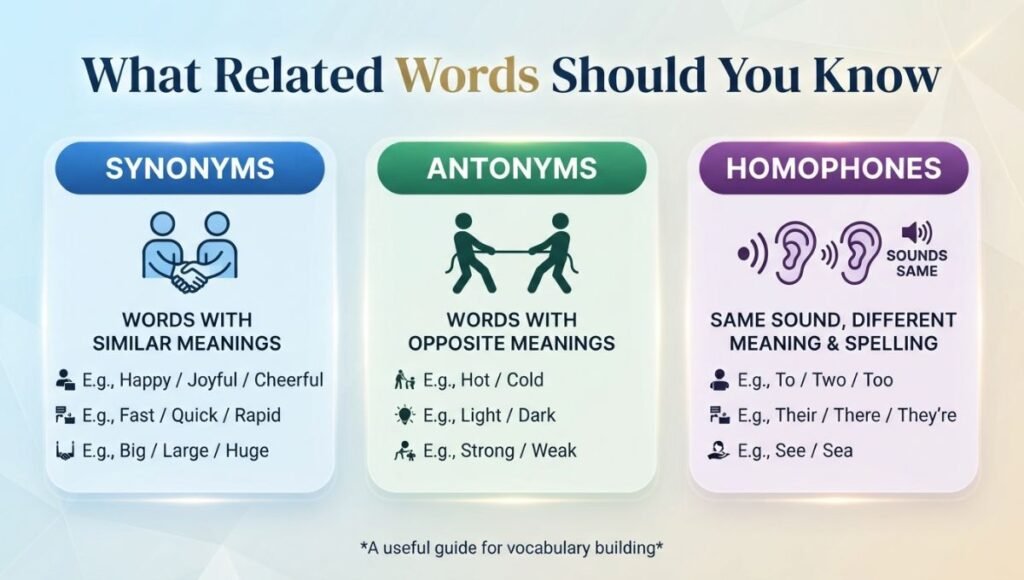
When you study Myself vs My Self, learn the whole family:
- Reflexive pronouns: yourself, himself, herself, itself, ourselves, yourselves, themselves, oneself
- Noun forms: self, selves
- Compound words: self-care, self-esteem, self-aware (the prefix self- is usually hyphenated)
- Common phrases: by myself, to myself, all by myself, be yourself
- Emphatic phrase: my own self (also correct, with own adding emphasis)
Related pairs people confuse include I and me, and its and it’s.
How Can You Choose Between Them Quickly?
For Myself vs My Self, use this four-step check:
- Look for I in the sentence. If the action returns to it, use myself.
- Look for an adjective after my. If you mean your identity (true, best, younger), use my plus the adjective plus self.
- Try removing the other person. “Send it to John and myself” becomes “Send it to myself,” which sounds wrong. Use me.
- Check for emphasis. If you are stressing that you personally did it, myself works.
A simple memory aid: one-word myself waits for an I, and two-word my self waits for an adjective.
Frequently Asked Questions
Is it “myself” or “my self”?
Use myself (one word) in most sentences. Use my self (two words) only when self is a noun meaning your identity, usually with an adjective: “my true self.”
Can Myself vs My Self be used interchangeably?
No. Myself is a pronoun that refers back to I or adds emphasis. My self is a possessive plus a noun that names your identity.
Is “John and myself” correct?
Usually not. Use John and I when the phrase is the subject, and John and me when it is the object.
What does “by myself” mean?
It means alone or without help: “I fixed the shelf by myself.”
What to Remember About Myself and My Self
Myself vs My Self comes down to grammar roles. Use myself, one word, when the action returns to the subject or for emphasis. Use my self, two words, only for a person’s inner identity, usually with an adjective between them. If you can swap in me, you probably needed me.









1 thought on “Myself vs My Self: 7 Rules to Choose the Right Form”