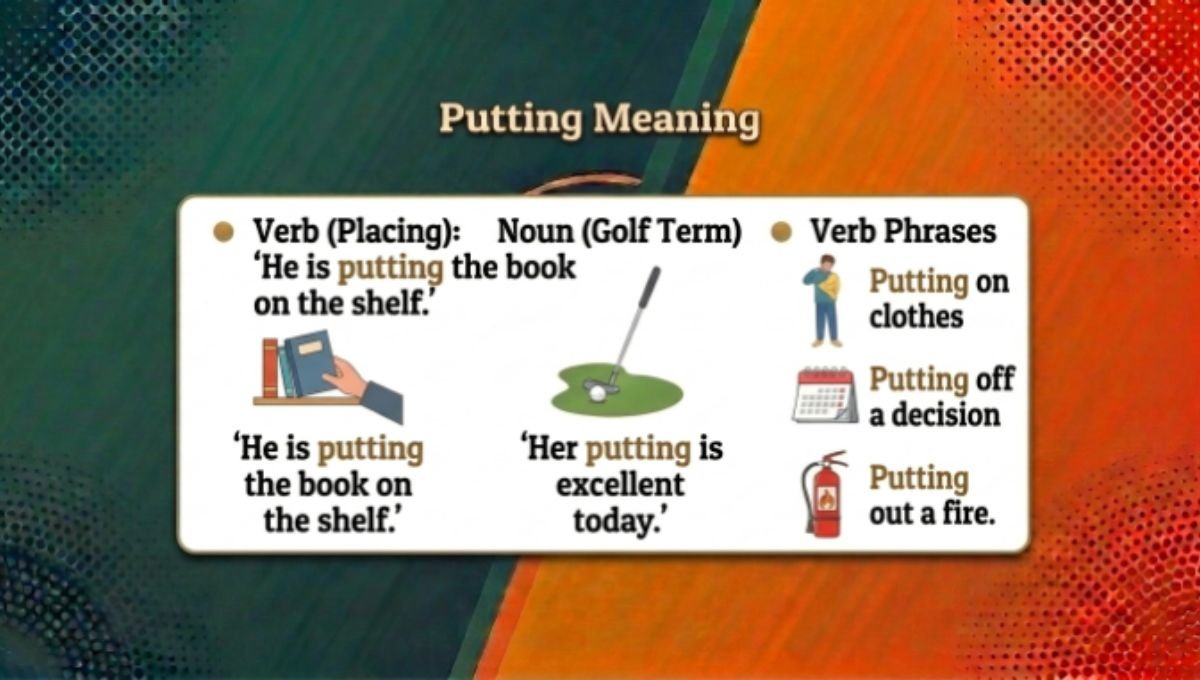
Seeing “putting” used five different ways in five different sentences can leave you wondering which definition actually applies. The putting meaning you need almost always depends on the words right around it. Here’s the quick version: “putting” is the “-ing” form of “put,” describing an ongoing action of placing, applying, or expressing something, though it also has a specialized meaning in golf.
What Does “Putting” Mean? (Quick Answer)
The core putting meaning is simple: “putting” describes the ongoing act of moving, placing, or applying something. For example, “I am putting my keys away” means the action of placing the keys is happening right now. From that single starting point, “putting” branches into idioms, business language, and even a completely separate sports term.
Why “Putting” Has So Many Different Meanings
“Put” is one of the most frequently used verbs in English, and frequently used words tend to accumulate extra jobs over time. Since “putting” is simply the “-ing” form of “put,” it inherits every one of those extra meanings, plus a few of its own tied specifically to ongoing or continuous action.
That’s really the whole story behind the confusion. One base verb, dozens of contexts, and a reader has to lean on the surrounding sentence to know which sense applies.
“Putting” as a Verb Form: Present Participle and Gerund
Grammatically, “putting” plays two different roles, and both use the exact same spelling.
As a present participle, it combines with “is,” “am,” “are,” “was,” or “were” to describe an action in progress: “She was putting the final touches on the report.” As a gerund, it acts like a noun and can even be the subject of a sentence: “Putting things off usually makes them harder later.”
Grammar and Spelling of “Putting” (Quick Overview)
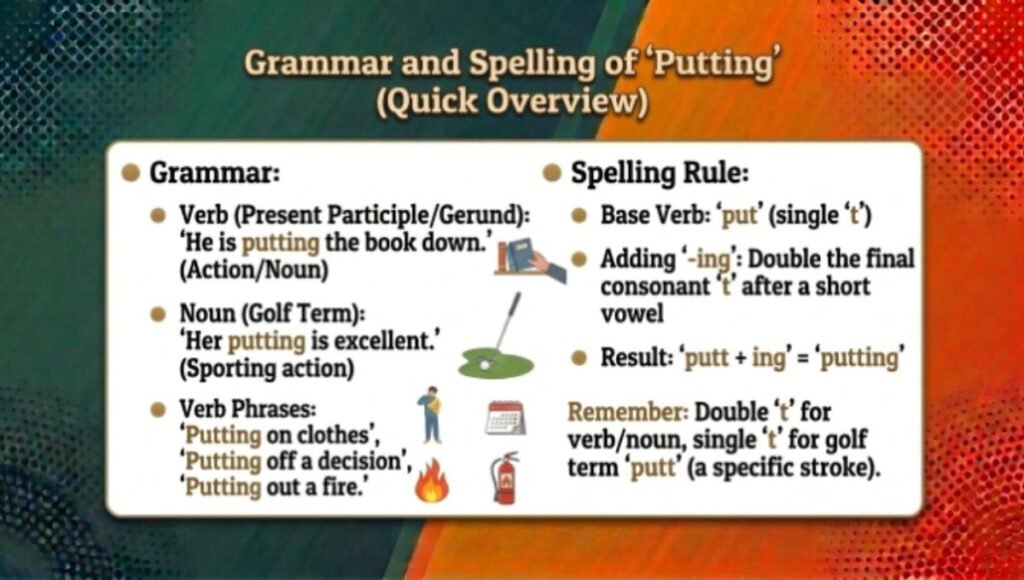
“Putting” is spelled with a doubled “t” because “put” is a short, one-syllable word ending in a single consonant after a single vowel. This follows a standard English spelling pattern, the same one that turns “run” into “running” and “sit” into “sitting.” There’s no irregular exception happening here, just a consistent spelling rule applied to a common verb.
Pronunciation of “Putting”
“Putting” is pronounced /ˈpʊtɪŋ/, with the same short vowel sound found in “foot” and “book,” not the longer sound in “cute.” The stress lands on the first syllable, and the “-ing” ending is unstressed, which is typical for this suffix across English verbs.
The Core Meaning: Placing Something in Progress
At its most literal, “putting” describes physical placement while it’s happening.
- “He’s putting the boxes in the truck right now.” (everyday conversation)
- “The intern is putting the files back in order.” (workplace communication)
- “Please stop putting your feet on the coffee table.” (casual, direct request)
In each example, an object is being physically relocated, and the “-ing” ending signals that the action is either happening now or was happening at a specific point in time.
More related Post : Take Effect or Take Affect? The 1 Correct Phrase Explained https://feastinsidar.com/take-effect-or-take-affect/
Figurative Meanings of “Putting”
Once you move past literal placement, “putting” starts describing abstract actions, and this is where most of the confusion around putting meaning actually comes from.
Expressing an idea: “She has a way of putting things that makes complicated topics simple.”
Applying effort or resources: “The team is putting a lot of work into this launch.”
Estimating or judging: “I’d be putting his salary somewhere in the six figures.”
Proposing or submitting: “He kept putting forward the same argument during the debate.”
None of these sentences involve a physical object moving from one place to another, yet all of them are grammatically and semantically correct.
Common Phrases That Use “Putting”
Phrasal combinations are where “putting” does the most heavy lifting in everyday English. Each phrase below carries its own distinct meaning.
| Phrase | Meaning | Example |
| Putting off | Delaying or postponing | She keeps putting off her dentist appointment. |
| Putting up with | Tolerating something difficult | I’m tired of putting up with his excuses. |
| Putting on | Wearing something, or pretending | He’s putting on a brave face for the kids. |
| Putting together | Assembling or organizing | We’re putting together a proposal for Friday. |
| Putting down | Writing something, or criticizing | Stop putting yourself down like that. |
| Putting across | Communicating clearly | She’s good at putting across difficult ideas simply. |
Notice how far some of these drift from physical placement. “Putting up with” someone’s behavior has nothing to do with location, but it’s one of the most common idioms in spoken American English.
“Putting” in Golf: A Specialized Meaning
In golf, “putting” refers specifically to the light, controlled stroke used to roll the ball across the green and into the hole, as in “her putting has really improved this season.” This sense is narrower than the general putting meaning used everywhere else, but it follows the exact same spelling and pronunciation rules. A golfer’s “putting stroke” or “putting green” both use this specialized sports definition.
“Putting” vs “Put”: When to Use Each Form
| Form | Function | Example |
| Put | Base form, past tense, past participle | I put the mail on the desk. |
| Putting | Present participle or gerund | I am putting the mail on the desk. |
Use “put” for simple statements about a completed or habitual action. Use “putting” when the action is ongoing, was happening at a specific past moment, or when you need the word to function as a noun (a gerund). Both forms are correct; they simply serve different grammatical purposes.
Common Mistakes With “Putting”
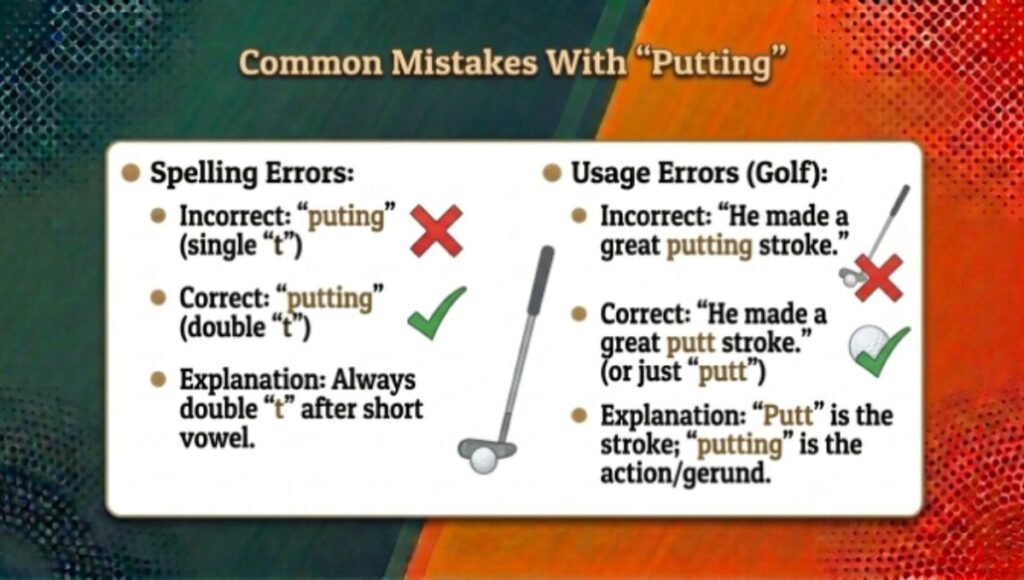
Incorrect: She is put the dishes away. Correct: She is putting the dishes away. Any “is/am/are/was/were” construction needs the “-ing” form, not the base form “put.”
Incorrect: I keep puting things off. Correct: I keep putting things off. This drops the doubled “t,” which breaks the standard spelling rule for short verbs like “put.”
Incorrect: Putting up his tent, he was tired afterward. Correct: After putting up his tent, he was tired. This isn’t wrong grammar exactly, but adding “after” clarifies the sequence and reads more naturally in American English.
Real-Life Examples of “Putting” in Sentences
- Academic writing: “The paper focuses on putting theoretical models into practical use.”
- Email: “I’ll be putting together the slides tonight and sending them over tomorrow.”
- Business writing: “We’re putting a new process in place to cut down on delays.”
- Formal writing: “The board is putting forth a revised budget for approval.”
- Casual conversation: “Quit putting it off and just call them already.”
Each sentence uses a different sense of “putting,” and native speakers move between these meanings without noticing, since the surrounding words carry the context.
Related Words and Terms
“Putting” connects to a family of related terms depending on the sentence, including “placing,” “positioning,” “applying,” and “submitting” as rough synonyms for the literal and figurative senses. It also appears in fixed phrases like “putting green” (golf) and “putting distance” (how close you are to a goal), along with the grammar terms “gerund” and “present participle” that describe its two core functions.
Frequently Asked Questions
What is the basic putting meaning in English?
The basic meaning describes an ongoing action of placing, applying, or expressing something, as in “I am putting the groceries away.”
Is “putting” a noun or a verb?
It can be either. As a gerund, it acts like a noun (“Putting things off is a bad habit”). As a present participle, it functions as part of a verb phrase (“She is putting the boxes down”).
Why does “putting” have a double “t”?
Because “put” is a short word ending in a single consonant after a single vowel, and English spelling doubles that consonant before adding “-ing” to preserve the short vowel sound.
What does “putting up with” mean?
It means tolerating or enduring something unpleasant, as in “I can’t keep putting up with these delays.”
Is the golf term “putting” different from the regular word?
Not in spelling or pronunciation, only in meaning. It refers specifically to the stroke used to roll the ball into the hole on the green.
Conclusion
The full putting meaning comes down to context every time: it’s the same word describing physical placement, ongoing effort, common idioms, and a specific golf stroke, depending on what surrounds it in the sentence. Learn the core sense first, then pick up the common phrases like “putting off” and “putting up with” as you run into them, and the rest will start to feel automatic.










1 thought on “Putting Meaning Explained: 12 Uses You Need to Know”