If you’ve ever paused mid-sentence wondering whether it’s “puting” or “putting,” you’re dealing with one of English’s trickiest spelling rules. So, is “putting” a correct word? Yes. “Putting” is the correct, standard spelling of the present participle and gerund form of “put.” The confusion happens because the base word “put” looks like it should follow simpler spelling logic, but a specific consonant rule changes things.
Is “Putting” a Correct Word? (Quick Answer)
Here’s the direct answer: “putting” is correct, and “puting” is not a recognized English word. “Putting” is formed by adding “-ing” to the verb “put” and doubling the final “t.” This follows a standard English spelling pattern, not an exception, so once you know the rule, you’ll never second-guess it again.
Why Do People Question the Spelling of “Putting”?
Most learners have already absorbed the general rule that you add “-ing” directly to a verb, like “walk” becoming “walking.” So when “put” becomes “putting” instead of the expected “puting,” it looks like an error.
It isn’t. The doubled consonant is doing important work: it protects the short vowel sound in “put” so the word doesn’t get mispronounced. This is exactly why so many people search is “putting” a correct word before submitting an email or assignment.
What Does “Putting” Mean?
“Putting” is the present participle and gerund form of the verb “put,” which means to place, position, or apply something.
As a present participle, it pairs with a form of “to be” to describe an ongoing action: “She is putting the dishes away.” As a gerund, it functions like a noun: “Putting things off never solves anything.” Same spelling, two different grammatical jobs.
The Grammar Rule Behind “Putting” (Consonant Doubling)
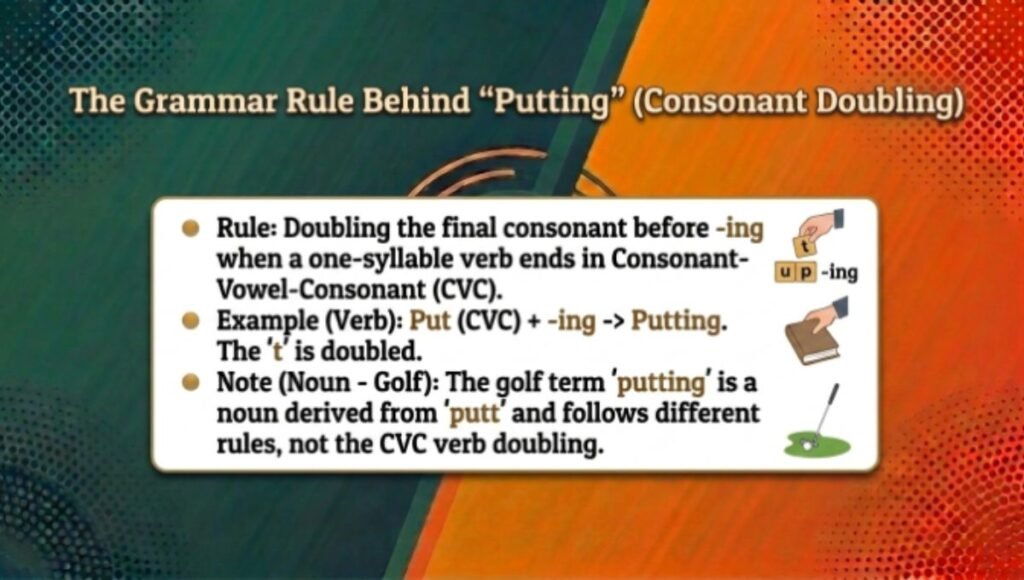
This is the real answer to is “putting” a correct word, and it comes down to a rule called the 1-1-1 rule (also called CVC doubling):
- The word has one syllable (put).
- It ends in one consonant (t).
- That consonant is preceded by one vowel (u).
When all three conditions are true, you double the final consonant before adding “-ing” or “-ed.” That’s why “put” becomes “putting,” “run” becomes “running,” and “stop” becomes “stopping.” Without the doubled letter, English readers would expect the “u” to sound long, like in “cute,” instead of short, like in “cut.”
Pronunciation of “Putting”
“Putting” is pronounced /ˈpʊtɪŋ/, with the same short vowel sound as “put,” “foot,” and “book.” The stress falls on the first syllable. If you drop the double “t” in spelling, nothing changes in speech, but the written word would technically violate the spelling pattern readers expect.
More related Post : Put Meaning Explained: 25 Definitions and Uses You Need to Know https://feastinsidar.com/put-meaning/
“Putting” vs “Puting”: Which Spelling Is Correct?
| Spelling | Correct? | Reason |
| Putting | Yes | Follows the 1-1-1 consonant doubling rule for short vowel words |
| Puting | No | Not a recognized word in any major English dictionary |
“Puting” simply doesn’t exist as a standard English word. It shows up sometimes as a typo or in informal digital shorthand, but it has no dictionary entry and no accepted grammatical function. If you’re ever unsure, remember that this pattern matches other common short verbs like “hit” (hitting), “sit” (sitting), and “get” (getting).
Origin of “Put” and “Putting”
“Put” traces back to Middle English “putten,” related to Old English words meaning to push or thrust. The consonant-doubling rule itself isn’t unique to “put.” It developed as English spelling standardized over centuries, giving readers a visual cue for short versus long vowel sounds. This is a spelling convention, not a random exception, which is part of why “putting” holds up so consistently across dictionaries.
How to Use “Putting” Correctly in a Sentence
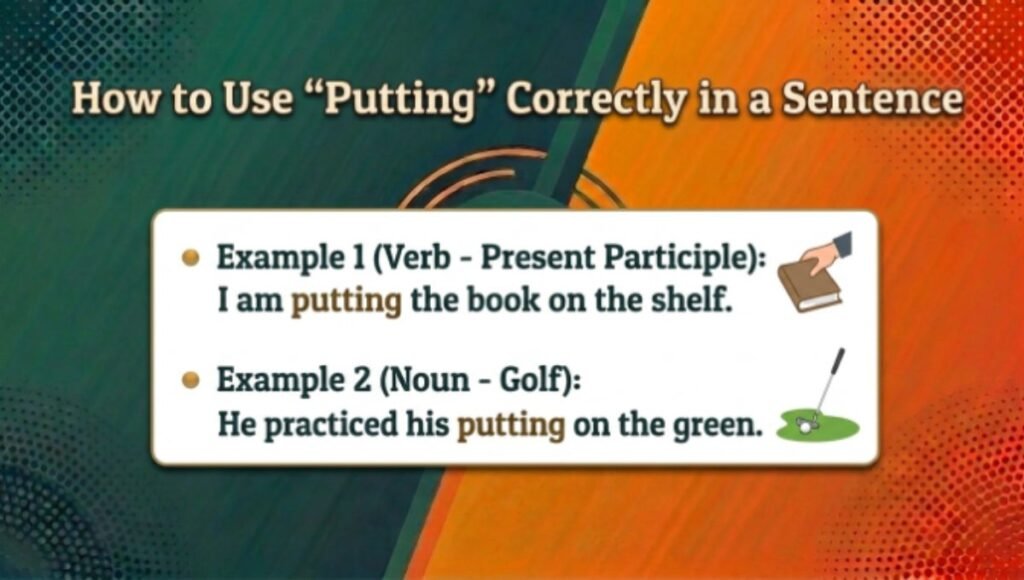
- Everyday conversation: “I’m putting my shoes on right now.”
- Workplace communication: “Thanks for putting together the report so quickly.”
- Academic writing: “The study focuses on putting theory into measurable practice.”
- Email: “I’ll be putting the final touches on the proposal this afternoon.”
- Formal writing: “The committee is putting forth a revised policy for review.”
Each sentence uses “putting” as either a present participle (an ongoing action) or a gerund (acting like a noun), and the spelling never changes between the two uses.
“Putting” in Golf: A Special Use
In golf, “putting” refers to the light stroke used to roll the ball into the hole on the green, as in “her putting improved after practice.” This is still the same word and the same spelling rule; it’s simply a specialized meaning tied to the sport. Don’t confuse it with “puttering,” which means moving around slowly and aimlessly, since the two words look similar but come from entirely different roots.
Common Mistakes With “Putting”
Incorrect: I am puting the boxes in the garage. Correct: I am putting the boxes in the garage. The single “t” breaks the consonant doubling rule and isn’t a recognized spelling.
Incorrect: She keeps puting things off until the last minute. Correct: She keeps putting things off until the last minute. Even in casual writing or texting, “puting” is still considered a spelling error, not an accepted shorthand.
Incorrect: He was put-ing his notes in order. Correct: He was putting his notes in order. There’s no hyphen in “putting.” The “-ing” suffix attaches directly to the doubled consonant.
Related Words and Forms
“Put” belongs to a family of short, one-syllable verbs that follow the same doubling pattern, including “sit/sitting,” “run/running,” “hit/hitting,” and “stop/stopping.” Related terms include the noun phrase “put option” in finance and the sports term “shot put,” both of which keep the single “t” spelling since they don’t take the “-ing” ending in those forms.
Frequently Asked Questions
Is “putting” a correct word?
Yes. “Putting” is the standard, dictionary-recognized spelling of the “-ing” form of “put.”
Is “puting” ever an acceptable spelling?
No. “Puting” is not found in standard English dictionaries and is considered a spelling mistake.
Why does “put” double its final letter before “-ing”?
Because “put” is a one-syllable word ending in a single consonant after a single vowel, English spelling rules require doubling that consonant to preserve the short vowel sound.
What part of speech is “putting”?
“Putting” can function as a present participle (describing an ongoing action) or as a gerund (acting like a noun), depending on the sentence.
Does British English spell “putting” differently?
No. American and British English both spell it “putting,” with no regional variation.
Conclusion
To sum up the answer to is “putting” a correct word: yes, it is, and the doubled “t” isn’t optional or stylistic. It follows a predictable spelling rule that also governs dozens of other short English verbs. Once you remember that rule, you’ll spell “putting” correctly every time without having to think twice.