If you’ve tried to label “put” for a grammar assignment or a language course and ended up more confused than before, you’re not imagining things. So, what type of verb is “put”? “Put” is a transitive, irregular action verb. That single sentence answers the question, but understanding why “put” earns all three labels at once is what actually helps the classification stick.
What Type of Verb Is “Put”? (Quick Answer)
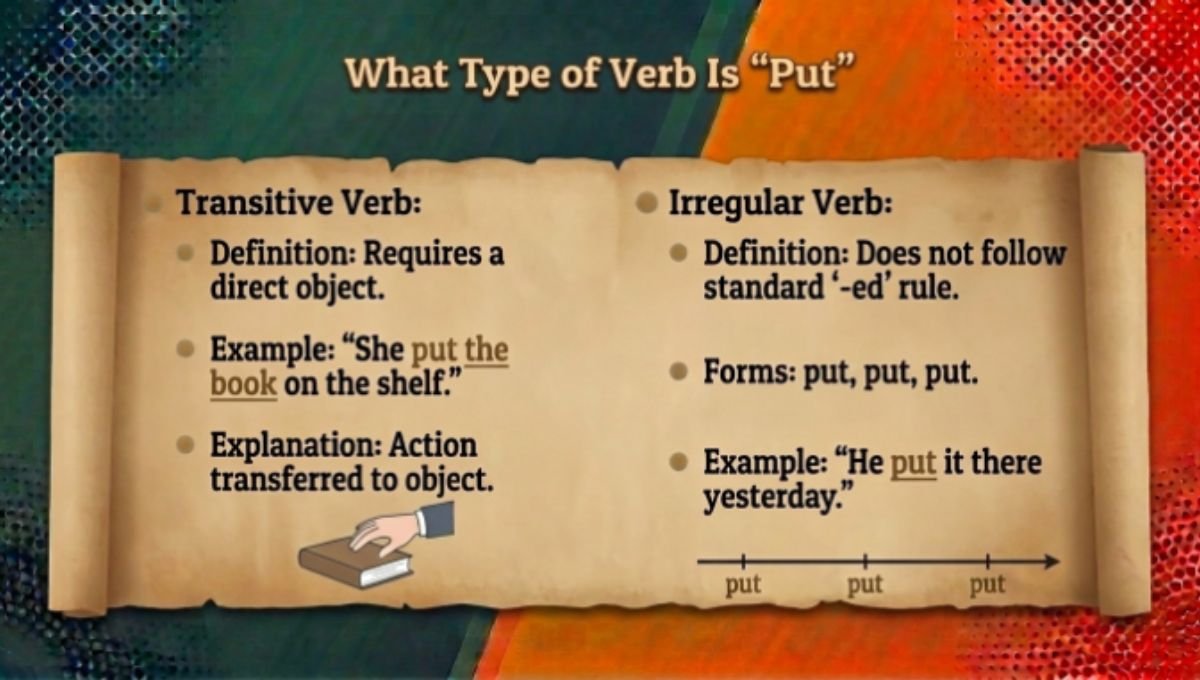
Here’s the direct answer: “put” is classified as a transitive verb, an irregular verb, and an action verb. It’s transitive because it needs a direct object to complete its meaning, irregular because its past tense doesn’t follow the standard “-ed” pattern, and an action verb because it describes something being done rather than a state of being.
Why Is Classifying “Put” So Confusing?
Most grammar lessons introduce verb categories one at a time, so learners expect a single, clean label. “Put” resists that expectation because verb categories aren’t mutually exclusive. A verb can be transitive, irregular, and an action verb all at once, and “put” happens to check every one of those boxes.
That overlap is exactly why so many students search what type of verb is “put” and come away with three different, seemingly contradictory answers from three different sources. All three answers are correct; they’re just describing different features of the same word.
“Put” Is a Transitive Verb: What That Means
A transitive verb requires a direct object to make sense. You can’t just say “I put.” The sentence feels incomplete because the listener needs to know what you put and often where.
- “I put the keys on the counter.” (direct object: the keys)
- “She put her phone away.” (direct object: her phone)
Without an object, “put” leaves a gap. This is one of the clearest, most testable answers to what type of verb is “put”, since the transitive requirement almost never changes across contexts.
“Put” Is Also an Irregular Verb
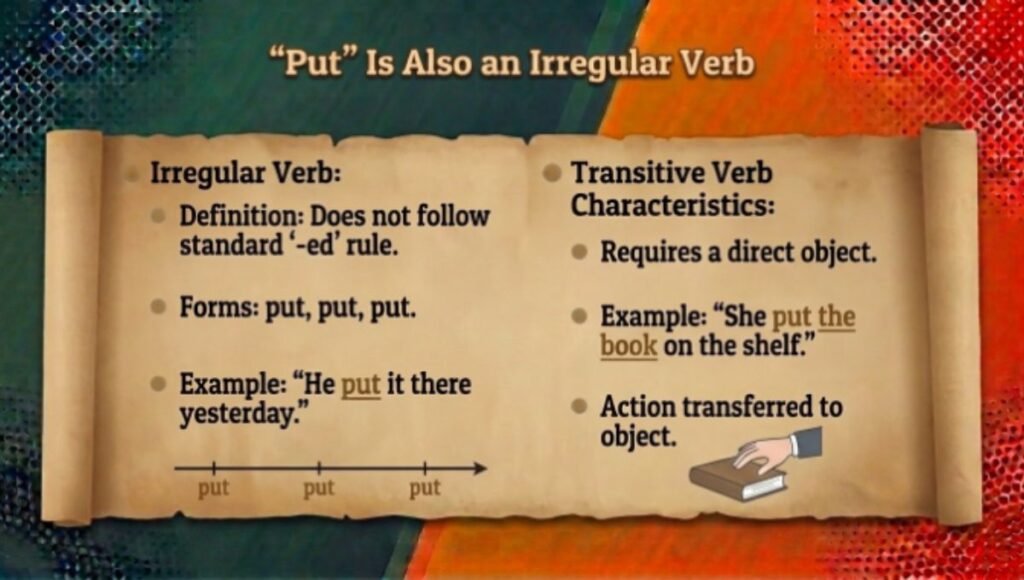
An irregular verb doesn’t form its past tense or past participle by adding “-ed.” Regular verbs like “walk” become “walked.” “Put” breaks that pattern entirely.
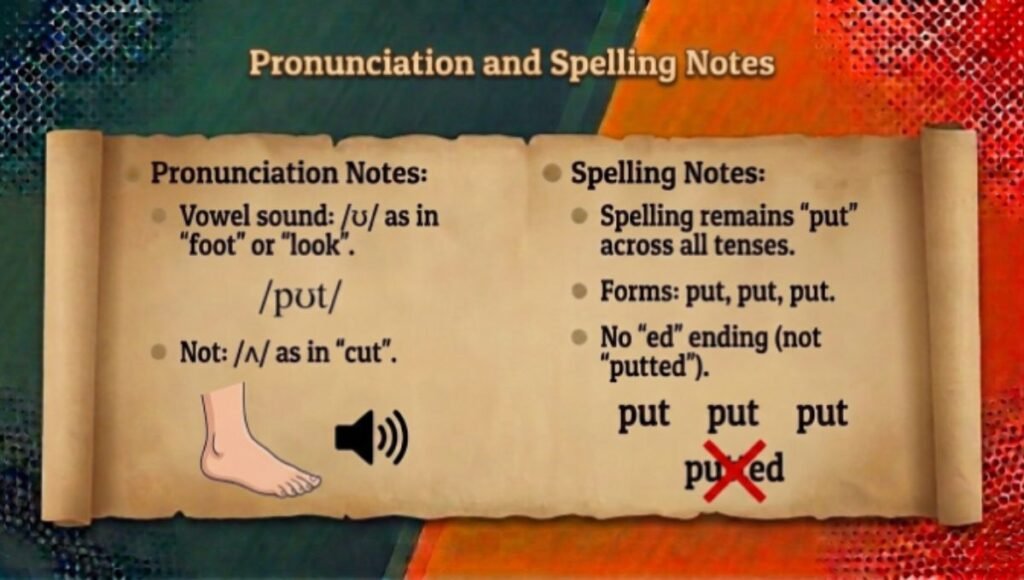
The base form, past tense, and past participle of “put” are all spelled identically: put, put, put. There’s no separate past tense spelling to memorize, which actually makes “put” easier than most irregular verbs once you know the rule (or in this case, the lack of one).
Is “Put” a Regular or Irregular Verb? (Comparison)
| Verb Type | Past Tense Pattern | Does “Put” Match? |
| Regular verb | Add “-ed” (walk, walked) | No |
| Irregular verb | Unique or unchanged form (put, put) | Yes |
This table settles one of the most common follow up questions to what type of verb is “put”: it is irregular, full stop, with no regional or stylistic exceptions in standard English.
More related Post : Putting Meaning Explained: 12 Uses You Need to Know https://feastinsidar.com/putting-meaning/
“Put” as an Action Verb vs a Linking Verb
Verbs also split into action verbs (describing something happening) and linking verbs (connecting a subject to a description, like “is” or “seems”). “Put” is always an action verb. It never functions as a linking verb because it always describes a physical or figurative act of placement, never a state of being.
Compare: “She is tired” (linking verb, describes a state) versus “She put the bag down” (action verb, describes an act). “Put” only ever behaves like the second sentence.
Verb Forms of “Put” (Base, Past, Past Participle, -ing, -s)
| Form | Word | Example Sentence |
| Base form | put | I put my bag by the door every day. |
| Past tense | put | I put my bag by the door yesterday. |
| Past participle | put | I have put my bag by the door already. |
| Present participle | putting | I am putting my bag by the door now. |
| Third person singular | puts | She puts her bag by the door every morning. |
Notice again that the base, past, and past participle forms never change spelling. This consistency is part of the answer whenever someone asks what type of verb is “put”, since irregular verbs are defined by exactly this kind of unpredictable (or in “put’s” case, unusually stable) pattern.
Pronunciation and Spelling Notes
“Put” is pronounced /pʊt/, with a short vowel sound that rhymes with “foot,” not “cut.” When adding “-ing,” the final consonant doubles to preserve that short vowel sound, giving you “putting” rather than the incorrect “puting.” This spelling rule applies because “put” is a one-syllable word ending in a single consonant after a single vowel.
Can “Put” Be Used Intransitively?
Almost never. Unlike verbs such as “eat” or “read,” which can stand alone (“I already ate”), “put” consistently requires both a direct object and, in most cases, a location or destination phrase. “I put” is not a complete sentence in standard English, which reinforces why the transitive label is such a central part of answering what type of verb is “put.”
Phrasal Verbs Built From “Put”
“Put” combines with prepositions to form phrasal verbs, and each one keeps the same underlying grammar even as the meaning shifts.
- Put off: to postpone (“We put off the trip.”)
- Put up with: to tolerate (“I put up with the noise.”)
- Put on: to wear or pretend (“He put on his jacket.”)
- Put away: to store (“She put away the dishes.”)
These phrasal forms are still transitive, action verb constructions. The preposition changes the meaning, not the grammatical category.
Common Mistakes When Using “Put” as a Verb
Incorrect: I put yesterday and forgot where. Correct: I put it down yesterday and forgot where. “Put” needs a direct object. Leaving one out makes the sentence sound incomplete to a native speaker.
Incorrect: She putted the folder on the desk. Correct: She put the folder on the desk. “Putted” is only correct in golf. For every other use, the past tense stays “put.”
Incorrect: He puts up the noise every day. Correct: He puts up with the noise every day. Dropping “with” changes “put up” (to build or display) into a completely different meaning than intended.
Real-Life Examples of “Put” in Different Verb Roles
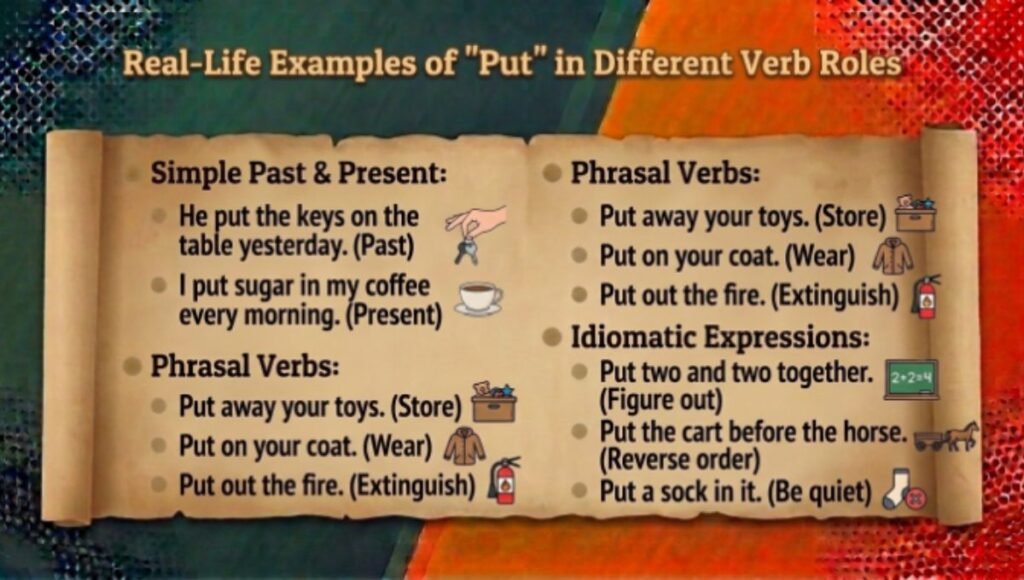
- Everyday conversation: “Just put it wherever there’s space.”
- Workplace communication: “Can you put the numbers into the spreadsheet before noon?”
- Academic writing: “The author puts forward a compelling argument in chapter three.”
- Email: “I’ll put together a summary and send it over shortly.”
- Formal writing: “The policy puts new restrictions in place starting next month.”
Every example above uses “put” transitively, with a direct object following it, which confirms the pattern holds true across formal and informal writing alike.
Related Words and Terms
Other common transitive, irregular action verbs that behave similarly to “put” include “set,” “cut,” and “let,” all of which keep the same spelling across base form, past tense, and past participle. Related grammar terms worth knowing include direct object, transitive verb, and irregular verb, since all three come up whenever “put” gets analyzed in a sentence.
Frequently Asked Questions
What type of verb is “put”?
“Put” is a transitive, irregular action verb. It needs a direct object, doesn’t follow the regular “-ed” past tense pattern, and describes an action rather than a state.
Is “put” a regular verb?
No. “Put” is irregular because its base form, past tense, and past participle are all spelled the same way: put.
Can “put” be used without an object?
Rarely, and not in standard usage. “Put” almost always needs a direct object and typically a location phrase to form a complete sentence.
Is “put” ever a linking verb?
No. “Put” always functions as an action verb and never connects a subject to a description the way linking verbs like “is” or “seems” do.
What is the past tense of “put”?
The past tense is “put,” identical to the base form, which is one of the clearest signs of its irregular status.
Conclusion
To answer what type of verb is “put” in one line: it’s transitive, irregular, and an action verb, all at the same time. Once you remember that it always needs a direct object and never changes spelling across its base, past, and past participle forms, the classification stops feeling like three separate rules and starts feeling like one consistent pattern.