If you have typed “the new policy will take affect next month” and then paused, wondering if that looks right, you are dealing with one of the most common mix ups in English. The confusion between take effect or take affect comes from two words that sound almost identical but work completely differently. The short answer: take effect is correct. “Take affect” is not a standard English phrase.
The Quick Answer: Take Effect Is Correct
Take effect is the correct phrase, and it means to become active, official, or operative, usually referring to a law, rule, policy, or change. “Take affect” is not recognized in standard English because “affect” is almost always a verb, and the idiom requires a noun. If you are asking take effect or take affect, the phrase you want is always “take effect.”
Why Do People Confuse Effect and Affect?
The mix up exists because “effect” and “affect” sound nearly the same when spoken aloud, and both relate to causing change. But they belong to different parts of speech in most everyday use, and that difference is exactly why only one of them fits into this particular idiom.
Affect is typically a verb, meaning to influence or produce a change in something. Effect is typically a noun, meaning a result or outcome. Since “take effect” needs a noun after the verb “take,” effect is the only word that fits grammatically.
What Does “Take Effect” Actually Mean?
Take effect means that something becomes active or starts to apply. It is most often used with laws, policies, contracts, medications, and official changes.
Common uses include:
- A new law taking effect on a specific date
- A policy change taking effect immediately
- A medication taking effect after a certain amount of time
- A contract clause taking effect once signed
Grammar Breakdown: Effect vs Affect
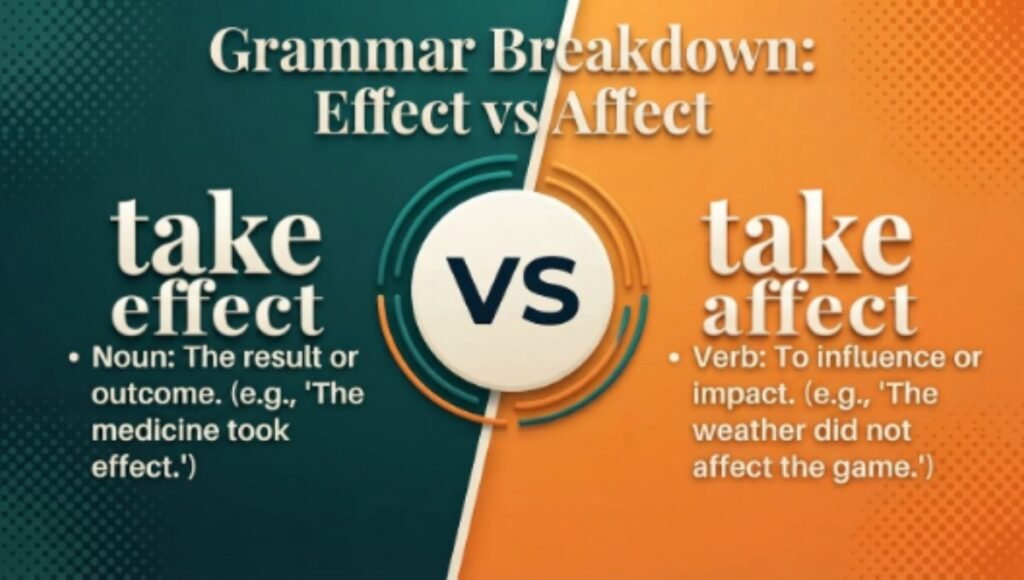
Understanding the grammar behind take effect or take affect makes the correct choice obvious once you see the pattern.
- Effect (noun): a result or outcome. Example: “The effect of the storm was visible for days.”
- Affect (verb): to influence or change something. Example: “The storm will affect our travel plans.”
- Idiom structure: “take” plus a noun. Since effect is the noun form, “take effect” is grammatically correct.
- Affect as a noun: rare, and used mainly in psychology to describe emotional expression. This is a specialized meaning and does not apply to this idiom.
- Effect as a verb: also rare, meaning to bring something about, as in “effect change.” This is a separate, formal usage and different from the idiom “take effect.”
Because “take affect” would pair a verb with a verb, it breaks basic sentence structure. That is the clearest reason it is considered incorrect.
Does “Take Affect” Have Any Legitimate Use?
No. “Take affect” is not listed as a standard phrase in any major dictionary or style guide. It is a common misspelling caused by confusing “affect” and “effect,” not a recognized variation. Whether you are writing an email, a legal document, or a casual text, take effect is the only correct choice when describing something becoming active or official.
More related Post : Vender or Vendor? 5 Facts That Settle the Spelling Question https://feastinsidar.com/vender-or-vendor/
Where Does the Phrase “Take Effect” Come From?
Effect comes from the Latin word “effectus,” meaning “accomplished” or “brought about,” which traces back to “efficere,” meaning “to work out” or “to bring about.” The phrase “take effect” developed naturally in English as a way to describe something becoming active or producing its intended result. Affect, by contrast, comes from the Latin “affectus,” related to influencing or acting upon something, which is why it functions as a verb describing influence rather than a resulting state.
How to Pronounce Effect and Affect Correctly
Both words are pronounced similarly, which is part of why they get confused. Effect is pronounced ih-FEKT, and affect is pronounced uh-FEKT. The difference is subtle, often just the first vowel sound, and many speakers do not distinguish them clearly in fast conversation. This is exactly why relying on spelling rules, rather than sound, is the safer way to choose the right word in writing.
Take Effect or Take Affect: Quick Comparison Table
| Phrase | Correct? | Meaning | Common Use |
| Take effect | Yes | To become active, official, or operative | Standard phrase for laws, policies, contracts, medication |
| Take affect | No | Not a standard phrase | Common misspelling caused by confusing affect and effect |
How to Use “Take Effect” Correctly in a Sentence
Once you know take effect is correct, using it naturally is simple. It typically follows a subject and describes when or how something becomes active.
- Basic statement: “The new rules will take effect on Monday.”
- Future tense: “This policy will take effect once the board approves it.”
- Past tense: “The agreement took effect last year.”
- With a time reference: “The medication should take effect within thirty minutes.”
Real Life Examples in Different Contexts
Everyday conversation: “My new phone plan takes effect at the start of next month.”
Workplace communication: “Please note that the updated dress code will take effect starting Friday.”
Academic writing: “The treaty took effect after ratification by all member nations.”
Email: “This change will take effect immediately upon your confirmation.”
Business writing: “The revised pricing structure takes effect at the beginning of the next billing cycle.”
Casual writing: “I think the coffee is finally taking effect, I feel awake now.”
Each example uses “take effect” as a standard idiom describing something becoming active, which is exactly how it functions in both formal and informal English.
Common Mistakes With Take Effect or Take Affect
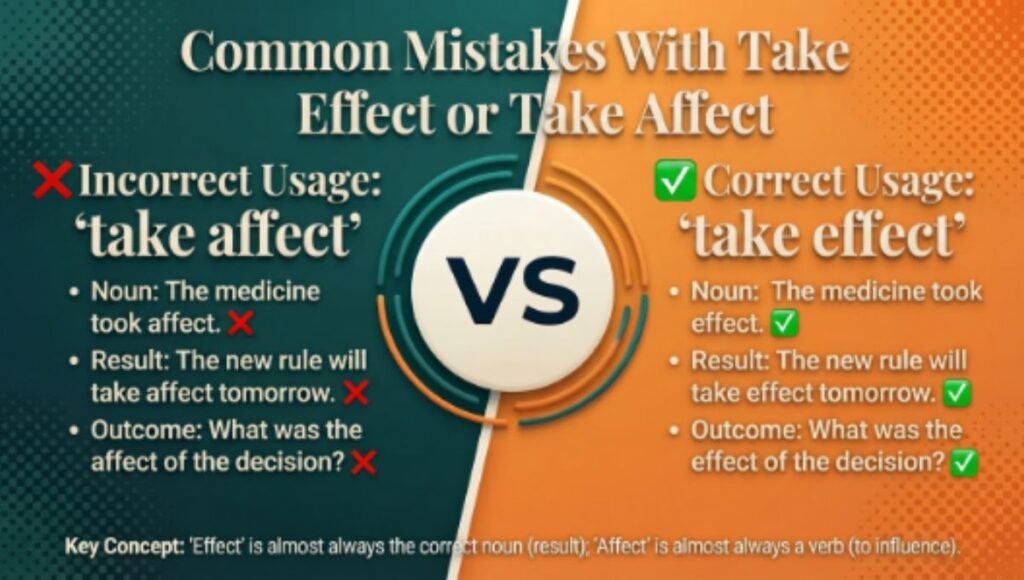
Confusion between take effect or take affect tends to show up in a few predictable situations. Here are the most common mistakes, along with corrections.
Incorrect: The new law will take affect next week. Correct: The new law will take effect next week. This happens because affect and effect sound alike, but only effect works as the noun needed here.
Incorrect: Her decision really took affect on the team. Correct: Her decision really affected the team. Here, “affect” should be used as a verb on its own, not paired with “take,” since the sentence describes influence rather than something becoming official.
Incorrect: The changes will take affect immediately. Correct: The changes will take effect immediately. This is the most frequent version of the mistake, and remembering that “effect” is the noun form solves it every time.
Words Related to Take Effect You Should Know
Expanding your vocabulary around this phrase makes similar mix ups easier to avoid.
- Go into effect: a close synonym, used the same way as “take effect”
- Become effective: a more formal alternative, often used in legal writing
- Influence: a synonym for the verb “affect”
- Outcome: a synonym for the noun “effect”
- Side effect: a related noun phrase describing a secondary result
Formal vs Informal Usage: Does It Matter?
Take effect works equally well in formal and informal writing, and this consistency is one of the reasons take effect or take affect questions come up so often, since the correct phrase never changes based on tone. You will see it in legal documents, news articles, casual conversation, and business emails without any shift in meaning or tone. This consistency makes it a reliable phrase to use anywhere. “Take affect,” on the other hand, has no accepted use in any register, formal or informal, and should always be corrected to “take effect.”
Practical Tips to Never Confuse Effect and Affect Again
A few memory tricks can help you lock in the difference for good, so take effect or take affect never causes hesitation again.
- Remember that “affect” starts with “a” like “action,” since it is usually a verb describing an action.
- Remember that “effect” starts with “e” like “end result,” since it is usually a noun describing an outcome.
- If you can replace the word with “result” or “outcome,” use effect. If you can replace it with “influence” or “change,” use affect.
Frequently Asked Questions
Is “take affect” ever correct?
No. “Take affect” is considered a misspelling in standard English. The correct phrase in every context, formal or informal, is take effect.
What does “take effect” mean?
Take effect means to become active, official, or operative, most often describing laws, policies, contracts, or medications.
How do I use “take effect” in a sentence?
Use it after a subject to describe when something becomes active, such as “The new policy will take effect on Monday” or “The medication took effect quickly.”
Why do people confuse take effect and take affect?
The confusion happens because “effect” and “affect” sound very similar when spoken. Since “affect” is usually a verb and “effect” is usually a noun, only effect fits correctly into this particular idiom.
Is “affect” ever a noun?
Rarely. “Affect” can function as a noun in psychology, referring to an observable emotional expression. This specialized meaning does not apply to everyday writing or to the phrase “take effect.”
The Bottom Line
When it comes to take effect or take affect, only one phrase is correct: take effect. Remember that effect is the noun form describing a result, while affect is the verb form describing influence, and you will never second guess this phrase again.











6 thoughts on “Take Effect or Take Affect? The 1 Correct Phrase Explained”