Autocorrect won’t catch this one, since both “whose” and “who’s” are real, correctly spelled words. That’s exactly why the whose or who’s mix up is so common, even among confident writers. Here’s the quick fix: once you understand what each word actually stands for, the whose or who’s confusion disappears for good.
Quick Answer: Is It Whose or Who’s?
“Whose” shows possession or ownership, while “who’s” is a contraction of “who is” or “who has.” Both spellings are correct, but they mean completely different things and are never interchangeable. When deciding between whose or who’s, ask yourself whether you’re describing ownership or short handing “who is.”
What Does “Whose” Mean?
“Whose” is a possessive pronoun used to ask or state who owns something. It functions similarly to “his,” “her,” or “their,” but specifically in question or descriptive form:
- Whose jacket is this?
- I met the woman whose car was towed.
In both examples, “whose” points to ownership, either asking about it or describing it.
What Does “Who’s” Mean?
“Who’s” is a contraction, meaning it’s a shortened combination of two words: “who is” or “who has.” The apostrophe signals that letters have been removed:
- Who’s coming to the party? (who is)
- Who’s already finished the assignment? (who has)
If you can replace “who’s” with “who is” or “who has” and the sentence still makes sense, you’ve used it correctly.
Why “Whose or Who’s” Trips People Up
The confusion here isn’t about spelling errors, since both words are valid. The real issue is that “who’s” looks like it should show possession, the way “it’s” sometimes gets mistaken for “its.” But apostrophes in contractions never indicate ownership, only missing letters. This is the core reason the whose or who’s mix up happens so frequently, even in professional writing.
The Simple Test to Choose Correctly
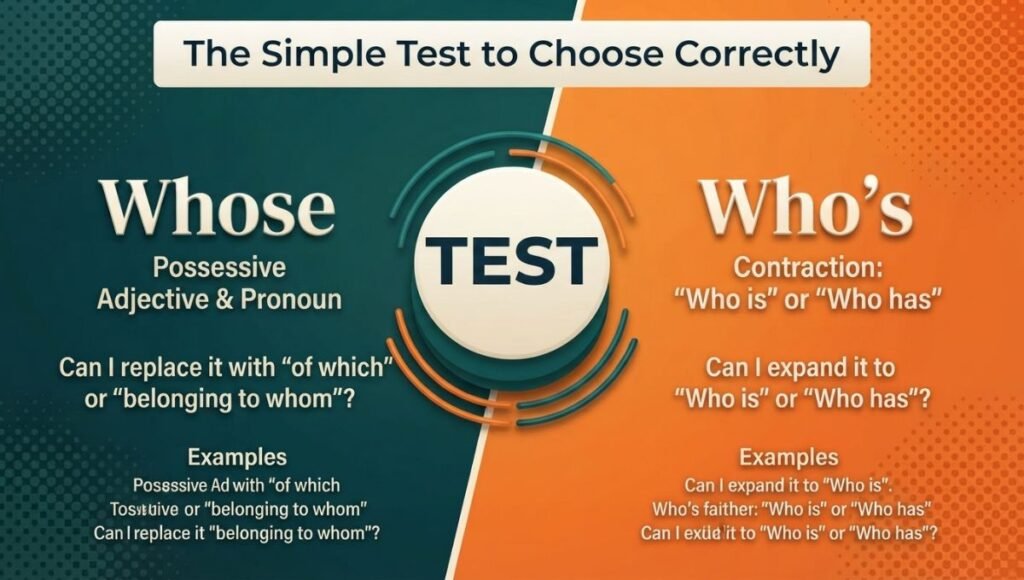
Here’s a quick, reliable trick: whenever you’re unsure about whose or who’s, try replacing the word with “who is” in your sentence.
- Who’s/Whose bag is this? → “Who is bag is this?” doesn’t make sense, so the correct word is whose.
- Who’s/Whose bringing dessert? → “Who is bringing dessert?” makes sense, so the correct word is who’s.
This test works almost every time, since “whose” never expands into “who is” or “who has.”
More related Post: Bite Past Tense (2026): 5 Simple Steps to Use Bit and Bitten Correctly https://feastinsidar.com/bite-past-tense/
Whose or Who’s: When Each Form Applies
Here’s the practical breakdown:
Use “whose” when you’re asking about or describing ownership: Whose phone keeps buzzing?
Use “who’s” when you mean “who is” or “who has”: Who’s responsible for this project?
There is no situation where the two words can substitute for each other, even though they sound identical when spoken aloud.
Is “Whose” Ever Used Without a Person?
Yes, and this is a detail many grammar guides skip. “Whose” can also refer to objects or ideas, not just people:
- The company whose policies changed last year saw a drop in complaints.
Some style guides historically preferred “of which” for non human subjects, but modern English widely accepts “whose” in these situations, especially in everyday and professional writing.
Grammar Breakdown: Pronoun and Contraction Forms
“Whose” is classified as a possessive pronoun, while “who’s” is a contraction built from a pronoun and a verb. This distinction is the entire reason the whose or who’s debate exists, since possessive pronouns in English never use apostrophes (compare “his,” “hers,” and “theirs,” none of which have one either).
Possessive pronoun: whose (no apostrophe, shows ownership)
Contraction: who’s (apostrophe, replaces “who is” or “who has”)
Where “Whose” and “Who’s” Come From
“Whose” developed from the Old English possessive form of “who,” reflecting a pattern shared by other English possessive pronouns. “Who’s,” on the other hand, is a modern contraction, formed the same way as other common contractions like “it’s” (it is) and “she’s” (she is). Understanding this origin helps explain why one word uses an apostrophe and the other doesn’t, since contractions consistently mark missing letters, while possessive pronouns generally do not.
How to Pronounce Whose and Who’s
Both words are pronounced identically: HOOZ. This is part of why the whose or who’s confusion is so persistent, since listening alone gives no clue about which spelling is correct. Only context and grammar function determine the right choice in writing.
Whose or Who’s: Quick Comparison Table
| Term | Correct? | Meaning | Use |
| Whose | Yes | Shows possession or ownership | Standard in questions and descriptions of ownership |
| Who’s | Yes | Contraction of “who is” or “who has” | Standard wherever “who is” or “who has” fits |
“Whose” and “Who’s” in Real Sentences
Everyday conversation: “Whose turn is it to do the dishes?”
Workplace communication: “Who’s leading the presentation on Thursday?”
Academic writing: “The researcher whose findings were cited most often received the award.”
Email: “Who’s available for a quick call this afternoon?”
Business writing: “We need to confirm whose signature is required on the contract.”
Casual writing: “Who’s up for pizza tonight?”
Each sentence uses “whose” or “who’s” correctly based on whether ownership or a contraction is intended.
Common Mistakes With Whose and Who’s
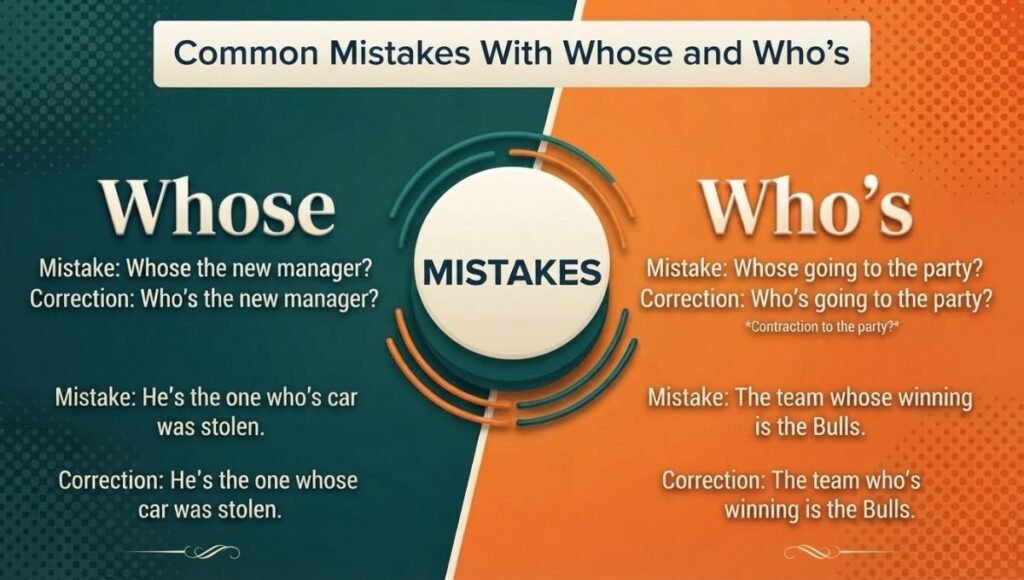
Incorrect: Who’s bike is parked outside?
Correct: Whose bike is parked outside?
This mistake happens because the writer meant to ask about ownership, but used the contraction instead of the possessive form.
Incorrect: I don’t know whose coming to dinner.
Correct: I don’t know who’s coming to dinner.
Here the sentence actually means “who is coming,” so the contraction is needed, not the possessive pronoun.
Incorrect: Whose going to answer the phone?
Correct: Who’s going to answer the phone?
Applying the “who is” test immediately reveals that the contraction is correct here, not “whose.”
Related Words and Terms
A few related terms add useful context:
- Its: a possessive pronoun often confused with “it’s,” following the same apostrophe logic
- Contraction: a shortened form of two words combined with an apostrophe
- Possessive pronoun: a word showing ownership, like “his,” “hers,” or “whose”
- Who: the base word both “whose” and “who’s” come from
- Homophone: words that sound alike but have different meanings and spellings
How to Remember the Difference
A simple trick: apostrophes almost always signal missing letters, never possession, in words like “who’s,” “it’s,” and “they’re.” If you remember that rule, the whose or who’s choice becomes a quick mental check rather than a guessing game.
FAQs About Whose or Who’s
Is “who’s” ever used to show possession?
No. “Who’s” is always a contraction meaning “who is” or “who has,” never a possessive form.
How do I know when to use “whose” instead of “who’s”?
Try replacing the word with “who is” in your sentence. If it makes sense, use “who’s.” If it doesn’t, use “whose.”
Can “whose” refer to objects, not just people?
Yes. “Whose” can describe ownership or association for both people and things, such as “a company whose reputation suffered.”
Is there a British English difference between “whose” and “who’s”?
No. Both words function the same way in American and British English, with no regional variation.
What does “who’s” stand for?
“Who’s” stands for either “who is” or “who has,” depending on the sentence.
The Bottom Line
The whose or who’s choice comes down to one simple question: are you showing possession, or shortening “who is” or “who has”? Once you run a sentence through that quick mental test, you’ll never second guess whether to use “whose” or “who’s” again.










1 thought on “Whose or Who’s (2026): 5 Simple Rules to Never Mix Them Up Again”