Seeing “Manuel” and “manual” side by side can make you second guess which one belongs in your sentence. The Manuel or Manual confusion happens because these two words look nearly identical but serve completely different purposes. Once you understand what each one actually refers to, the Manuel or Manual mix up becomes easy to avoid for good.
Quick Answer: Is It Manuel or Manual?
“Manual” is the common English word, used as an adjective meaning done by hand or as a noun referring to an instruction guide. “Manuel” is a personal name, typically a man’s first name of Spanish and Portuguese origin. Neither word is a misspelling of the other. They’re simply two different words that happen to look and sound alike.
What Does “Manual” Mean?
“Manual” functions in two main ways in English. As an adjective, it describes something done by hand rather than by machine:
- She prefers manual labor over office work.
- This car has a manual transmission.
As a noun, “manual” refers to an instruction booklet or guidebook:
- Please read the manual before assembling the furniture.
Both meanings are extremely common in everyday, technical, and professional writing.
What Does “Manuel” Mean?
“Manuel” is a proper noun, specifically a personal first name commonly used in Spanish, Portuguese, and other Romance language speaking cultures. It’s not an English word with a dictionary definition, since it functions purely as a name:
- Manuel works as an electrician downtown.
- I met Manuel at the conference last week.
Because “Manuel” is a name, it’s always capitalized, unlike the common noun or adjective “manual.”
Why “Manuel or Manual” Confuses People
The confusion here isn’t really about spelling errors in the traditional sense. Both words are correctly spelled, but they’re easy to mix up because they differ by only one letter and sound almost identical when spoken. This is exactly why the Manuel or Manual mix up shows up so often, especially in fast typing, autocorrect suggestions, or when English learners encounter the name “Manuel” for the first time.
Manuel or Manual: When Each Word Applies
Here’s the practical breakdown:
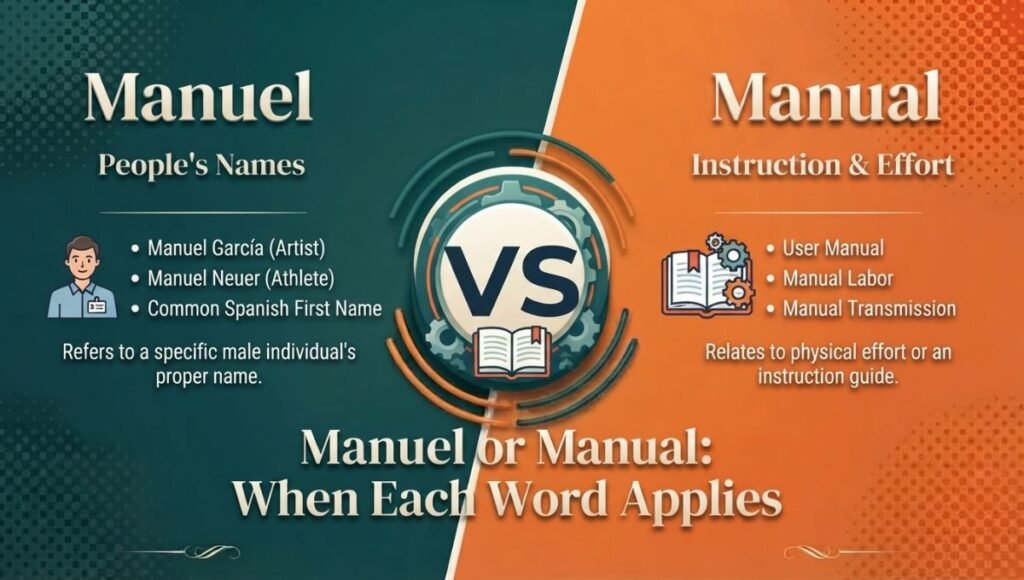
Use “manual” whenever you’re describing something done by hand, referring to a guidebook, or discussing a transmission type in a vehicle.
Use “Manuel” only when referring to a specific person’s name.
If you’re unsure about Manuel or Manual while writing, ask yourself whether you’re talking about a person or describing something hand operated or instructional. That distinction almost always settles it.
More related Post: Whose or Who’s (2026): 5 Simple Rules to Never Mix Them Up Again https://feastinsidar.com/whose-or-whos/
Is “Manuel” Ever Used as a Common Word?
No. “Manuel” does not function as an adjective, verb, or general noun in English. It exists solely as a personal name. If you’re tempted to use “Manuel” to describe something done by hand or to refer to an instruction booklet, that would be an incorrect substitution, since only “manual” carries those meanings.
Grammar Breakdown: Adjective, Noun, and Proper Noun Forms
Manual (adjective): He switched the car back to manual mode.
Manual (noun): The technician referred to the manual for troubleshooting steps.
Manuel (proper noun): Manuel arrived early to help set up the event.
Since “Manuel” is a proper noun, it always starts with a capital letter, no matter where it appears in a sentence. “Manual,” as a common noun or adjective, is only capitalized when it starts a sentence or appears in a title.
Where “Manual” and “Manuel” Come From
“Manual” comes from the Latin word manualis, meaning “of the hand,” which itself derives from manus, meaning “hand.” This root explains both meanings of the word, since manual labor involves the hands, and a manual is something you hold and reference by hand.
“Manuel,” on the other hand, developed as a personal name with roots in the Hebrew name Immanuel, meaning “God is with us.” The name spread widely through Spanish, Portuguese, and other European naming traditions, eventually becoming one of the more common male first names in several cultures.
How to Pronounce Manual and Manuel
“Manual” is pronounced MAN-yoo-uhl, with stress on the first syllable. “Manuel,” as a name, is typically pronounced man-WELL in English, though pronunciation can vary slightly depending on the speaker’s language background. The difference in pronunciation, while subtle, is another small clue that helps separate the two words in speech, even though the Manuel or Manual confusion usually happens in writing rather than conversation.
Manuel or Manual: Quick Comparison Table
| Term | Correct? | Meaning | Use |
| Manual | Yes | Done by hand, or an instruction guide | Common noun and adjective in everyday and technical writing |
| Manuel | Yes | A personal first name | Used only when referring to a specific person |
“Manual” and “Manuel” in Real Sentences
Everyday conversation: “I always keep the car manual in the glove compartment.”
Workplace communication: “Please update the training manual before the new hires start.”
Academic writing: “The study compared manual data entry methods to automated systems.”
Email: “Manuel will be joining the call to walk us through the new process.”
Business writing: “Manual review of the invoices revealed several discrepancies.”
Referring to a person: “Manuel has been with the company for over ten years.”
Common Mistakes With Manual and Manuel
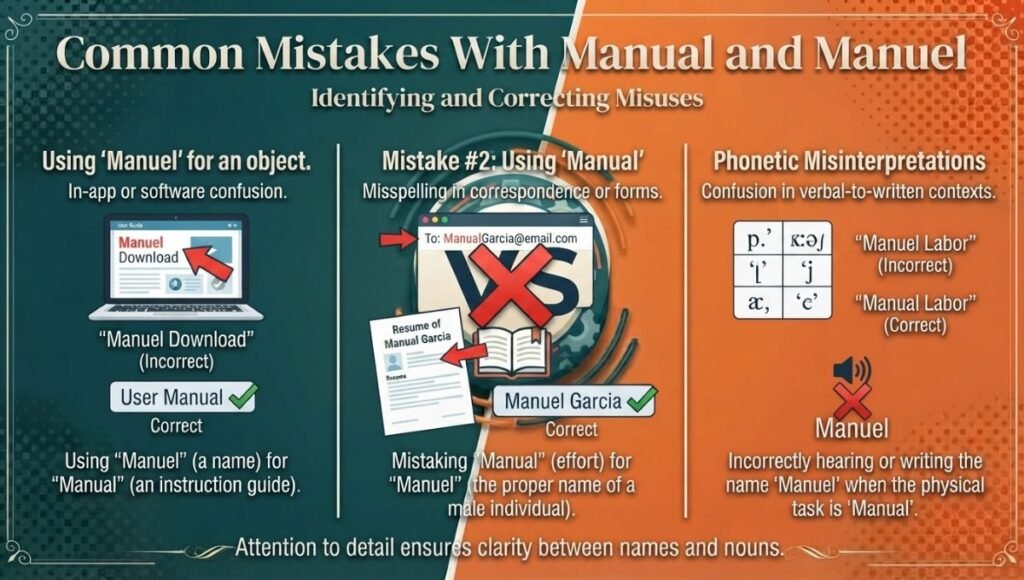
Incorrect: Please check the manuel for setup instructions.
Correct: Please check the manual for setup instructions.
This is the classic Manuel or Manual mistake, usually caused by autocorrect or simply misremembering which spelling applies to the instruction guide.
Incorrect: I spoke with Manual about the schedule change.
Correct: I spoke with Manuel about the schedule change.
Here the writer meant to reference a person’s name but accidentally used the common word instead.
Incorrect: This machine requires manuel operation.
Correct: This machine requires manual operation.
Since this sentence describes an action done by hand, the adjective “manual” is correct, not the name “Manuel.”
Related Words and Terms
A few related terms add useful context:
- Handbook: a synonym for “manual” when referring to an instruction guide
- Automatic: the opposite of “manual” when describing a process or transmission
- Immanuel: the historical root name behind “Manuel”
- Manually: the adverb form, describing how something is done by hand
- Instruction guide: another common phrase similar to “manual” as a noun
How to Remember Which Word to Use
A simple trick: “manual” relates to hands, since both words share the Latin root for “hand.” “Manuel” is a name, and names always refer to people. If you keep that connection in mind, the Manuel or Manual choice becomes much easier to make correctly every time.
FAQs About Manuel or Manual
Is “Manuel” a misspelling of “manual”?
No. “Manuel” is a legitimate personal name, not a misspelling. The two words are simply different from each other, despite looking similar.
Which word should I use for an instruction guide, Manuel or Manual?
Always use “manual” when referring to an instruction guide or hand operated process. “Manuel” only refers to a person’s name.
Is “manual” always spelled the same way in American and British English?
Yes. “Manual” is spelled identically in both American and British English, with no regional variation.
Can “Manuel” ever mean something other than a name?
No. “Manuel” functions exclusively as a personal name in English and does not carry any other meaning.
How do I know which spelling to use in a sentence?
If you’re referring to a specific person, use “Manuel.” If you’re describing something done by hand or referencing a guidebook, use “manual.”
The Bottom Line
The Manuel or Manual question comes down to context: “manual” describes something done by hand or refers to an instruction guide, while “Manuel” is strictly a personal name. Once you remember that one relates to hands and the other refers to people, you’ll never mix up “Manuel or Manual” again.










1 thought on “Manuel or Manual (2026): 5 Facts to Clear Up This Common Mix-Up”