
Seeing “curtesy” in an old legal document can make you think someone simply misspelled “courtesy.” Surprisingly, that’s not the case. The curtesy or courtesy question involves two real, separate words with completely different meanings. Once you understand where each one applies, the curtesy or courtesy confusion clears up in minutes.
Quick Answer: Is It Curtesy or Courtesy?
“Courtesy” is the word almost everyone means, referring to polite, considerate behavior. “Curtesy” is a real but rare legal term, historically referring to a husband’s right to his deceased wife’s property under certain conditions. If you’re writing about politeness or manners, always use “courtesy.” “Curtesy” only applies in a narrow historical and legal context.
What Does “Courtesy” Mean?
“Courtesy” is a noun describing polite, respectful, or considerate behavior toward others. It’s the word people almost always intend to use in everyday writing:
- She held the door open as a courtesy to the elderly man behind her.
- Thank you for your courtesy during the delay.
“Courtesy” can also function as an adjective in phrases like “courtesy call” or “courtesy discount,” referring to something offered as a polite gesture.
What Does “Curtesy” Mean?
“Curtesy” is a much rarer word with a specific legal and historical meaning. In common law, “curtesy” referred to a husband’s right to a life estate in his deceased wife’s property, provided certain legal conditions were met, such as the birth of a living child during the marriage. This term appears almost exclusively in legal history, property law, and estate related documents. Outside of that narrow context, “curtesy” is not a word most people will ever need to use.
Why “Curtesy or Courtesy” Confuses People
The confusion here isn’t a typical spelling mistake. Both words are legitimate, correctly spelled English terms. The issue is that “curtesy” looks so similar to “courtesy” that most readers assume it’s simply a misspelling, especially since “curtesy” is rarely encountered outside legal writing. This is exactly why the curtesy or courtesy mix up trips up even careful writers who stumble across the legal term for the first time.
More related Post: Useable or Usable (2026): 5 Key Facts to Settle This Spelling Question https://feastinsidar.com/useable-or-usable/
Curtesy or Courtesy: When Each Word Applies
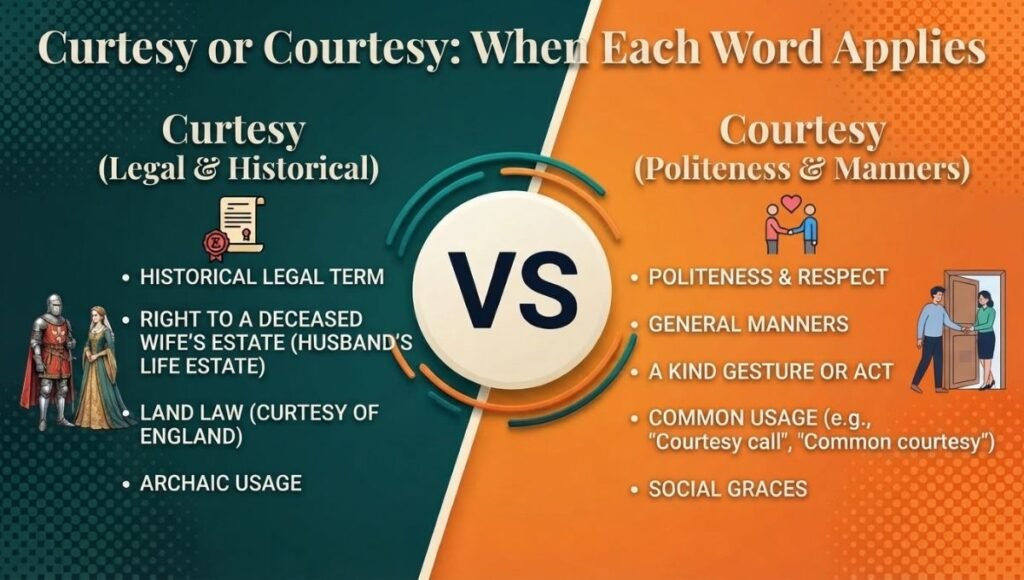
Here’s the practical breakdown:
Use “courtesy” in nearly all everyday, business, academic, and casual writing, whenever you mean politeness or consideration.
Use “curtesy” only when referring to the specific historical legal concept involving a husband’s property rights, typically in legal history texts, property law discussions, or historical documents.
If you’re unsure about curtesy or courtesy in your own writing, the odds are overwhelmingly in favor of “courtesy.”
Is “Curtesy” Considered a Misspelling?
No, though it’s easy to see why people assume that. “Curtesy” is a legitimate word found in legal dictionaries and historical law texts, not an error. However, if you’re writing about politeness, manners, or considerate behavior and you type “curtesy,” that would be an incorrect use of the word, since it doesn’t carry that meaning at all.
Grammar Breakdown: Noun and Adjective Forms
Courtesy (noun): He showed great courtesy to the new employees.
Courtesy (adjective, in compound phrases): The hotel offered a courtesy shuttle to the airport.
Curtesy (noun only): Under curtesy, the widower retained rights to the estate.
“Curtesy” does not function as an adjective and rarely appears outside formal or historical legal writing. “Courtesy,” on the other hand, is flexible and appears constantly across everyday and professional English.
Where “Courtesy” and “Curtesy” Come From
“Courtesy” comes from the Old French word courtoisie, related to behavior fitting for a royal court, eventually evolving into the modern sense of politeness and consideration. “Curtesy,” despite looking similar, developed separately within English common law tradition, referring specifically to a husband’s legal interest in his wife’s property after her death. Though the two words share a distant linguistic root tied to court and property customs, they diverged into entirely different meanings over centuries of legal and social use.
How to Pronounce Curtesy and Courtesy
“Courtesy” is pronounced KUR-tuh-see, with stress on the first syllable. “Curtesy” is pronounced nearly identically, which adds to the confusion between the two. Since the pronunciation is so close, the difference between curtesy or courtesy almost always comes down to spelling and context rather than sound.
Curtesy or Courtesy: Quick Comparison Table
| Term | Correct? | Meaning | Use |
| Courtesy | Yes | Polite, considerate behavior | Everyday, business, academic, and casual writing |
| Curtesy | Yes (rare) | Historical legal right to a deceased spouse’s property | Legal history, property law, historical documents only |
“Courtesy” in Real Sentences
Everyday conversation: “I appreciate you calling ahead as a courtesy.”
Workplace communication: “As a courtesy, please give at least two weeks notice before your last day.”
Academic writing: “The study explored courtesy norms across different cultures in professional settings.”
Email: “Thank you for the courtesy of a quick response.”
Business writing: “The airline offered a courtesy upgrade due to the delay.”
Casual writing: “It’s just common courtesy to say thank you.”
“Curtesy” in a Real Sentence
Legal or historical writing: “Under English common law, curtesy granted a surviving husband a life estate in his wife’s land if a child had been born of the marriage.”
This is the type of sentence where “curtesy” actually belongs, and it would not make sense to replace it with “courtesy.”
Common Mistakes With Curtesy and Courtesy
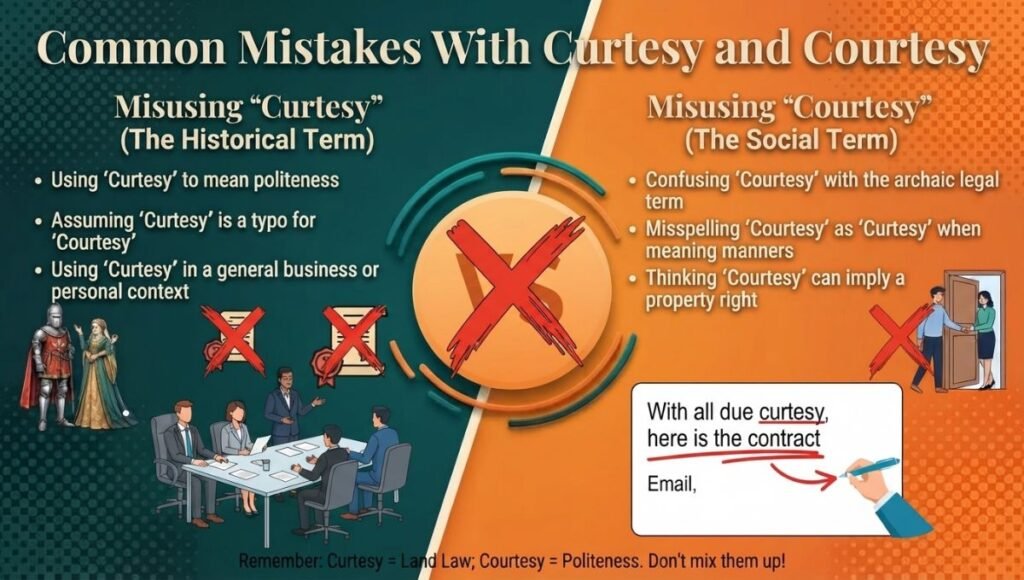
Incorrect: Thank you for your curtesy during this process.
Correct: Thank you for your courtesy during this process.
This is the most common version of the curtesy or courtesy mistake, where someone unintentionally uses the rare legal term instead of the everyday word for politeness.
Incorrect: The hotel provided a curtesy shuttle to guests.
Correct: The hotel provided a courtesy shuttle to guests.
Since this sentence describes a polite gesture rather than a legal property right, “courtesy” is the correct word here.
Incorrect: She was known for her courtesy rights to the estate.
Correct: She was known for her curtesy rights to the estate. (if referring to the specific legal concept)
In this rare case, the legal meaning is intended, so “curtesy” would actually be the correct term, not “courtesy.”
Related Words and Terms
A few related terms add useful context:
- Politeness: a close synonym for “courtesy” in everyday use
- Etiquette: the broader set of social rules that courtesy often reflects
- Dower: a related historical legal term describing a widow’s property rights, the counterpart to curtesy
- Common law: the legal tradition where “curtesy” originated
- Consideration: another synonym often used alongside “courtesy”
How to Remember Which Word to Use
A simple trick: if you’re not currently reading or writing about historical property law, you almost certainly want “courtesy.” Save “curtesy” for the rare legal or historical context where it belongs, and you’ll navigate the curtesy or courtesy choice correctly every time.
FAQs About Curtesy or Courtesy
Is “curtesy” a real word?
Yes. “Curtesy” is a legitimate legal term referring to a husband’s historical right to his deceased wife’s property, though it’s rarely used outside legal or historical writing.
Which word should I use for politeness, curtesy or courtesy?
Always use “courtesy” when referring to polite or considerate behavior. “Curtesy” does not carry that meaning.
Is “curtesy” still used in modern law?
It appears mainly in historical legal texts and discussions of common law property rights, since many jurisdictions have since reformed these laws.
Are “curtesy” and “courtesy” pronounced the same way?
They’re pronounced almost identically, which is part of why the two words are so easily confused in writing.
Is there a British English difference between the two words?
No. Both words carry the same meanings and spellings in American and British English, though “curtesy” as a legal term has roots specifically in English common law history.
The Bottom Line
The curtesy or courtesy question comes down to context: use “courtesy” for everyday politeness, and reserve “curtesy” strictly for its narrow legal and historical meaning. Once you remember that one word covers nearly every situation you’ll encounter, you’ll rarely need “curtesy” at all.











2 thoughts on “Curtesy or Courtesy (2026): 5 Facts That Explain This Rare Word Mix-Up”