Vertex vs vertices: which one do you write? The confusion is understandable, because the plural does not end in an s. Vertex is singular (one point), and vertices is plural (two or more points). Both forms come from Latin, which explains the unusual ending. Below, you will find clear examples, shape counts, and easy memory tricks for vertex vs vertices.
Vertex vs Vertices: Which One Is Singular and Which Is Plural?
Vertex is the singular form, and vertices is the plural form. Use vertex when you mean one corner or turning point. Use vertices when you mean more than one.
A triangle has three corners, so you say it has three vertices. If you point to a single corner, you call it a vertex. The rule is the same in math, geometry, computer science, and everyday technical writing.
What Does Vertex Mean?
A vertex is a point where two or more lines, rays, or edges meet. It is a noun, and it has a few closely related uses:
- In geometry: the corner of a shape or angle, such as each corner of a square.
- In algebra: the highest or lowest point of a parabola, also called its turning point.
- In graph theory and computing: a point (also called a node) in a network that edges connect.
- In everyday language: the top point of something. In anatomy, the vertex is the top of the skull.
In all these uses, the idea is the same: a vertex is a special point where something meets, turns, or peaks.
What Is the Difference Between Vertex and Vertices?
The difference is number. Vertex names one point, and vertices names several. Here is vertex vs vertices at a glance, along with forms that people often confuse them with:
| Term | Correct? | Meaning | Use |
| vertex | Yes | One corner or turning point | Singular |
| vertices | Yes | Two or more corners or points | Standard plural |
| vertexes | Yes (less common) | Alternate plural | Acceptable, but rarer in math |
| vertice | No | Not a real singular form | Use vertex instead |
| verteces | No | Misspelling of vertices | Avoid |
| vertexs | No | Misspelling of vertexes | Avoid |
Does the “incorrect” form have any legitimate use? “Vertice” and “verteces” do not, so treat them as spelling errors. “Vertexes” is different. It is a recognized plural, but math and science writing overwhelmingly use vertices.
More related Post: Curtesy or Courtesy (2026): 5 Facts That Explain This Rare Word Mix-Up https://feastinsidar.com/curtesy-or-courtesy/
How Do You Pronounce Vertex and Vertices?
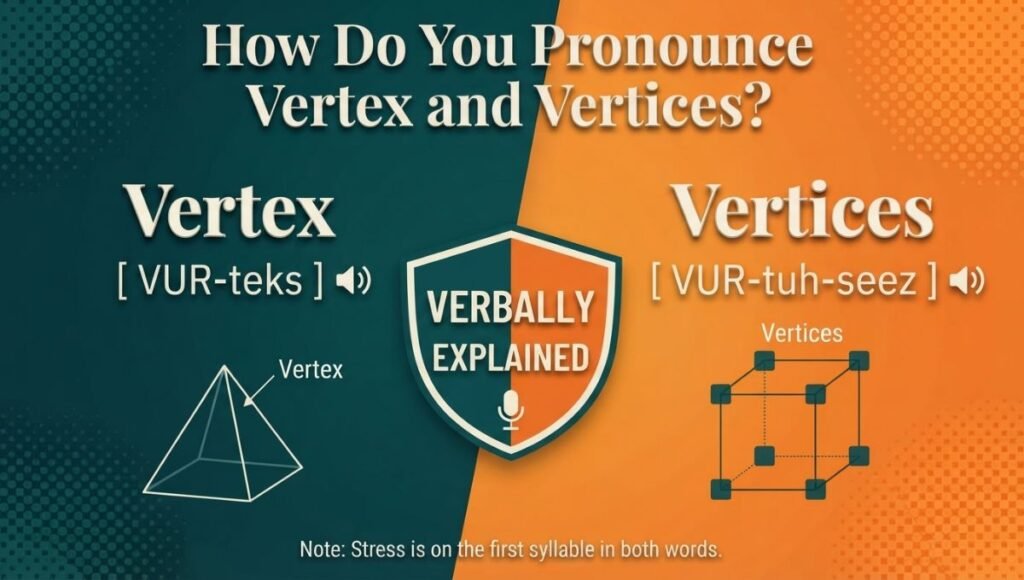
Vertex is pronounced VUR-teks (/ˈvɜːrtɛks/). It has two syllables, and the stress falls on the first.
Vertices is pronounced VUR-tuh-seez (/ˈvɜːrtɪsiːz/). It has three syllables, with the stress still on the first, and it ends with a long “ee” sound followed by z.
A common slip is to say “VUR-tih-sez” with a short ending. The final “ces” in vertices sounds like the word “seas” or “sees.”
Is Vertexes Also Correct?
Yes. Vertexes is a recognized English plural, formed by adding -es to a word that ends in x. Dictionaries list both vertices and vertexes.
Still, vertices is the form you should expect in textbooks, exams, and technical documents. It follows the Latin pattern and is the standard choice for geometry and graph theory. If you write vertexes, some teachers or editors may mark it as unusual.
Other words follow the same Latin-to-English pattern:
- index becomes indices
- matrix becomes matrices
- appendix becomes appendices
- vortex becomes vortices
If you know these plurals, you already know why vertices is spelled with -ices.
Where Do Vertex and Vertices Come From?
Vertex is a Latin word. In Latin, it could mean a whirl or a whirlpool, and it could also mean the crown of the head, which led to the meaning “highest point.” It comes from the verb vertere, which means “to turn.”
The plural in Latin was vertices, and English kept it. That is why the plural does not follow the usual “add an s” rule.
The same root also gave English the word vertical, which describes something that runs straight up toward the top point. This link is a handy reminder that a vertex is often a peak or turning point.
How Many Vertices Do Common Shapes Have?
This table shows how the plural is used with real shapes. Use vertices for any number other than one.
| Shape | Number of vertices |
| Triangle | 3 |
| Square or rectangle | 4 |
| Pentagon | 5 |
| Hexagon | 6 |
| Tetrahedron | 4 |
| Square pyramid | 5 |
| Cube | 8 |
| Cone | 1 (one vertex, at the tip) |
Notice that a cone has exactly one vertex, so the singular applies. Shapes with no corners, such as a circle or a sphere, have zero vertices. In English, the plural is used with zero, so you say “a sphere has zero vertices.”
How Do You Use Vertex and Vertices in a Sentence?
Here are natural examples for different situations:
- Everyday conversation: “Start at one vertex and trace the edges of the triangle.”
- Classroom: “A cube has 8 vertices, 12 edges, and 6 faces.”
- Workplace: “In our network diagram, each vertex represents a server.”
- Email: “I marked the three vertices on the attached diagram so you can check the angles.”
- Academic writing: “The graph has 10 vertices, and each one connects to at least two others.”
- Algebra: “The vertex of the parabola is at (2, 3).”
Whenever you face vertex vs vertices in a sentence, count the points. One point takes “vertex,” and any other number takes “vertices.”
Why is “vertex” correct in the algebra example? A parabola has only one turning point, so the singular is right. In the network example, “each vertex” is singular because “each” points to one item at a time, even though there are many servers.
What Are Common Mistakes With Vertex and Vertices?
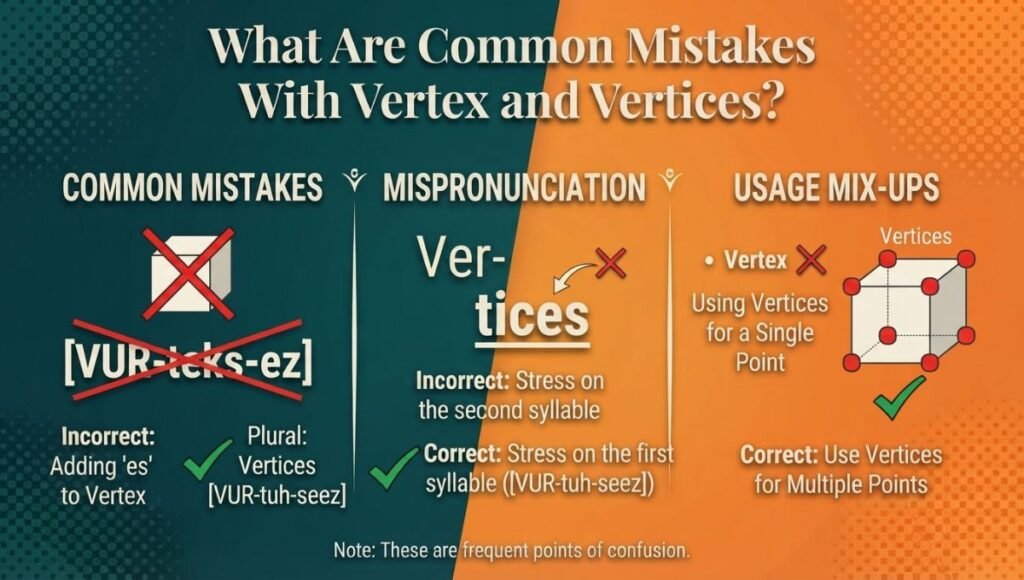
These errors are common, and they are easy to fix. Anyone who has to stop and check vertex vs vertices is in good company, because the plural looks nothing like the singular.
Mistake 1: Using “vertice” as the singular
Incorrect: Each vertice of the square is a right angle.
Correct: Each vertex of the square is a right angle.
The singular is vertex. “Vertice” is not a word.
Mistake 2: Using the singular with a number
Incorrect: The triangle has three vertex.
Correct: The triangle has three vertices.
Any count above one needs the plural.
Mistake 3: Mismatching the verb
Incorrect: The vertices of the parabola is at (2, 3).
Correct: The vertex of the parabola is at (2, 3).
A parabola has one vertex, so the singular noun goes with “is.”
Mistake 4: Misspelling the plural
Incorrect: verteces or vertexs
Correct: vertices (or vertexes)
The plural uses -ices, not -eces.
Mistake 5: Using vertices for one point
Incorrect: Label the vertices at the tip of the cone.
Correct: Label the vertex at the tip of the cone.
A cone has only one vertex, so the singular fits.
Which Related Words Should You Know?
A few terms often appear alongside vertex and vertices:
- Synonyms: corner, point, apex (the top vertex), node (in graph theory)
- Related geometry terms: edge, face, side, angle, polygon, polyhedron
- Related word: vertical, which comes from the same Latin root
- Look-alike word: vortex, whose plural is also vortices (a spinning mass, not a corner)
The word “apex” is close in meaning, but it usually names the top point of a shape, such as the tip of a pyramid. A vertex can be any corner, not only the top one.
How Can You Remember Vertex vs Vertices?
Here are some simple memory tricks:
- Match the ending to the number. The x in vertex is singular, and the -ices ending is plural. If you see “-ices,” think “more than one.”
- Link it to other Latin plurals. Index becomes indices and matrix becomes matrices, so vertex becomes vertices.
- Count the corners first. Ask whether you mean one point or several, then pick the form.
- Say “one vertex, two vertices” out loud. The quick contrast helps the pattern stick.
Frequently Asked Questions About Vertex and Vertices
Is vertex vs vertices a singular and plural difference?
Yes. Vertex is singular, and vertices is plural. There is no difference in meaning beyond the number.
What is the plural of vertex?
The standard plural is vertices. The alternate plural vertexes is also correct but less common in math and science.
Is vertice a word?
No. “Vertice” is not a standard English word. Use vertex for one point and vertices for more than one.
How many vertices does a cube have?
A cube has 8 vertices, along with 12 edges and 6 faces.
Which Form Should You Use?
The vertex vs vertices question has a simple answer: vertex is singular, and vertices is plural. Use vertex for one point and vertices for two or more. Reserve vertexes for rare cases, and never write “vertice.