Stuck on benefitted or benefited? You’re dealing with one of English’s most common spelling splits between American and British usage. The quick answer: “benefited” (one “t”) is the standard spelling in American English, while “benefitted” (two “t’s”) is the more traditional British English spelling. Both are grammatically valid, but the benefitted or benefited choice depends on which style of English you’re writing in.
The Quick Answer: Benefitted or Benefited?
Neither spelling is technically wrong, but they belong to different regions. In American English, “benefited” is the standard, dictionary preferred spelling. In British English, “benefitted” has traditionally been the more common form, though usage in both regions overlaps more than many writers assume. If you’re writing for a US audience, “benefited” is the safer, more expected choice.
Why Benefitted or Benefited Causes So Much Confusion
The confusion exists because the verb “benefit” doesn’t clearly follow the usual spelling rule for doubling consonants before adding “-ed.” Most one syllable words that end in a consonant, vowel, consonant pattern double the final consonant (like “stop” becoming “stopped”). “Benefit” has three syllables, and the stress falls on the first syllable, not the last, which normally means the final consonant should not double. That’s exactly why “benefited” follows standard American spelling logic while “benefitted” breaks from it.
What “Benefited” Means
“Benefited” is the past tense and past participle of the verb “benefit,” meaning to receive an advantage or to gain something positive from a situation. It’s used the same way as any regular past tense verb, describing something that happened or a state that resulted from an action, as in “the students benefited from the extra tutoring.”
What “Benefitted” Means
“Benefitted” carries the exact same meaning as “benefited.” It is not a different word with a different definition, only a different spelling. This spelling shows up more frequently in British English writing and in some older American texts, though its use has become less common over time even in British publications.
Benefited vs Benefitted: The Grammar Rule Behind the Spelling
The general English spelling rule says that a final consonant doubles before adding “-ed” only when the last syllable is stressed. Compare “refer,” which becomes “referred” because the stress falls on the second syllable, with “benefit,” where the stress falls on the first syllable (“BEN-e-fit”). Following that rule strictly, “benefited” is the version that matches standard spelling logic, which is why American dictionaries treat it as the primary form.
Where the Two Spellings Come From
“Benefit” comes from the Latin word “benefactum,” meaning “a good deed,” formed from “bene” (well) and “facere” (to do). As English speakers began adding standard verb endings to the word, American and British English settled on slightly different conventions for handling the final consonant, which is a pattern also seen in other spelling differences like “traveled” versus “travelled” and “canceled” versus “cancelled.”
How to Pronounce Benefited and Benefitted
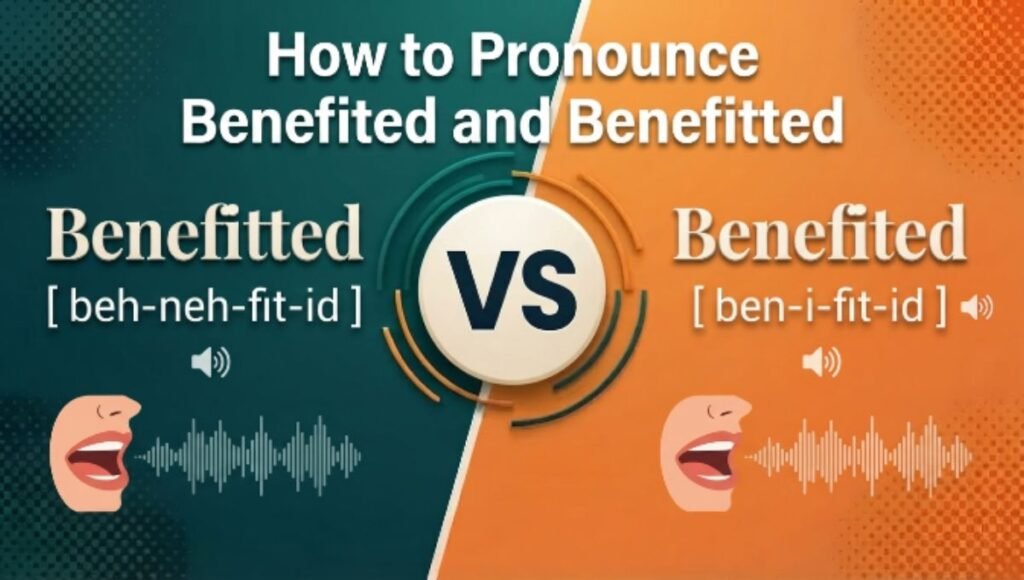
Both spellings are pronounced the same way: /ˈbɛnɪfɪtɪd/, with the stress on the first syllable, “BEN.” The spelling difference has no effect on pronunciation, which is part of why the benefitted or benefited mix up is so easy to make. Readers cannot hear a difference between the two forms in speech, only see one in writing.
Benefitted or Benefited: Comparison Table
| Term | Correct? | Region | Use |
| Benefited | Yes | Standard in American English | “The program benefited thousands of families.” |
| Benefitted | Yes (variant) | More traditional in British English | “The charity benefitted from the donation.” |
More related post : Signup or Sign Up: The 2026 Guide to Using Each Form Correctly https://feastinsidar.com/signup-or-sign-up/
How to Choose the Right Spelling for Your Audience
If you’re writing for American readers, a US based company, or any American publication, use “benefited.” If you’re writing for a British audience or following British style guides, “benefitted” is an accepted, traditional choice, though even British writers increasingly use “benefited” as well. When in doubt, or when writing for an international audience, “benefited” is the safer default.
Real Life Examples in Different Contexts
Everyday conversation: “I really benefited from taking that weekend off before the exam.”
Workplace communication: “Our team benefited from the new project management software this quarter.”
Academic writing: “The study found that participants benefited significantly from the intervention over a twelve week period.”
Email: “Thank you again, our department has genuinely benefited from your guidance this year.”
Business writing: “Shareholders benefited from the company’s strong fourth quarter earnings.”
British style writing: “The local school benefitted from a grant awarded by the regional council.”
Each example uses the spelling appropriate to its intended audience, with American contexts favoring “benefited” and British style contexts allowing “benefitted.”
Common Mistakes People Make With Benefitted and Benefited
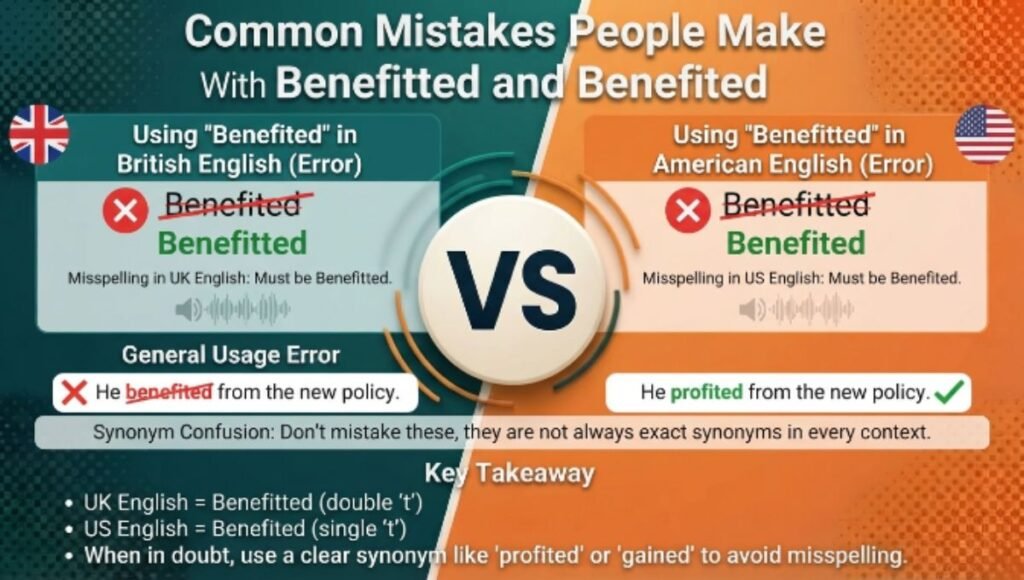
Incorrect (for American audiences): The company benefitted from the merger last year. More standard: The company benefited from the merger last year. This isn’t a hard grammar error, but American style guides and dictionaries treat “benefited” as the preferred and expected spelling.
Incorrect: She has benefitted and benefited from the same program in different sentences of one document. Correct: She has benefited from the program, consistently, throughout the document. Mixing both spellings within a single piece of writing looks inconsistent, even though neither spelling is inherently wrong on its own.
Incorrect assumption: Benefitted is a misspelling. Correct understanding: Benefitted is a legitimate variant, not an error, particularly in British English. Treating “benefitted” as flatly incorrect ignores its long standing, accepted use outside the United States.
Related Words and Terms
A few related forms follow the same American versus British spelling pattern as benefitted or benefited:
- Benefiting and benefitting: the present participle forms, following the same regional split
- Traveled and travelled: another common American versus British spelling pair
- Canceled and cancelled: a nearly identical pattern involving a single versus double consonant
- Advantage: a close synonym for the noun “benefit”
- Profited: a similar verb describing financial or practical gain
Practical Guidance for Staying Consistent With Benefitted or Benefited
Pick one spelling based on your target audience and style guide, then stay consistent throughout the entire document. Most American style guides, including those followed by major US publications, recommend “benefited.” If a client or publication specifies British English, “benefitted” remains a fully acceptable choice. Consistency matters more than which single spelling you choose.
Frequently Asked Questions
Is “benefited” or “benefitted” correct in American English?
“Benefited” is the standard and preferred spelling in American English. “Benefitted” is not considered incorrect, but it is far less common in the United States.
Is “benefitted” wrong?
No. “Benefitted” is a legitimate variant spelling, especially common in British English, not a spelling error.
How do I use “benefited” in a sentence?
Use it as the past tense of “benefit,” for example: “The entire neighborhood benefited from the new community center.”
Why does “benefit” not double its final consonant like other short verbs?
Because the stress in “benefit” falls on the first syllable, not the last, standard English spelling rules do not require doubling the final consonant before adding “-ed.”
Should I use “benefited” or “benefitted” for a UK audience?
Either is acceptable for a UK audience, though “benefitted” reflects the more traditional British style, while “benefited” is increasingly common there as well.
Conclusion
Choosing between benefitted or benefited comes down to region rather than right and wrong: “benefited” is the standard American English spelling, and “benefitted” is a valid, traditional British English variant. Match your spelling to your audience, stay consistent within a single document, and this common mix up will never slow down your writing again.










1 thought on “Benefitted or Benefited: The 2026 Guide to the Correct Spelling”