Typing recieved or received and not sure which one looks right? You’re not alone, since this is one of the most commonly misspelled words in English. The quick answer: “received” is the correct spelling, and “recieved” is simply a misspelling. Once you understand the spelling rule behind it, the recieved or received mix up disappears for good.
The Quick Answer: Recieved or Received?
“Received” is correct. “Recieved” is not a real word, only a common typing mistake. Unlike some English word pairs where two spellings are both valid, this one has a single correct form. “Received” is the past tense and past participle of the verb “receive,” meaning to get, accept, or take delivery of something.
Why People Keep Writing “Recieved” Instead of “Received”
The recieved or received confusion almost always comes down to one famous spelling rule: “i before e, except after c.” Many English learners memorize this rule early on, then misapply it to every word containing “ie” or “ei,” including “receive.” The truth is that “receive” is actually a textbook example of the rule working correctly, not an exception to it, which is exactly where the confusion starts.
What “Received” Means
“Received” describes the act of getting or accepting something, whether that’s a physical item, a message, information, or an experience. It functions as the simple past tense (“I received the package yesterday”) and as the past participle used with helping verbs (“I have received your email”).
Is “Recieved” Ever an Acceptable Spelling?
No. “Recieved” has no legitimate use in standard English, in any dialect, in any context. It is not a British versus American variation, not an older historical spelling, and not an informal alternative. It is simply an incorrect arrangement of letters that should always be corrected to “received.”
The Grammar Rule Behind Recieved or Received
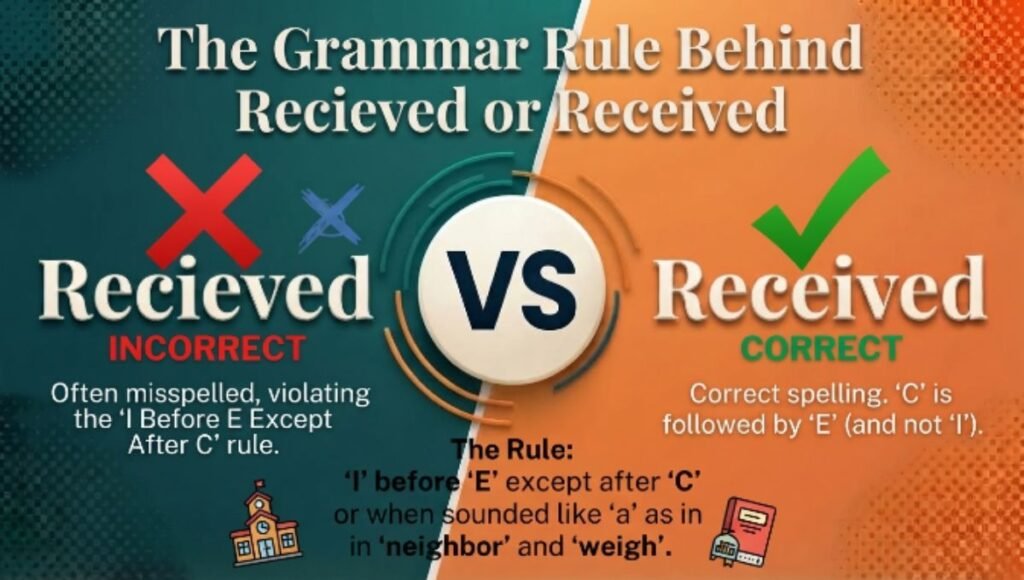
The classic spelling rule states: “i” before “e,” except after “c.” In “receive,” the letter right before “ie” is “c,” so the rule requires “ei” instead of “ie.” That gives you r-e-c-e-i-v-e, which becomes “received” once the past tense ending is added.
Compare this to a word like “believe,” where there’s no “c” before the vowel combination, so it correctly follows the standard “ie” pattern. Seeing the two side by side makes the rule much easier to apply correctly going forward.
More related Post: Benefitted or Benefited: The 2026 Guide to the Correct Spelling https://feastinsidar.com/benefitted-or-benefited/
Where the Word “Receive” Comes From
“Receive” comes from the Old French word “receivre,” which traces back to the Latin “recipere,” meaning “to take back” or “to take in,” formed from “re-” (back) and “capere” (to take or seize). English adopted the word through French, along with the “ei after c” spelling pattern that still causes confusion for writers today.
How to Pronounce “Received”
“Received” is pronounced /rɪˈsiːvd/, with the stress on the second syllable, “SEEVD.” The pronunciation itself offers no clue about the spelling, since “ei” and “ie” sound identical in this word, which is exactly why so many writers rely on memory tricks instead of sound.
Recieved or Received: Comparison Table
| Term | Correct? | Meaning | Use |
| Received | Yes | Got, accepted, or took delivery of something | “She received the award last night.” |
| Recieved | No | Not a real word, a common misspelling | Should always be corrected to “received” |
How to Remember the Correct Spelling
A simple memory trick settles this spelling question permanently: think of the phrase “i before e, except after c,” and notice that “receive” has a “c” right before the vowel pair. That “c” is the signal to write “ei,” not “ie.” Saying “c, e, i” out loud while spelling the word can also help lock in the correct order.
Real Life Examples in Different Contexts
Everyday conversation: “I finally received the birthday gift you sent last week.”
Workplace communication: “Please confirm once you’ve received the updated contract.”
Academic writing: “The researchers received funding from three separate institutions to complete the study.”
Email: “Thank you, I have received your message and will respond by Friday.”
Business writing: “The company received a record number of applications this quarter.”
Formal writing: “The committee received the proposal on the fourteenth of March.”
Casual writing: “Just received your text, on my way now.”
Each example uses “received” correctly as either the simple past tense or the past participle form of “receive.”
Common Mistakes People Make With Recieved and Received
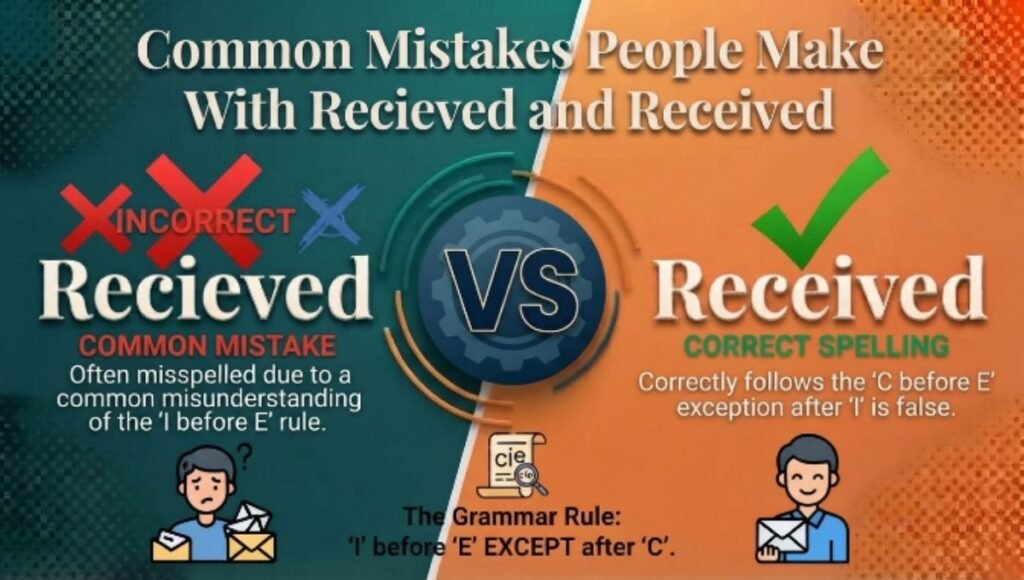
Incorrect: I recieved your email yesterday. Correct: I received your email yesterday. This is the single most common version of the mistake, caused by misapplying the “i before e” rule to a word that actually follows the “except after c” part of it.
Incorrect: Have you recieved the package yet? Correct: Have you received the package yet? The same rule applies here: the “c” before the vowel pair always calls for “ei,” never “ie.”
Incorrect: She recieves dozens of messages a day. Correct: She receives dozens of messages a day. Even in the present tense form “receives,” the same “ei after c” spelling pattern still applies.
These mistakes are extremely common, even among confident writers, since autocorrect doesn’t always catch every instance, and the rule feels counterintuitive at first glance.
Related Words and Terms
A few related words follow the exact same “i before e, except after c” pattern as recieved or received:
- Receipt: a noun describing proof of a transaction, also spelled with “ei” after “c”
- Deceive: a similar verb following the same “c” plus “ei” pattern
- Perceive: another common verb that follows this exact spelling rule
- Conceive: a related word also spelled with “ei” after “c”
- Believe: a helpful contrast, since it uses “ie” because there’s no “c” before it
Practical Guidance for Avoiding This Mistake
Before sending an email, submitting an assignment, or publishing any piece of writing, run a quick mental check: does the word contain a “c” right before the “ie” or “ei” combination? If so, the correct order is almost always “ei,” as in “received,” “receipt,” and “perceive.” This one habit prevents the recieved or received mistake from ever reaching a reader.
Frequently Asked Questions
Is “recieved” ever correct?
No. “Recieved” is always a misspelling. The only correct spelling is “received.”
What does “received” mean?
“Received” means to have gotten, accepted, or taken delivery of something, whether that’s an item, a message, or information.
How do I use “received” in a sentence?
Use it as a past tense or past participle verb, for example: “We received your application and will follow up within a week.”
Why do so many people misspell “received” as “recieved”?
The mistake usually comes from misapplying the “i before e” rule without remembering the “except after c” part, which is exactly the rule this word follows.
Is there a trick to remembering the correct spelling?
Yes. Remember that “receive” has a “c” right before the vowel pair, which means the correct order is “ei,” not “ie.”
Conclusion
The debate over recieved or received has a simple, permanent answer: “received” is correct, and “recieved” is always a misspelling with no legitimate use. Remember the “i before e, except after c” rule, and this common typing mistake will stop showing up in your writing for good.











1 thought on “Recieved or Received: The 2026 Guide to the Correct Spelling”