
Trying to figure out signup or sign up? Both spellings are correct, which is exactly why so many writers get stuck. The quick answer: “sign up” is the verb form, used for the action of registering, while “signup” is the noun or adjective form, used for the thing itself, like a signup form or a signup process. Once you know which job each form does, the signup or sign up choice becomes automatic.
The Quick Answer: Signup or Sign Up?
Both “signup” and “sign up” are correct English, but they are not interchangeable. “Sign up” (two words) is a phrasal verb, meaning to register or enroll for something. “Signup” (one word) is a noun or adjective, referring to the act of registering, a form used for registering, or a related process. Choosing the right one depends entirely on the word’s job in the sentence.
Why Signup and Sign Up Get Mixed Up So Easily
The signup or sign up confusion happens because English regularly turns two word phrasal verbs into single word nouns, and there’s no visual difference beyond the space. “Log in” becomes “login,” “check out” becomes “checkout,” and “sign up” becomes “signup” in exactly the same way. Readers see both spellings used constantly online, often inconsistently, which makes the correct pattern harder to spot.
What “Sign Up” Means
“Sign up” is a verb phrase made of two separate words: “sign” and “up.” It describes the action of registering, enrolling, or agreeing to participate in something. Because it’s a verb, it needs a subject performing the action, as in “I need to sign up for the newsletter” or “She signed up for the marathon last week.”
What “Signup” Means
“Signup” is a single word functioning as a noun or an adjective. As a noun, it refers to the act of registering or the event of registration, as in “the signup takes less than a minute.” As an adjective, it describes something related to registration, as in “signup form” or “signup page.” “Signup” never functions as a verb on its own.
Signup vs Sign Up: The Grammar Rule Behind the Difference
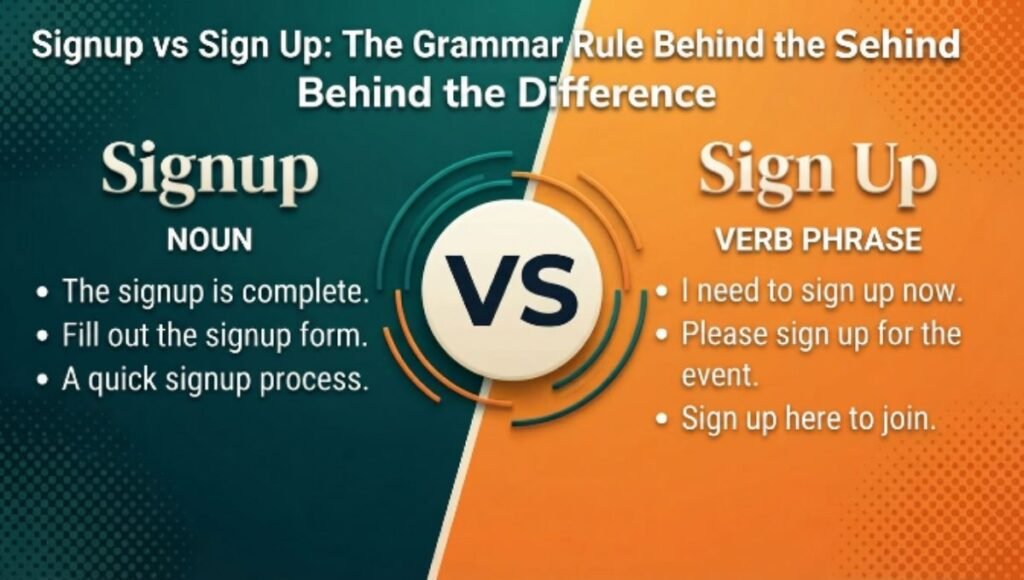
The rule is simple once you see the pattern. If the word is doing an action, use the two word verb “sign up.” If the word is naming a thing, a form, a page, or a process, use the one word noun or adjective “signup.”
A quick test: try replacing the word with another verb, like “register.” If “register” fits the sentence naturally, use “sign up.” If “register” sounds wrong but a noun like “registration” fits instead, use “signup.”
Where This Pattern Comes From
This split between a two word verb phrase and a compressed one word noun is common in English and has grown more common with digital and business language. “Sign up” existed first as a standard phrasal verb, and “signup” developed later as English speakers needed a compact noun to describe forms, buttons, and processes tied to that action, following the same pattern as “backup,” “checkup,” and “makeup.”
More related Post : Principal or Principle: The 2026 Guide to Using Each Word Correctly https://feastinsidar.com/principal-or-principle/
How to Pronounce Signup and Sign Up
Both forms are pronounced the same way out loud: “sign” followed by “up,” with slightly more stress on “sign.” Spoken English doesn’t distinguish between the noun and verb forms, so the difference only matters in writing, which is exactly why the signup or sign up question shows up in search far more often than in conversation.
Signup or Sign Up: Comparison Table
| Term | Part of Speech | Meaning | Use |
| Sign up | Verb (phrasal) | To register or enroll for something | “Please sign up for the webinar.” |
| Signup | Noun or adjective | The act of registering, or something related to registration | “The signup only takes a minute.” / “signup form” |
How to Choose the Right Form in Your Own Writing
When choosing between these two forms, look at what comes right before the word. If a subject is performing an action (“I,” “she,” “they,” “please”), the sentence needs the verb “sign up.” If the word follows “the,” “a,” or an adjective slot, the sentence needs the noun or adjective “signup.”
Real Life Examples in Different Contexts
Everyday conversation: “Did you sign up for the gym membership yet?”
Workplace communication: “The signup deadline for the training session is Friday at noon.”
Academic writing: “Students must sign up for lab sections through the university portal.”
Email: “Thanks for your interest. Please complete the signup form attached to this email.”
Business writing: “Our signup process was redesigned last quarter to reduce drop off rates.”
Formal writing: “Participants are required to sign up in advance to secure a seat.”
Casual writing: “Signup was so easy, it took like two minutes tops.”
Each example works because the sentence structure signals whether an action or a thing is being described.
Common Mistakes People Make With Signup and Sign Up
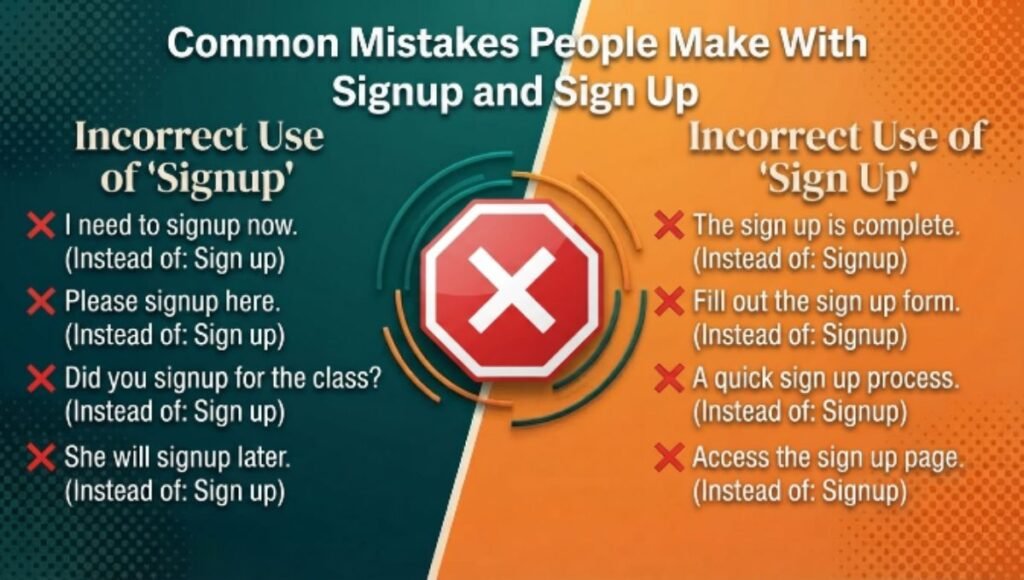
Incorrect: Please signup for the newsletter below. Correct: Please sign up for the newsletter below. This is the most frequent mistake, since “please” signals an action, which needs the two word verb “sign up,” not the one word noun.
Incorrect: Click here to complete your sign up. Correct: Click here to complete your signup. Here, “your” is followed by a thing being completed, which calls for the noun “signup,” not the verb phrase.
Incorrect: The sign-up process is fast, but you have to signup online first. Correct: The signup process is fast, but you have to sign up online first. Mixing both forms in one sentence usually means the writer hasn’t identified which word is acting as a noun and which is acting as a verb.
These mix ups are extremely common, especially in marketing and web copy, since both forms appear constantly across different websites with inconsistent use.
Related Words and Terms
A few related word pairs follow the exact same pattern as signup or sign up:
- Login and log in: “login” is the noun, “log in” is the verb
- Checkout and check out: “checkout” is the noun, “check out” is the verb
- Setup and set up: “setup” is the noun, “set up” is the verb
- Backup and back up: “backup” is the noun, “back up” is the verb
- Workout and work out: “workout” is the noun, “work out” is the verb
Recognizing this pattern makes it much easier to get similar word pairs right in the future.
Practical Guidance for Avoiding This Mistake
Before publishing any sentence with this word, ask one question: is something happening, or is something being named? If an action is happening, use two words, “sign up.” If a thing is being named, whether it’s a form, a page, a process, or an event, use one word, “signup.” This quick check works for every version of this word pair, every time.
Frequently Asked Questions
Is it “signup” or “sign up” on a website button?
Button text depends on grammar, not preference. A button that triggers the action, like “Sign Up Now,” should use two words. A label describing a page or process, like “Signup Page,” should use one word.
What does “signup” mean as a noun?
“Signup” as a noun refers to the act of registering or the form, page, or process used to complete that registration.
How do I use “sign up” in a sentence?
Use “sign up” as a verb describing the action of registering, for example: “You can sign up for the course anytime before Friday.”
Why do so many websites get signup or sign up wrong?
Marketing and web copy is often written quickly, and since both spellings sound identical out loud, the grammatical distinction is easy to overlook during editing.
Is “sign-up” with a hyphen also correct?
“Sign-up” with a hyphen is sometimes used as an adjective in place of “signup,” though “signup” without a hyphen is now the more common and widely accepted style in American English.
Conclusion
The choice between signup or sign up comes down to one clear rule: use the two word verb “sign up” for the action of registering, and use the one word noun or adjective “signup” for the form, page, or process itself. Run the quick action versus thing test before you publish, and this word pair will never trip you up again.











1 thought on “Signup or Sign Up: The 2026 Guide to Using Each Form Correctly”