Is it bingeing or binging when you’re talking about a weekend TV marathon? Both spellings look slightly off, and that is why writers stall mid-sentence. The confusion comes from two competing rules for verbs that end in silent e. The answer is simple: both are correct, and US dictionaries list them together. Whether you write bingeing or binging, choose one and keep it consistent.
What Is the Correct Spelling: Bingeing or Binging?
Both spellings are correct. “Bingeing” keeps the silent e from the verb “binge,” and “binging” drops it. The meaning, pronunciation, and grammar are identical.
Major US dictionaries list “binged” as the past tense and accept both “bingeing” and “binging” for the -ing form. Neither one is a typo, and neither is a British-only variant.
So if a spellchecker or a teacher flags one of them, you can politely stand your ground. The only real rule is consistency.
What Does Binge Mean?
“Binge” works as both a verb and a noun. As a verb, it means to do something to excess in a short period, usually eating, drinking, or (more recently) watching television. As a noun, a binge is one of those episodes.
The -ing form can play three roles depending on the sentence:
- Verb: They are bingeing the whole season tonight.
- Noun (gerund): Binging is easy when the next episode starts automatically.
- Adjective: Her binging habit wrecked her sleep schedule.
The tone shifts with context. In health settings, as in “binge eating” or “binge drinking,” the word is serious. In entertainment, it is casual and often playful.
Is There Any Difference Between the Two Spellings?
No. There is no difference in meaning, formality, or sound. In the choice between bingeing or binging, you are only deciding how the word looks on the page.
Neither spelling is more formal than the other, and neither is slang. Some writers like “bingeing” because the visible e shows care. Others prefer “binging” because it looks cleaner. Those are preferences, not rules.
The only truly incorrect forms are things like “bingeed” or “binge-ing,” which we will cover in the mistakes section.
Why Does English Allow Two Spellings?
Two spelling patterns compete here.
The standard rule says to drop the silent e before adding -ing. That gives us make → making, hope → hoping, and love → loving. Under this rule, binge becomes “binging.”
The second pattern keeps the e when dropping it could cause confusion. Think of “singeing” (so it does not look like “singing”) and “dyeing” (so it does not look like “dying”). Under this pattern, binge becomes “bingeing.”
There is also a pronunciation argument. “Binging” can tempt a reader to say BING-ing, like “ringing.” The extra e signals the soft j sound. Similar verbs such as “tinge” can go either way, which is why bingeing or binging both survived in modern usage.
How Do You Pronounce Binge and Its Forms?
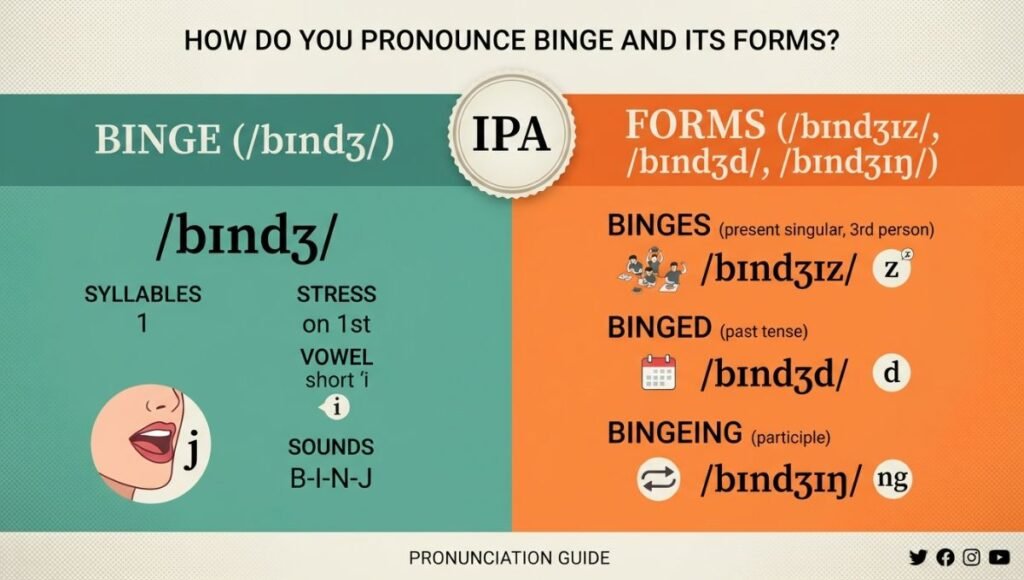
“Binge” rhymes with “hinge” and is pronounced BINJ. Add -ing and you get BIN-jing (/ˈbɪndʒɪŋ/). It rhymes with “cringing” and “fringing.”
Both spellings sound exactly the same. The one common slip is reading “binging” as BING-ing, which would sound like the search engine’s name. If your readers might do that, the spelling with the e can help.
Where Does the Word Binge Come From?
The word appeared in English dialects in the 1800s with the sense of soaking or drinking heavily. Its deeper origin is unclear, so it is best not to claim more than that.
The meaning then widened to any excessive indulgence, including eating. The television sense grew with streaming services. Collins Dictionary named “binge-watch” its Word of the Year for 2015, which shows how quickly the usage took hold.
More related Post: Explicit vs Implicit: 2 Meanings, 1 Simple Test, and 8 Examples https://feastinsidar.com/explicit-vs-implicit/
Bingeing or Binging at a Glance
Here is how each form works:
| Form | Correct? | Meaning | Use |
| bingeing | Yes | Present participle, keeps the silent e | Verb, noun, or adjective use |
| binging | Yes | Present participle, drops the silent e | Same uses, same meaning |
| binged | Yes | Past tense and past participle | Completed actions |
| binges | Yes | Third person singular or plural noun | She binges on weekends |
| bingeed | No | Not a word | Avoid |
The takeaway: the -ing spelling is your choice, but the past tense is always “binged.”
How Do You Use Bingeing and Binging in Sentences?
Here are natural examples across different contexts.
Everyday conversation: “We spent the whole weekend bingeing a crime series.”
Casual writing: “No binging snacks tonight. I mean it this time.”
Workplace communication: “Viewers are binging entire seasons in a single weekend, so we should plan releases accordingly.”
Email: “Sorry for the late reply. I was binging the last season of that show and lost track of time.”
Academic writing: “Researchers examined how bingeing on streaming content affects sleep habits.”
Formal or business writing: “The service designs its release schedule to encourage bingeing.”
Notice that any of these sentences works with either spelling. The academic example uses “bingeing on” as a gerund, meaning the activity itself is the subject of study. The business example works the same way: “bingeing” is a noun naming the behavior.
What Mistakes Do People Make With Binge Forms?
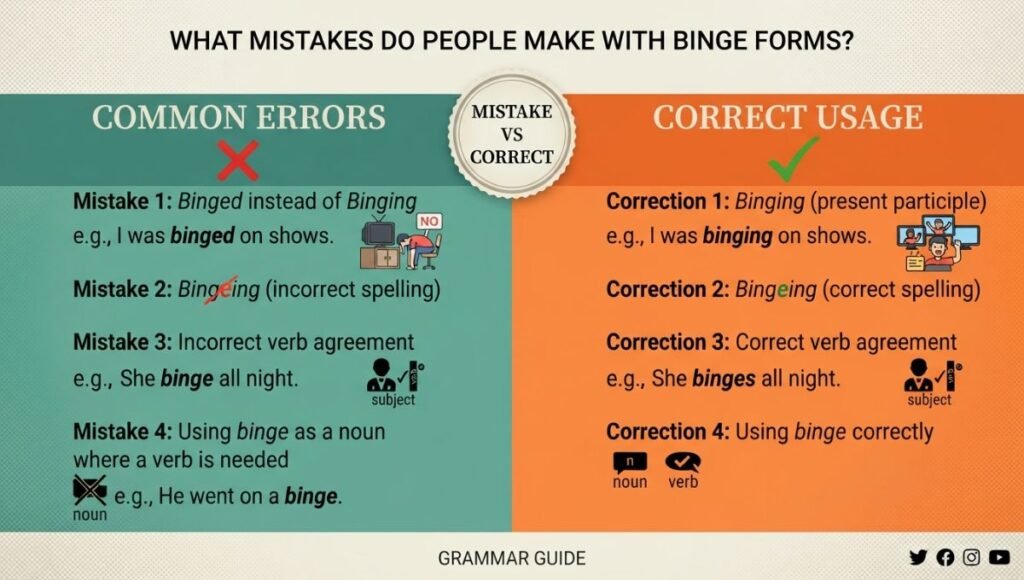
These slips are normal, and each has a quick fix.
Incorrect: I binge the whole series last weekend.
Correct: I binged the whole series last weekend.
The action is finished, so the verb needs the past tense ending.
Incorrect: They bingeed on snacks all night.
Correct: They binged on snacks all night.
The word already ends in e, so you only add d.
Incorrect: I’m binge-ing cartoons today.
Correct: I’m bingeing cartoons today.
Never hyphenate the ending. The suffix attaches directly to the word.
Inconsistent: She was bingeing on Friday and binging again on Sunday.
Consistent: She was bingeing on Friday and bingeing again on Sunday.
Both spellings are fine, but mixing bingeing or binging inside one document looks careless.
What Other Forms of Binge Should You Know?
Here are the related forms and terms you are likely to meet:
- Verb forms: binge, binges, binged, bingeing or binging
- Noun: binge (as in “a weekend binge”), and the less common “binger” for a person who binges
- Compounds: binge-watch, binge-watching, binge-watched, binge-eating, binge drinking, binge-worthy
- Synonyms: overindulge, gorge, splurge, marathon (as in “marathon viewing”)
- Antonyms: abstain, ration, pace oneself
Most US dictionaries hyphenate “binge-watch,” so the forms are “binge-watching” and “binge-watched.”
Which Spelling Should You Choose?
Use this short decision guide:
- Follow the style guide if your publisher, school, or employer has one.
- Otherwise, pick the version you prefer and use it throughout.
- Use “binged” for the past tense, always.
British dictionaries also accept both forms, so there is no American versus British split to worry about. If you write for a mixed audience, the question of bingeing or binging is simply about consistency, not correctness.
A helpful habit: use your editor’s search function to check that only one spelling appears before you publish.
Frequently asked question
Is “bingeing” spelled with an e?
Yes. “Bingeing” keeps the e, and “binging” drops it. Both are accepted spellings of the same word.
Is “binging” a real word?
Yes. “Binging” is a standard spelling of the present participle of “binge.” It appears in major dictionaries alongside “bingeing.”
What is the past tense of binge?
The past tense is binged. Example: “We binged three episodes before midnight.”
Can I use either spelling in formal writing?
Yes. Neither spelling is informal. The word itself can sound casual when used for TV, but the spelling has no effect on formality.
The One Rule to Remember
Bingeing or binging? Both are correct, so pick one and stay with it throughout your writing. Remember that the past tense is always “binged,” and the -ing spelling is simply a matter of style.









1 thought on “Bingeing or Binging: 2 Correct Spellings and 1 Simple Rule”