
Fetus vs foetus looks like a big difference, but it is only a spelling difference. Both words mean the same thing: an unborn offspring in the later stages of development. Fetus is the standard American spelling, while foetus is the traditional British one. The split exists because American English simplified many “oe” words. Read on to see which form fits your audience in the fetus vs foetus question.
Fetus vs Foetus: Which Spelling Is Correct?
Both spellings are correct. Fetus is the standard spelling in American English and is widely used in international scientific writing. Foetus is a traditional British spelling that you will still see in UK books, newspapers, and older texts.
If you write for a US audience, use fetus. If you write for a British audience that follows traditional UK spelling, foetus is acceptable. Whichever you choose, stay consistent from the first sentence to the last.
What Does Fetus Mean?
A fetus is the developing offspring of a mammal in the stage after the embryo and before birth. In humans, the term is generally used from about eight weeks after conception until birth.
The word is a noun, and it applies to other mammals too. A veterinarian may speak of a fetus in a pregnant dog, cow, or horse. Foetus has exactly the same meaning, so switching spellings never changes the definition.
What Is the Difference Between Fetus and Foetus?
There is no difference in meaning, pronunciation, or grammar. The only difference is spelling and regional preference. This table sums up fetus vs foetus and the related forms:
| Term | Correct? | Meaning | Use |
| fetus | Yes | Unborn offspring after the embryo stage | Standard in American English and common in scientific writing |
| foetus | Yes | Same meaning as fetus | Traditional British spelling |
| fetal | Yes | Adjective: relating to a fetus | American spelling |
| foetal | Yes | Adjective: relating to a foetus | Traditional British spelling |
| fetuses / foetuses | Yes | Plural forms | Follow whichever spelling you chose |
Does either form have a special legal or medical meaning that the other lacks? No. Any difference you may notice comes from the writer’s region or the publication’s style guide, not from the word itself.
How Do You Pronounce Fetus and Foetus?
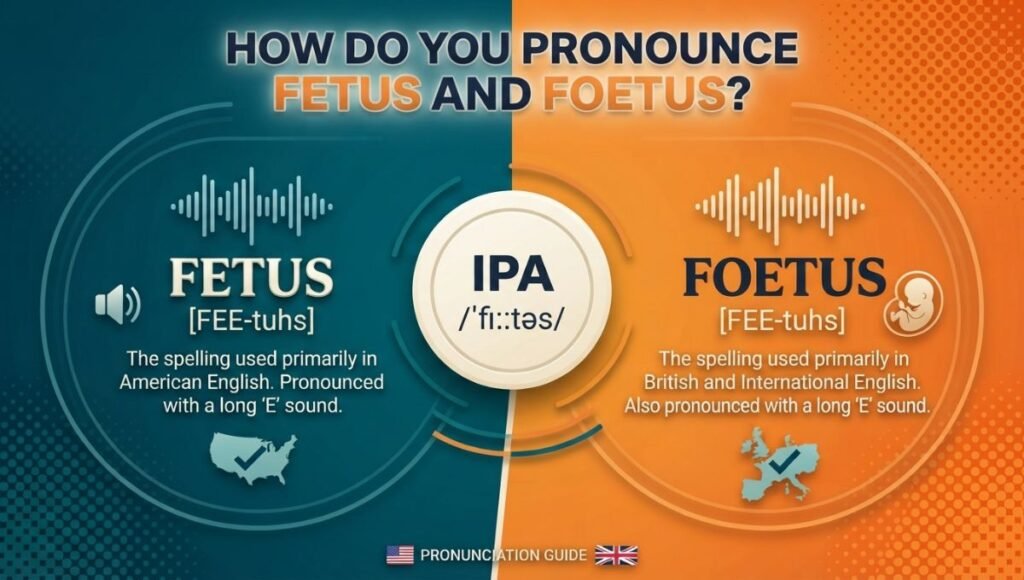
Both spellings are pronounced the same way: FEE-tus (/ˈfiːtəs/). The “oe” in foetus does not create a different sound, and no one says “foy-tus” in standard English.
The pronunciation is the same for the adjective forms: fetal and foetal are both said as FEE-tul. Because the sound never changes, this is purely a spelling issue. That is why the confusion appears only in writing and never in conversation.
More related Post : Box vs Boxes: Meaning, Difference, and 10 Clear Examples https://feastinsidar.com/box-vs-boxes/
Why Do American and British English Spell It Differently?
American English simplified many words that British English spells with “oe” or “ae.” This pattern is a big part of the fetus vs foetus split, and it appears across many everyday and medical terms:
- anemia (US) and anaemia (UK)
- esophagus (US) and oesophagus (UK)
- pediatric (US) and paediatric (UK)
- hemoglobin (US) and haemoglobin (UK)
- estrogen (US) and oestrogen (UK)
- diarrhea (US) and diarrhoea (UK)
The pattern is consistent: American spelling drops the extra vowel, and traditional British spelling keeps it. Fetus and foetus follow the same rule.
British usage is not uniform. Everyday British writing often keeps foetus, but many modern medical and scientific publications, including UK ones, use fetus and fetal. Writers in other English-speaking countries vary, so check the style guide for your publication.
Where Does the Word Fetus Come From?
Fetus comes from a Latin word meaning offspring, or the bearing and bringing forth of young. The classical Latin spelling was fetus. The “oe” form appeared later in Latin manuscripts and then carried over into English.
The same Latin root also gave English words such as fecund (fertile) and fecundity. That family resemblance is a useful clue: these words are spelled with a plain “e,” and so is the original form of fetus.
Do not confuse fetus with fetid (smelly). The two words look alike but have different Latin origins and meanings. Interestingly, British English also has the variant spelling foetid for fetid, so the same “oe” habit shows up there too.
What Are the Grammar Forms of Fetus (Plural, Adjective)?
Fetus is a countable noun. Its forms are simple:
- Singular: fetus (or foetus)
- Plural: fetuses (or foetuses)
- Adjective: fetal (or foetal)
Use “fetuses,” not a Latin-style plural like “feti.” Standard English adds -es to words ending in -s, just as with “bonus” and “bonuses.”
The adjective is very common in medical and health writing. Typical phrases include fetal development, fetal heartbeat, fetal growth, fetal position, and fetal alcohol syndrome. British writers often write foetal in the same phrases.
Fetus has no verb form and no adverb form. If you need a verb, you would use ones like “develop,” “grow,” or “carry” in the sentence around it.
How Do You Use Fetus and Foetus in a Sentence?
Here are natural examples for different contexts:
- Everyday conversation: “The ultrasound showed the fetus was growing right on schedule.”
- Workplace: “Our clinic offers prenatal classes that explain fetal development week by week.”
- Email: “Please review the attached guide on fetal health screening before Thursday’s meeting.”
- Academic writing: “The study measured how maternal stress affects fetal brain development in mice.”
- Veterinary writing: “The vet confirmed that each fetus in the litter was healthy.”
- British writing: “The midwife explained how the foetus moves during the third trimester.”
Why does the academic example say “fetal brain development”? Because “fetal” is the adjective form. It describes the noun “brain development,” while “fetus” is the noun itself. In the British example, “foetus” is correct because the sentence follows traditional UK spelling.
What Are Common Mistakes With Fetus and Foetus?
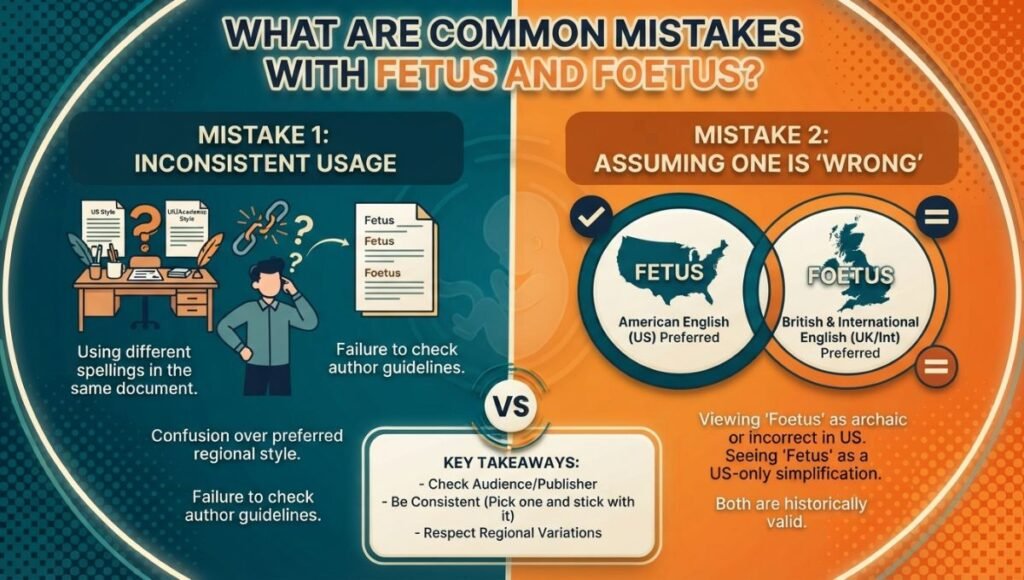
Most problems here are not spelling errors. They are inconsistencies or word choice issues, and they are easy to fix. Even experienced writers slip on fetus vs foetus when they copy text from different sources.
Mistake 1: Mixing spellings in the same document
Inconsistent: The foetus grows quickly, and fetal movement begins early.
Consistent: The fetus grows quickly, and fetal movement begins early.
Pick one spelling system and apply it to every related form.
Mistake 2: Using British spelling for a US audience
Less suitable: Doctors monitored the foetal heart rate.
Better: Doctors monitored the fetal heart rate.
Foetal is not wrong, but American readers and US style guides expect fetal.
Mistake 3: Using an invented plural
Incorrect: The scan showed three feti.
Correct: The scan showed three fetuses.
Standard English plural rules apply here.
Mistake 4: Misspelling the word
Incorrect: fetis, feotus, or foetis
Correct: fetus (or foetus)
Double-check the vowels, since this word has an unusual spelling in both versions.
Mistake 5: Using fetus for the wrong stage
Less precise: The embryo is fully formed and moves around in the womb.
More precise: The fetus is fully formed and moves around in the womb.
Fetus refers to a later stage of development than embryo.
What Is the Difference Between a Fetus, an Embryo, and a Baby?
These words describe different stages, and each has its own use:
- Embryo: the earliest stage of development, before the fetal stage begins.
- Fetus (or foetus): the stage from about eight weeks after conception until birth.
- Baby: the everyday word for an unborn or newborn child, used in casual writing and conversation.
- Newborn or infant: terms for a child after birth.
Related terms you may see include prenatal (before birth), antenatal (the British equivalent), gestation (the period of development in the womb), and trimester. Use “fetus” in medical, scientific, and formal contexts. In casual or emotional contexts, most people simply say “baby.”
How Can You Remember Fetus vs Foetus?
Here are some simple memory tricks:
- Think “simpler is American.” American English tends to drop extra vowels, so the shorter fetus is the US choice.
- Link it with other “oe” words. If you spell “anemia” without the extra vowel, do the same with “fetus.”
- Match your audience. Writing for a US readership means fetus, and writing for a traditional UK readership means foetus is fine.
- Search your document before publishing. A quick find-and-replace helps you catch fetus, foetus, fetal, and foetal in the same file.
Frequently Asked Questions About Fetus and Foetus
Is fetus vs foetus a spelling difference or a meaning difference?
It is only a spelling difference. Both words mean the same thing, and both are pronounced FEE-tus.
Is foetus a wrong spelling?
No. Foetus is a traditional British spelling. It is not an error, though fetus is standard in American English and common in international scientific writing.
What is the plural of fetus?
The plural is fetuses. In traditional British spelling, it is foetuses.
Which spelling should I use in academic or medical writing?
Follow the style guide of your school or publication. In American writing, use fetus and fetal. Many international journals also prefer these forms, even in the UK.
Which Spelling Should You Use?
The fetus vs foetus question has a simple answer: both spellings are correct, and both mean the same thing. Use fetus for American English and most scientific writing. Use foetus only when a traditional British style requires it.











1 thought on “Fetus vs Foetus: What’s the Difference? A 2-Minute Guide”