You are typing a sentence, you get to that word, and suddenly you cannot remember if it is “to” or “too.” You are not alone. The to badly or too badly question trips up even confident writers, because both spellings are real words that sound identical out loud. Here is the short answer: it depends on what the word is doing in your sentence, and both forms can be correct.
To Badly or Too Badly: The Quick Answer
“Too badly” means “excessively bad” or “excessively poorly,” while “to badly” is part of an infinitive phrase where “badly” describes the verb that follows “to.”
For example: “I don’t want to mess this up too badly” uses “too” as an intensifier. But “He wanted to badly injure his opponent” uses “to” as part of the infinitive “to injure,” with “badly” simply describing how. Neither one is automatically wrong. The choice between to badly or too badly comes down to what role the word is playing.
Why This Mix-Up Happens So Often
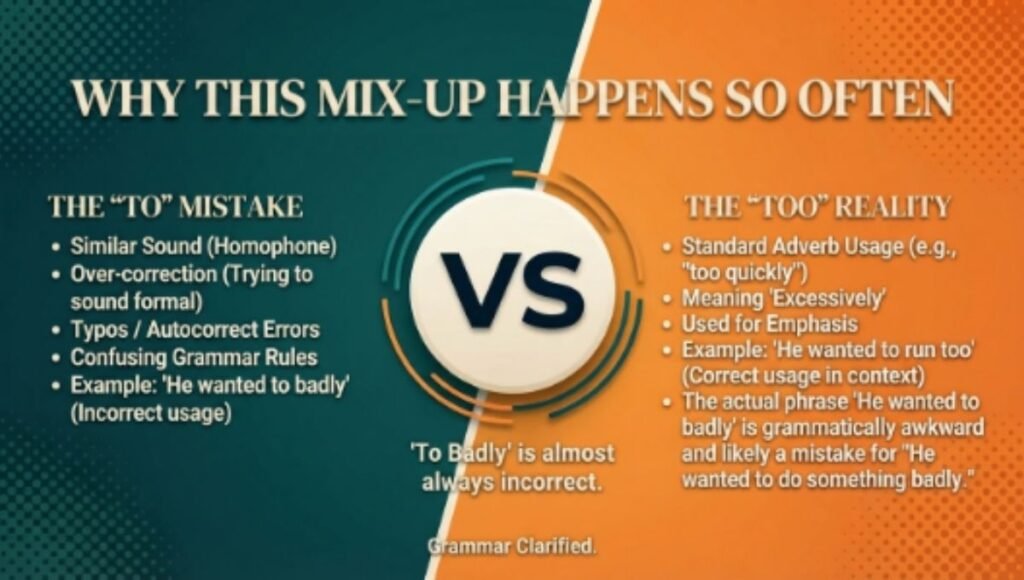
“To” and “too” are homophones, meaning they sound exactly the same when spoken. Since English relies heavily on spelling to carry meaning in writing, this creates constant confusion. Add the word “badly” right after either one, and it becomes even harder to catch the mistake while typing quickly.
What “Too” Actually Means
“Too” is an adverb that means “excessively,” “also,” or “as well.” When paired with another adverb like “badly,” it intensifies that word. “Too badly” describes something done in a way that goes beyond a reasonable or acceptable degree.
Example: “The team played too badly to win the game.” Here, “too” is boosting “badly,” suggesting the poor performance went beyond what was acceptable.
What “To” Actually Means
“To” is a preposition, and it also functions as the marker that begins an infinitive verb form, such as “to run,” “to think,” or “to injure.” When “badly” follows “to” in this structure, it is not modifying “to” at all. It is modifying the verb that comes right after.
Example: “She tried not to badly overreact.” Here, “to overreact” is the infinitive, and “badly” describes how the overreacting might happen.
More related Post : Puting vs Putting: 3 Rules That Settle the Spelling for Good https://feastinsidar.com/puting-vs-putting/
Is “To Badly” Ever Correct?
Yes. “To badly” is grammatically legitimate whenever “badly” sits between the infinitive marker “to” and a verb, forming what grammarians call a split infinitive. Some traditional style guides discourage splitting infinitives in very formal writing, but modern usage accepts it, especially when it sounds more natural than the alternative.
Example: “I need to badly want this before I commit.” Rewriting it as “I need to want this badly” is also correct, but slightly less direct in tone.
Is “Too Badly” Ever Correct?
Yes, and this is actually the more common of the two in everyday writing. “Too badly” is correct whenever you are describing something as excessively bad, excessively poor in quality, or excessively intense.
Example: “I hope I didn’t scare you too badly.” Here, “too” intensifies “badly,” and there is no infinitive verb involved at all.
Comparison Table: To Badly vs Too Badly
| Phrase | Correct? | Function | Example |
| too badly | Yes | Intensifies the adverb “badly” (means “excessively”) | Don’t take it too badly. |
| to badly | Yes, in context | Infinitive marker “to” plus adverb “badly” modifying a verb | He hopes to badly outperform last year’s numbers. |
| to badly (meaning “excessively”) | No | Confuses “to” with the intensifier “too” | Incorrect: I don’t want to hurt you to badly. |
Grammar Breakdown: Adverbs, Infinitives, and Intensifiers
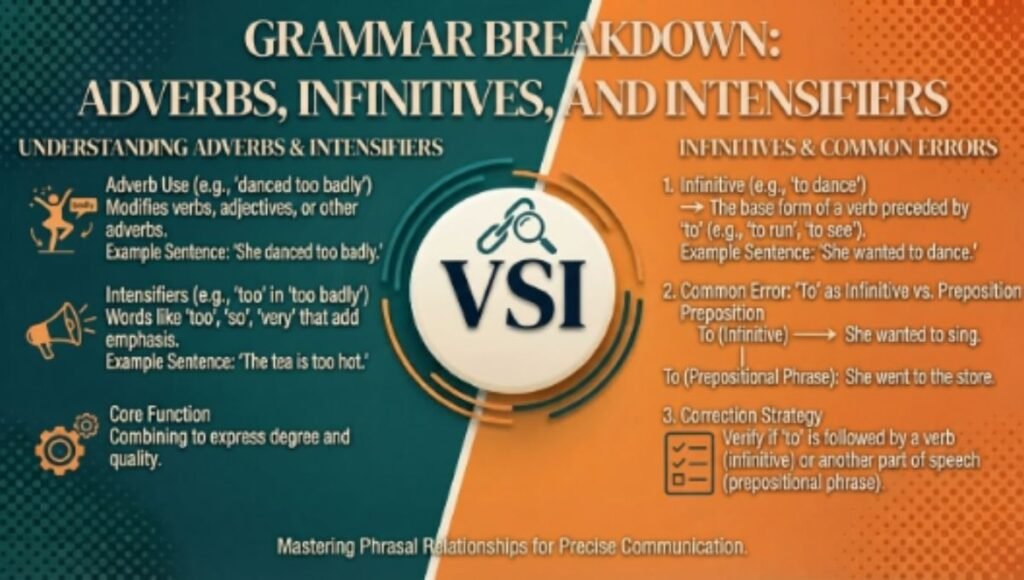
Both “to” and “too” can sit next to “badly,” but they belong to different grammar categories. “Too” is always an adverb of degree. “To” is either a preposition or the infinitive marker attached to a verb. Understanding which job the word is doing in your sentence is the fastest way to pick the right spelling.
A simple test: if you can replace the word with “very” or “extremely” and the sentence still makes sense, you need “too.” If the word is followed by a verb and the sentence describes an action someone is trying to do, you likely need “to.”
Pronunciation: Do “To” and “Too” Sound the Same?
Yes, “to” and “too” are pronounced identically as /tuː/. This is exactly why the mistake is so common in writing but never noticeable in speech. Native speakers rely entirely on context and spelling conventions to keep the two straight on the page.
“To Badly” and “Too Badly” in Real Sentences
Everyday conversation: “I didn’t want to upset her too badly.”
Workplace communication: “The client wants us to badly beat last quarter’s targets.”
Academic writing: “The study aimed to badly disrupt the control group’s usual routine, in order to measure resilience.”
Email: “Please don’t take this feedback too badly, it’s meant to help.”
Formal writing: “The proposal failed too badly to be reconsidered this cycle.”
Each example shows how to badly or too badly depends entirely on sentence structure rather than personal preference.
Common Mistakes With To Badly or Too Badly
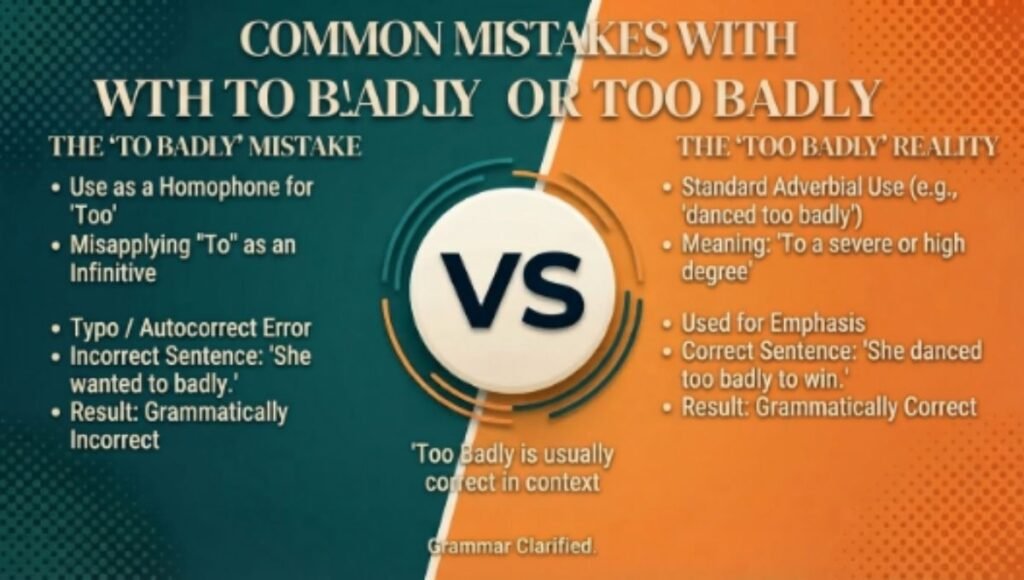
Incorrect: I don’t want to fail to badly. Correct: I don’t want to fail too badly. Here, “too” intensifies “badly,” describing the degree of failure, so “to” is the wrong choice.
Incorrect: She wants too badly injure her rival in the debate. Correct: She wants to badly injure her rival in the debate. Since “injure” is the verb being modified, this needs the infinitive marker “to,” not the intensifier “too.”
Incorrect: He played to badly to make the team. Correct: He played too badly to make the team. “Badly” here describes the quality of his playing, which calls for the intensifier “too.”
Related Words and Phrases
Several related terms often show up alongside this confusion:
- Very badly (a simpler intensifier alternative to “too badly”)
- Too much (a related “too” construction)
- To try, to want, to need (common infinitives paired with “badly”)
- Excessively (a formal synonym for “too” in this context)
- Poorly (a close synonym for “badly”)
Practical Tips to Never Mix Them Up Again
A quick trick: read the sentence aloud and mentally swap in “very.” If “very badly” makes sense, you need “too badly.” If it sounds strange, check whether a verb follows the word, since that usually signals the infinitive “to badly” instead.
Another tip: count the O’s. “Too” has two O’s, just like the word “extra,” which can help you remember that “too” means “extra” or “excessive.”
Frequently Asked Questions
Is it “to badly” or “too badly”?
Both can be correct depending on the sentence. Use “too badly” when describing something as excessively bad, and use “to badly” when “badly” is modifying a verb right after the infinitive marker “to.”
What does “too badly” mean?
“Too badly” means “excessively poorly” or “to an unacceptable degree,” as in “I don’t want to disappoint him too badly.”
Is “to badly” a grammar mistake?
Not on its own. “To badly” is only a mistake when it is used in place of the intensifier “too,” such as writing “he failed to badly” instead of “he failed too badly.”
How can I tell which one to use in a sentence?
Check what comes after the word. If a verb follows, like “injure” or “want,” you likely need “to badly.” If nothing but the sentence’s ending follows, or the meaning is “excessively,” you need “too badly.”
Are “to” and “too” pronounced differently?
No. Both are pronounced the same way, which is exactly why this mix-up is so common in writing.
Conclusion
The debate over to badly or too badly is not really about right versus wrong. It is about recognizing whether “badly” is intensified by “too” or attached to a verb through the infinitive “to.” Once you spot which job the sentence needs, the correct choice becomes automatic.