Sending a quick text or writing a farewell line, and now you’re second-guessing goodnight or good night? This mix-up is common because both spellings are actually correct, just not interchangeable in every situation. Quick answer: good night (two words) is the standard farewell interjection, while goodnight (one word) works as an informal variant and as an adjective before a noun. Once you see the pattern, deciding between goodnight or good night takes about ten seconds.
Quick Answer: Which Spelling Is Correct?
Both spellings are legitimate, but they serve different roles.
Good night, written as two words, is the traditional, standard spelling used when you’re saying farewell at the end of the evening: “Good night, see you tomorrow.”
Goodnight, written as one word, is a more informal variant of that same farewell, common in texting and casual writing. It’s also the correct spelling when the word functions as an adjective describing a noun, such as “goodnight kiss.”
Why Does This Confusion Happen?
The confusion around goodnight or good night comes from a broader pattern in English: some greeting phrases stay as two separate words forever, while others gradually merge into one.
“Good morning” and “good afternoon” have never merged into single words, and most style guides don’t expect them to. “Good night” is a little different, since the closed, one-word spelling has picked up enough informal use over recent decades that it now shows up constantly in texts, emails, and casual writing, even though the traditional two-word form remains the formal standard.
Good Night: The Standard Interjection
As an interjection, “good night” is what you say when parting ways in the evening or right before sleep. It functions similarly to “goodbye,” except it’s tied specifically to nighttime or bedtime.
- Good night, Mom. I’ll see you in the morning.
- It was wonderful catching up. Good night!
- Good night, everyone. Thanks for coming.
This two-word form is what you’ll find as the primary, recommended spelling in traditional style guides, including references like The Chicago Manual of Style.
Goodnight: The Informal Variant and the Adjective Form
Goodnight, as one word, shows up in two main situations.
First, it’s an increasingly common informal alternative to the two-word farewell, especially in texting, social media, and casual conversation: “Goodnight, talk tomorrow.”
Second, and more importantly for correct grammar, it’s the required spelling when the word functions as an adjective directly before a noun.
- I gave her a goodnight kiss before she went to bed.
- He sang a goodnight lullaby to the baby.
- She sent a sweet goodnight message before logging off.
In each of these examples, “goodnight” is describing the noun that follows it (kiss, lullaby, message), which is a different grammatical job than simply saying farewell.
Goodnight or Good Night: The Core Grammar Rule
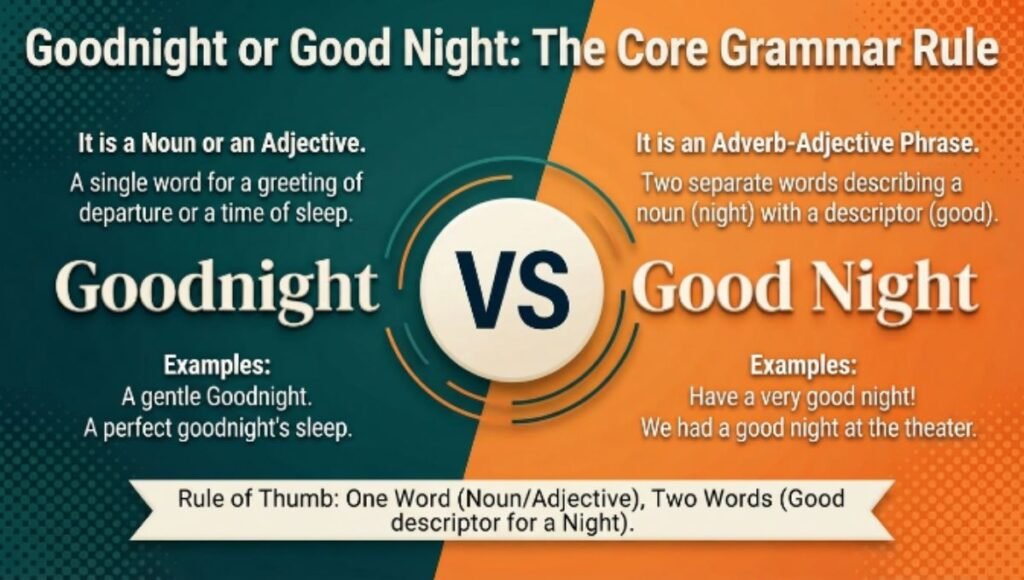
Here’s the rule that resolves most of this confusion in a single sentence: use two words when you’re saying farewell as an interjection, and use one word when you’re describing a noun as an adjective.
A simple test: if you can replace the phrase with “goodbye” and the sentence still makes sense, use two words. If the word is sitting directly in front of a noun, describing it, use one word.
More related Post: Woah or Whoa: The Correct Spelling and 5 Rules for Using it (2026) https://feastinsidar.com/woah-or-whoa/
Grammar Notes: Parts of Speech and Usage
Both forms are relatively simple grammatically, but a few details matter.
- Good night functions as an interjection or exclamation, not a noun or verb, and doesn’t change form for tense or number.
- Goodnight functions as an adjective when placed before a noun, following normal adjective placement rules in English.
- Neither form has a plural, since interjections and this particular adjective use don’t pluralize.
- Capitalization follows normal sentence rules: capitalize the first word of a sentence or direct quotation, such as “Good night, everyone,” but don’t capitalize it mid-sentence otherwise.
A Related Phrase: “Good Night’s Sleep”
One phrase worth separating out is “a good night’s sleep,” which always uses two words plus an apostrophe. Here, “night’s” is possessive, modifying “sleep,” and this phrase is unrelated to the farewell or adjective uses covered above.
- I finally got a good night’s sleep after weeks of stress.
This construction never becomes “goodnight’s sleep” or “goodnights sleep” in standard writing.
American English vs. British English
There isn’t a sharp regional divide here the way there is with some other spelling pairs. Traditional style guides in both American and British English favor the two-word “good night” for formal writing. However, the informal one-word spelling has spread widely through digital communication in both regions, without becoming the accepted formal standard in either one.
Real-Life Examples Across Different Contexts
Everyday conversation: “Good night, drive safe!”
Text message (casual): “Goodnight! Talk to you tomorrow.”
Workplace email: “Thanks again for today’s call. Good night, and I’ll follow up in the morning.”
Children’s book or bedtime routine: “Time for your goodnight story before bed.”
Formal writing or narration: “She wished him good night and closed the door quietly.”
Social media caption: “Goodnight from this gorgeous sunset view.”
Common Mistakes Peoplec Make
Incorrect: “I gave her a good night kiss before bed.” Correct: “I gave her a goodnight kiss before bed.” Since this describes the kiss, it needs the one-word adjective form, not the two-word farewell spelling.
Incorrect: “Goodnight, Mom,” in a formal letter or professional email closing. Correct: “Good night, Mom,” using the traditional two-word spelling in formal contexts. The one-word version isn’t wrong exactly, but it reads as more casual than most formal writing calls for.
Incorrect: “I hope you have a goodnights sleep.” Correct: “I hope you have a good night’s sleep.” This phrase always uses two words with an apostrophe before the “s,” since “night’s” is possessive here.
Goodnight or Good Night: A Side-by-Side Comparison
| Form | Part of Speech | Correct Use | Register |
| Good night | Interjection | Farewell at night (“Good night, everyone”) | Formal and general use |
| Goodnight | Adjective | Describing a noun (“goodnight kiss”) | Formal and general use |
| Goodnight | Informal farewell | Casual alternative to “good night” | Texting, social media, casual speech |
Related Words and Phrases
- Good morning and good afternoon, which remain two words in virtually all writing
- Goodbye, a fully merged compound word with no two-word alternative
- Sleep tight, a related casual farewell phrase used at bedtime
- Nighty-night, an informal, affectionate variant used especially with children
A Simple Trick to Remember the Difference
If the word comes right before a noun and describes it, squeeze it into one word: goodnight kiss, goodnight story, goodnight hug. If you’re simply saying farewell on its own, keep the space: good night.
Frequently Asked Questions
Is it goodnight or good night when texting someone?
Either is acceptable in casual texting, though “good night” remains the more traditionally correct spelling. “Goodnight” is a widely used informal alternative.
Is goodnight one word in formal writing?
For the farewell itself, formal writing traditionally favors “good night” as two words. Use “goodnight” as one word only when it functions as an adjective before a noun.
What does “goodnight kiss” mean, and how is it spelled?
It refers to a kiss given before someone goes to bed, and it’s always spelled as one word, “goodnight,” since it functions as an adjective here.
Is “good night’s sleep” ever spelled as one word?
No. This phrase always uses two words plus an apostrophe: “a good night’s sleep.”
Which spelling should I default to if I’m unsure?
For a plain farewell in formal or professional writing, default to “good night.” For describing a noun, use “goodnight.”
Final Answer: Goodnight or Good Night
The debate over goodnight or good night comes down to grammar, not personal preference. Use two words for a straightforward farewell, especially in formal writing, and squeeze it into one word only when it’s describing a noun that follows it. Keep that single distinction in mind, and you’ll never second-guess goodnight or good night again.











1 thought on “Goodnight or Good Night: Stop Making This Common Mistake (2026)”