Summarize vs Summarise: which spelling is right? Both look correct, so it is easy to stall mid-sentence. The split comes from American and British spelling habits, not from meaning. Use “summarize” in American English and “summarise” in British English. For a US audience, pick -ize every time. This guide gives you the rule, the exceptions, and examples, so the Summarize vs Summarise question never slows you down again.
Summarize vs Summarise: Which Spelling Is Correct?
Both are correct. “Summarize” is the standard American spelling, and “summarise” is the standard British spelling. They mean the same thing: to give a short version of something longer.
In the United States, most spellcheckers and style guides treat “summarise” as an error. In the UK, “summarise” is the everyday choice, though some British publishers, including Oxford University Press, prefer the -ize ending.
Neither spelling is a typo. The real mistake is mixing them in the same document.
What Does Summarize Mean?
“Summarize” is a transitive verb, which means it needs an object. You summarize a book, a meeting, a study, or a long email thread. The action always answers the question “summarize what?”
Example: “Can you summarize the meeting for the people who missed it?”
The related noun is summary, and it is spelled the same in American and British English. A summary is the short version itself. So you summarize a report, and then you write a summary.
Summary also works as an adjective in phrases like “summary report,” though that use is less common.
Which Countries Use Summarize and Which Use Summarise?
The Summarize vs Summarise divide follows regional spelling habits:
- United States: summarize
- Canada: usually summarize
- United Kingdom: usually summarise, with some publishers using summarize
- Australia and New Zealand: usually summarise
- Ireland and South Africa: usually summarise
Canada is the one that surprises people. Canadian English leans American on the -ize ending but often keeps British spellings elsewhere, such as “colour.”
Why Does English Have Two Spellings?
The -ize ending traces back to a Greek suffix that passed into English through Latin and French. The -ise spelling grew out of the French form, and British writers adopted it widely over time. American English settled on -ize as its standard, while British English leaned toward -ise.
The Summarize vs Summarise difference is part of a much larger pattern. Other pairs include organize and organise, realize and realise, and apologize and apologise. If you learn the pattern once, you know it for all of them.
The word itself comes from “summary,” which traces back to the Latin summa, meaning “sum” or “main part.” That is a helpful memory hook: to summarize is to give the sum of something.
One warning: some words end in -ise in both countries because the ending is not the suffix at all. Examples are advertise, revise, surprise, compromise, exercise, and supervise. Never change those to -ize.
How Do You Pronounce Summarize and Summarise?
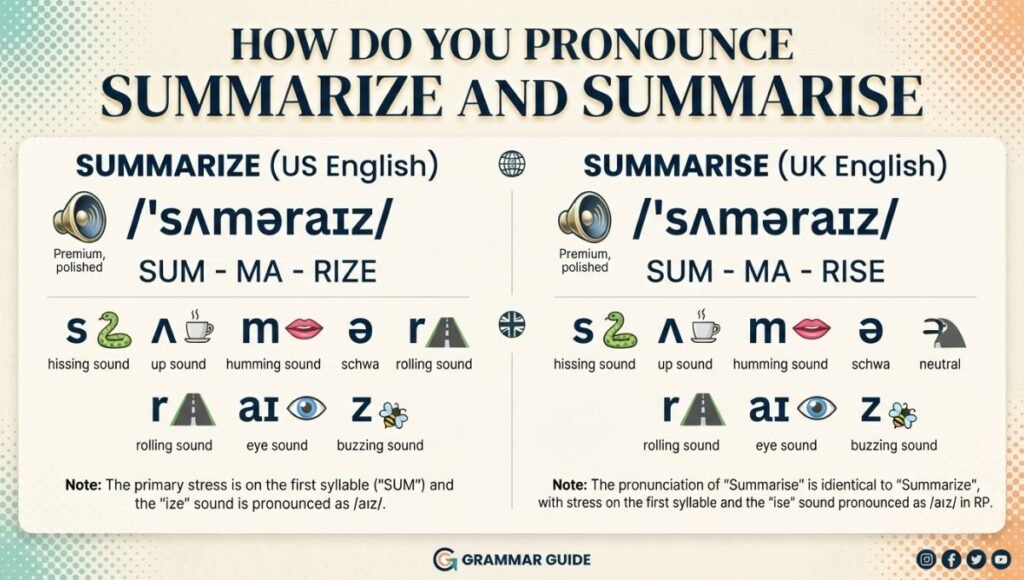
Both spellings sound identical: SUM-uh-rize (/ˈsʌməraɪz/). The stress falls on the first syllable, and the ending rhymes with “eyes.”
Many speakers glide over the middle syllable, so it can sound closer to SUM-riz in fast speech. That is normal and does not change the spelling.
Because the pronunciation is the same, spelling is the only difference you need to manage.
More related Post: Bingeing or Binging: 2 Correct Spellings and 1 Simple Rule https://feastinsidar.com/bingeing-or-binging/
Summarize vs Summarise at a Glance
Here is how the main forms compare:
| Term | Correct? | Meaning | Use |
| summarize | Yes | To state the main points briefly | US and Canadian English, US-facing writing |
| summarise | Yes | Same meaning | UK, Australian, and New Zealand English |
| summarized | Yes | Past tense (US) | Completed actions in US writing |
| summarised | Yes | Past tense (UK) | Completed actions in UK writing |
| sumarize, summerize | No | Misspellings | Avoid |
| summarily | Yes, but a different word | Quickly, without formality | Not a synonym for summarize |
The takeaway: the -ize and -ise versions are twins, but “summarily” is a stranger who only looks similar.
How Do the Verb Forms Change?
Every form of the verb follows the same spelling choice. Pick one column and stay in it.
| Form | American English | British English |
| Base form | summarize | summarise |
| Third person singular | summarizes | summarises |
| Past tense | summarized | summarised |
| Present participle | summarizing | summarising |
| Noun form of the action | summarization | summarisation |
| Person or tool that does it | summarizer | summariser |
The noun summary and its plural summaries never change. Only the verb and its derived forms split by region.
A quick example of each tense: “I summarize the notes every Friday.” “She summarized the notes yesterday.” “He is summarizing the notes now.”
How Do You Use Summarize in a Sentence?
Here are natural examples for different contexts, using US spelling.
Everyday conversation: “Can you summarize the movie in one sentence? I fell asleep halfway through.”
Workplace communication: “Please summarize the client’s feedback before tomorrow’s call.”
Email: “I’ll summarize the action items below so nobody misses a deadline.”
Academic writing: “This paper summarizes findings from several studies on sleep and memory.”
Business writing: “The report summarizes quarterly sales by region.”
Formal writing: “The committee summarized its recommendations in a two-page memo.”
Casual writing: “Long story short, let me summarize: we’re late.”
British English: “Could you summarise the minutes before Friday?”
Notice that “summarizes” in the academic and business examples ends in -s because the subject (“this paper,” “the report”) is singular. The past tense in the formal example takes -d because the action is finished.
What Mistakes Do People Make With Summarize and Summarise?
These slips are common and easy to fix.
Incorrect: Please summarize the report and summarise the results.
Correct: Please summarize the report and summarize the results.
Both spellings are fine on their own, but mixing them in one document looks careless. The Summarize vs Summarise choice should be made once and kept.
Incorrect: I’ll send you a summarize of the call.
Correct: I’ll send you a summary of the call.
“Summarize” is a verb. The noun you want is “summary.”
Incorrect: Let me summarily explain the key points.
Correct: Let me briefly summarize the key points.
“Summarily” means quickly and without formality, as in “the employee was summarily dismissed.” It is not the adverb form of “summarize.”
Incorrect: Can you sumarize this article?
Correct: Can you summarize this article?
Remember the double m. The word grows out of “summary,” which also has two.
What Related Words and Terms Should You Know?
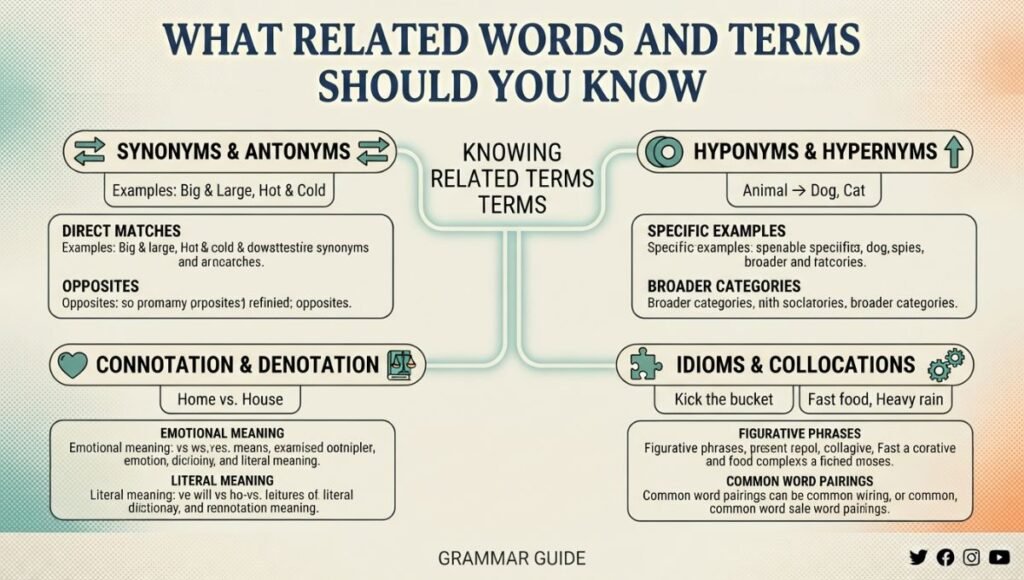
Several words sit close to “summarize” in meaning:
- Synonyms: recap, sum up, condense, boil down, outline, abridge, encapsulate (more formal)
- Antonyms: expand on, elaborate, lengthen
- Related nouns: summary, overview, synopsis, abstract, recap
- Common phrases: in summary, to sum up, executive summary
One more lookalike: summation means a total or a closing statement, as in a lawyer’s summation. It is not the everyday word for a short overview, so do not swap it in for “summary.”
Which Spelling Should You Use for Your Audience?
Use this simple guide:
- Follow the style guide if your employer, publisher, or school has one.
- Match your readers. Use summarize for US and Canadian readers, and summarise for UK, Australian, and New Zealand readers.
- Set your spellchecker language to match, so it catches the wrong form automatically.
- Stay consistent across the whole word family. Do not pair “summarize” with “organise” in the same piece.
Before you publish, run a quick search for the spelling you did not intend to use. When you write for a mixed audience, the Summarize vs Summarise decision is really about consistency, not correctness. A single find-and-replace can fix a whole draft in seconds.
Quick Answers About Summarize and Summarise
Is it summarize or summarise?
Both are correct. “Summarize” is the American spelling, and “summarise” is the British spelling.
Is summarise correct in American English?
It is a British spelling, so US readers will usually treat it as an error. Use “summarize” for American audiences.
What is the past tense of summarize?
The past tense is summarized in American English and summarised in British English. Example: “She summarized the article in two lines.”
What is another word for summarize?
Common alternatives are recap, sum up, condense, and outline. Example: “Let me recap the main points before we finish.”
The One Rule to Remember
Summarize vs Summarise is a question about your audience, not your grammar. Use “summarize” for American readers and “summarise” for British ones, then keep every form consistent, including “summarized” or “summarised” in the past tense. The takeaway: match the spelling to your reader, then stay with it.











1 thought on “Summarize vs Summarise: 2 Spellings, 1 Meaning, and a Rule to Choose”