Confused about principal or principle? You’re not alone. These two words sound identical, share the same root, and still mean completely different things. The quick answer: “principal” refers to a person or thing of primary importance, while “principle” refers to a rule, belief, or fundamental truth. Understanding this one distinction settles the principal or principle question for good.
The Quick Answer: Principal or Principle?
“Principal” and “principle” are both correct words, but they are not interchangeable. “Principal” is usually a noun describing a leader (like a school principal) or an adjective meaning “main” or “most important” (as in “principal reason”). “Principle” is always a noun, and it refers to a rule, standard, or core belief that guides behavior or thinking. Neither word is wrong. They simply belong in different sentences.
Why Principal and Principle Get Confused So Often
The confusion around principal or principle comes down to sound, not meaning. Both words are pronounced exactly the same way in everyday speech, which is unusual for English. Add in the fact that they come from the same Latin root, and it’s easy to see why even careful writers second guess themselves when typing one or the other.
What “Principal” Means
“Principal” has two common uses. As a noun, it refers to the head of a school, a key person in a business deal, or the original sum of money in a loan before interest is added. As an adjective, it means “main” or “most significant,” as in “the principal cause of the delay.”
In every one of these uses, “principal” points to something that ranks first, whether that’s a person in charge, an amount of money, or a leading factor.
What “Principle” Means
“Principle” is a noun only, and it always refers to a fundamental rule, law, belief, or standard. Scientific principles explain how the physical world works. Moral principles guide how a person behaves. Company principles outline the values a business operates by.
Unlike “principal,” which can describe people, money, or importance, “principle” is strictly about ideas, rules, and beliefs.
Principal vs Principle: The Core Grammar Difference
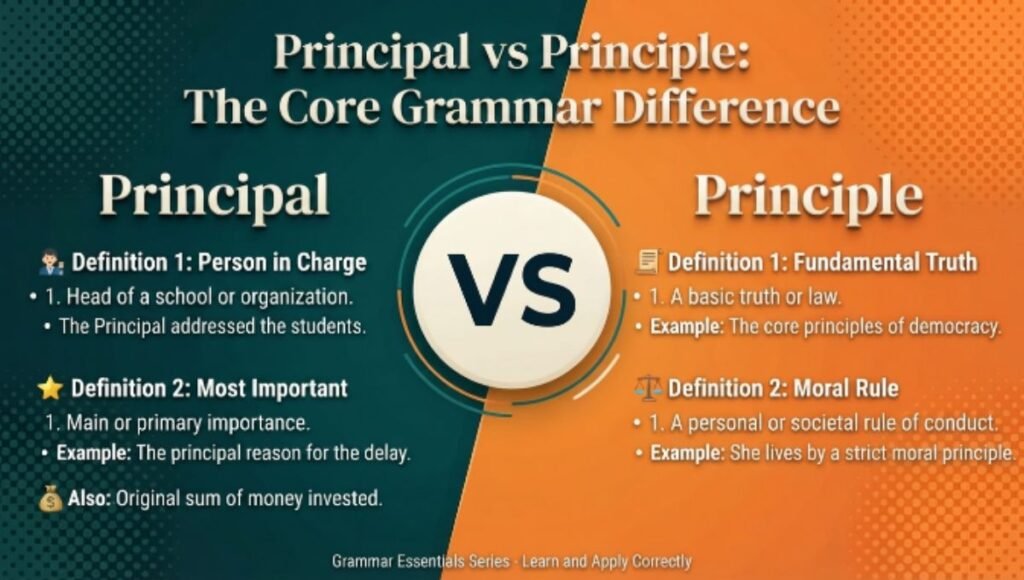
A simple memory trick separates these two permanently. “Principal” ends in “-pal,” like “pal,” and a principal is often a person, such as your school pal in charge. “Principle” ends in “-ple,” like “rule,” and a principle is always a rule or belief.
This spelling based trick works better than trying to memorize definitions, since the ending itself hints at the correct meaning every time.
Where These Words Come From
Both words trace back to the Latin word “principalis,” meaning “first” or “original,” which itself comes from “princeps,” meaning “first person” or “chief.” Over time, English split this single root into two spellings with two distinct jobs: “principal” kept the sense of “first in rank or importance,” while “principle” developed to describe “first in a system of ideas,” meaning a foundational rule.
How to Pronounce Principal and Principle
Both words are pronounced the same way: /ˈprɪn.sə.pəl/, with the stress on the first syllable. There is no audible difference between them in casual speech, which is exactly why spelling matters so much here. Readers cannot rely on sound to tell these words apart, only on context and correct spelling.
More related Post: Turn for the Worse or Worst: The 2026 Guide to Getting This Phrase Right https://feastinsidar.com/turn-for-the-worse-or-worst/
Principal or Principle: Comparison Table
| Term | Part of Speech | Meaning | Use |
| Principal | Noun or adjective | A leader, key person, original sum of money, or “main/most important” | “The principal called a meeting.” / “the principal reason” |
| Principle | Noun only | A rule, belief, or fundamental truth | “She acted on principle.” / “a scientific principle” |
How to Remember Which One to Use
Since choosing correctly between principal or principle depends entirely on context, ask a simple question before writing: is this about a person, money, or something ranked as most important? Use “principal.” Is this about a rule, belief, or standard? Use “principle.” That one question resolves nearly every case.
Real Life Examples in Different Contexts
Everyday conversation: “My daughter got called to the principal’s office today, but it was nothing serious.”
Workplace communication: “The principal reason for the delay was a shortage of materials, not a scheduling error.”
Academic writing: “The experiment demonstrates a basic principle of thermodynamics.”
Email: “Attached is the updated loan schedule showing the remaining principal balance.”
Business writing: “Our company operates on the principle of transparency in all client communications.”
Formal writing: “The committee’s principal concern was the budget shortfall for the coming fiscal year.”
Casual writing: “Honestly, I just don’t eat meat anymore, it’s more of a principle than a diet choice.”
Each example works because the word chosen matches its role: a person or main idea calls for “principal,” while a belief or rule calls for “principle.”
Common Mistakes People Make With Principal or Principle
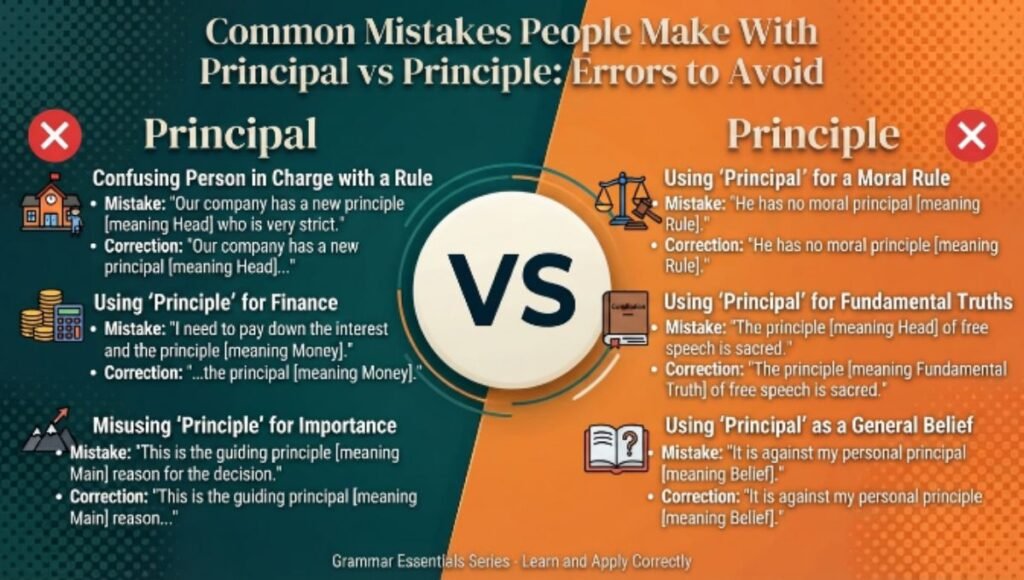
Incorrect: She refused on principal. Correct: She refused on principle. This mistake happens because “principal” looks more familiar to many writers, but refusing “on principle” always refers to a personal belief or standard, so “principle” is the only correct choice.
Incorrect: The school’s new principle starts Monday. Correct: The school’s new principal starts Monday. Here the sentence is about a person leading the school, which calls for “principal,” not “principle.”
Incorrect: The bank charges interest on top of the principle. Correct: The bank charges interest on top of the principal. In lending, “principal” refers to the original amount borrowed, so this financial context always requires “principal.”
These slips are extremely common, even among experienced writers, since the identical pronunciation offers no clue about which spelling belongs where.
Related Words and Terms
A few related terms make the principal or principle distinction easier to keep straight:
- Principled: an adjective meaning guided by strong moral principles
- Principality: a territory ruled by a prince, related to “principal” through the idea of rank
- Fundamental: a close synonym for “principle” in the sense of a core rule
- Chief: a close synonym for “principal” when it means “main” or “leading”
- Interest and principal: a common financial pairing where “principal” is the original loan amount
Practical Guidance for Avoiding the Mistake
Before finalizing any sentence, ask whether the word is describing a person, a sum of money, or something labeled as the most important, or whether it’s describing a rule, belief, or standard. The first group always takes “principal.” The second group always takes “principle.” Running this check for a few seconds catches the mistake before it reaches a reader.
Frequently Asked Questions
Is it “principal” or “principle” for a school leader?
It’s “principal.” The head of a school is always spelled “principal,” never “principle.”
What does “principle” mean?
“Principle” means a fundamental rule, belief, or standard that guides behavior, thinking, or a system of ideas.
How do I use “principal” in a sentence?
Use “principal” for a person in charge, an original sum of money, or something described as “main,” for example: “The principal reason for the meeting was the upcoming merger.”
Why are principal and principle pronounced the same?
Both words descend from the same Latin root, “principalis,” and English never developed a separate pronunciation for the two spellings, even though their meanings split apart over time.
Can “principal” ever mean the same thing as “principle”?
No. Even though they share a root, “principal” and “principle” serve different grammatical roles and meanings today, and using one in place of the other is considered incorrect in standard English.
Conclusion
Sorting out principal or principle comes down to one clear rule: use “principal” for a person, an amount of money, or something described as most important, and use “principle” for a rule, belief, or fundamental truth. Remember the “-pal” and “-ple” trick, and this word pair will never cause confusion again.










1 thought on “Principal or Principle: The 2026 Guide to Using Each Word Correctly”