Anyone who has typed turn for the worse or worst into a search bar knows the frustration. Both words look similar, sound similar, and seem like they should work the same way. They don’t. The quick answer: the confusion around turn for the worse or worst ends here, because only one form is standard English, and this guide explains exactly why.
The Quick Answer: Worse or Worst?
“Turn for the worse” is grammatically correct. “Turn for the worst” is not standard English. The whole turn for the worse or worst debate comes down to comparison: this phrase describes a situation that has become more negative than it was before. “Worse” is a comparative adjective, which is exactly what this idiom needs. “Worst” is a superlative, and superlatives don’t fit the comparison being made here.
Why People Mix Up Worse and Worst Here
Part of the reason the turn for the worse or worst question keeps coming up is that “worst” feels more dramatic, and native speakers often reach for dramatic language when describing a bad situation. “Worst” also shows up constantly in everyday speech (“worst day ever,” “worst case scenario”), so it feels familiar even when it’s grammatically wrong here. Add in the fact that “worse” and “worst” differ by a single letter, and mistakes are almost guaranteed.
What “Turn for the Worse” Actually Means
“Turn for the worse” means a situation, condition, or circumstance has changed and become more negative than it previously was. It implies a shift, a before and after. Someone’s health can take a turn for the worse. Weather can take a turn for the worse. A business deal, a relationship, or an economy can all take a turn for the worse.
The phrase always involves comparison: how things are now versus how they were. That comparative quality is the grammatical clue that “worse,” not “worst,” belongs here.
Is “Turn for the Worst” Ever Correct?
No. “Turn for the worst” is not accepted in standard American or British English. It’s a common error, not an alternate spelling or informal variant. Major dictionaries and style guides list only “turn for the worse” as the established idiom. If someone writes “turn for the worst,” it should be corrected in any formal, academic, or professional context.
Worse vs Worst: The Grammar Rule Behind the Confusion
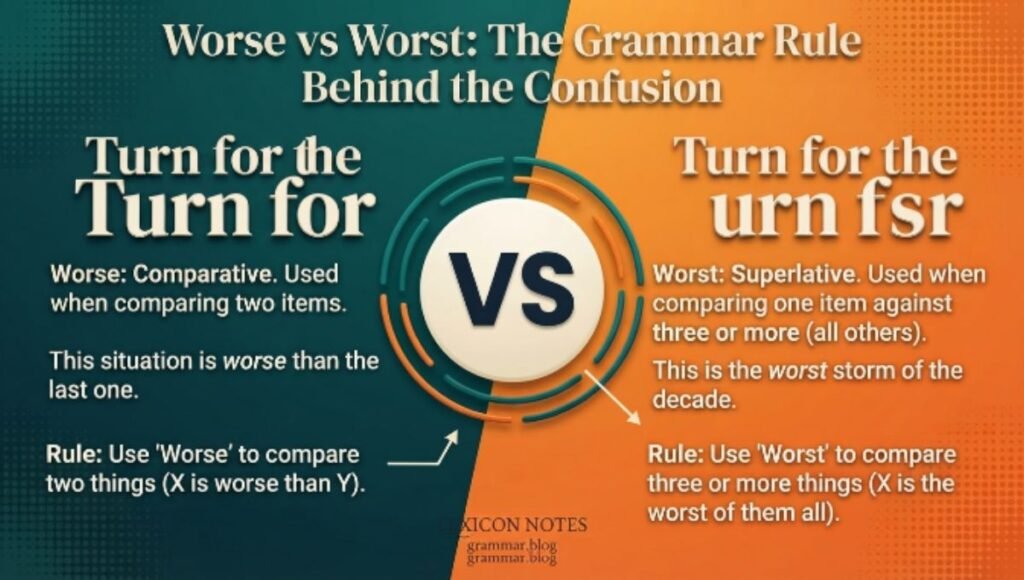
Understanding the rule settles the turn for the worse or worst question permanently.
- Worse is the comparative form of “bad.” It compares two things: this situation is worse than that one.
- Worst is the superlative form of “bad.” It compares three or more things, identifying the most extreme: this is the worst outcome of all possible outcomes.
Because the idiom is really asking about a shift from one state to another, only a comparative word fits. There are only two points being compared (before and after), not a whole group being ranked, so “worst” has no grammatical role here.
Where “Turn for the Worse” Comes From
The phrase has been part of English for centuries, built from the pattern of describing change using “for the [comparative adjective].” Similar constructions exist, such as “for the better,” which follows the same logic in the opposite direction. The structure itself is old and stable, which is part of why “turn for the worse” has stayed fixed while newer, incorrect variations occasionally circulate online.
More related Post : Baptised or Baptized: 1 Word, 2 Correct Spellings for 2026 https://feastinsidar.com/baptised-or-baptized/
How to Pronounce “Turn for the Worse” Correctly
“Worse” is pronounced /wɜːrs/, rhyming with “purse” and “nurse.” “Worst” is pronounced /wɜːrst/, with an added “t” sound at the end, rhyming with “burst” and “first.” Saying the phrase aloud slowly can help writers catch the mistake before it lands on the page, since the extra “t” sound in “worst” is easy to hear once you’re listening for it.
Turn for the Worse or Worst: Comparison Table
| Term | Correct? | Meaning | Use |
| Turn for the worse | Yes | A situation becomes more negative than before | Standard idiom, all contexts |
| Turn for the worst | No | Not a recognized grammatical form | Common error to avoid |
How to Use “Turn for the Worse” in a Sentence
Once the grammar rule is clear, using this idiom correctly is easy. The phrase almost always follows a form of “take” or “make,” as in “take a turn for the worse.” It can apply to health, weather, relationships, careers, finances, and general circumstances, and it fits formal writing just as comfortably as casual conversation.
Real Life Examples in Different Contexts
Everyday conversation: “Her mood took a turn for the worse after the meeting got rescheduled again.”
Workplace communication: “If the client relationship takes a turn for the worse, we need a plan to address it before the renewal date.”
Academic writing: “The patient’s condition took a turn for the worse within twenty four hours of admission, prompting a change in treatment.”
Email: “Just a heads up that the weather forecast has taken a turn for the worse, so we may need to move the outdoor event indoors.”
Business writing: “Market conditions took a sudden turn for the worse in the third quarter, affecting projected revenue.”
Casual writing: “This week started fine, then took a turn for the worse when my laptop died.”
Each example works because “worse” correctly signals a comparison between an earlier, better state and the current, more negative one.
Common Mistakes People Make With This Phrase
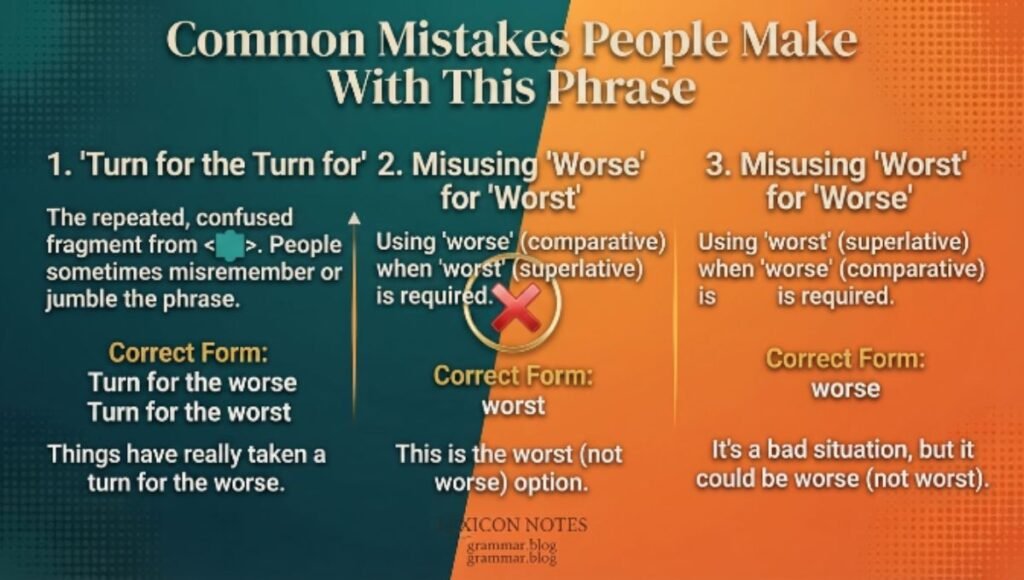
Incorrect: The situation took a turn for the worst. Correct: The situation took a turn for the worse. This is the single most common turn for the worse or worst mistake, and it happens because “worst” sounds more intense, even though the phrase needs a comparative word, not a superlative one.
Incorrect: Things turned for the worse, worst than we expected. Correct: Things turned for the worse, worse than we expected. Mixing both words in one sentence usually signals uncertainty about which is comparative and which is superlative.
Incorrect: It’s the worse case scenario. Correct: It’s the worst case scenario. This is the reverse error: “worst case scenario” needs the superlative, since it’s identifying the single most extreme outcome among many possibilities.
Mistakes like these are extremely common, even among fluent English speakers, so there’s no need to feel embarrassed about mixing them up occasionally.
Related Words and Phrases to Know
Understanding a few related terms makes the whole “worse versus worst” pattern easier to remember:
- For the better: the positive counterpart, describing a positive shift
- Worsen: the verb form, meaning to become worse
- Deteriorate: a more formal synonym for taking a turn for the worse
- Worst case scenario: correctly uses the superlative because it compares many possible outcomes
- Comparative adjective: the grammar category “worse” belongs to
- Superlative adjective: the grammar category “worst” belongs to
Practical Guidance for Avoiding This Mistake
A simple trick settles the turn for the worse or worst question every time: mentally replace “worse” or “worst” with “better.” If “for the better” sounds natural in the sentence, then “for the worse” is the correct comparative match, since both follow the identical grammatical pattern. This quick substitution test takes only a second to run through before hitting send on an email or publishing a piece of writing.
Frequently Asked Questions
Is “turn for the worse” or “turn for the worst” correct?
“Turn for the worse” is correct. “Turn for the worst” is a common error and is not accepted in standard English.
What does “turn for the worse” mean?
It means a situation has become more negative or difficult than it previously was, implying a clear before and after comparison.
How do I use “turn for the worse” in a sentence?
Use it after a form of “take” or “make,” for example: “The negotiations took a turn for the worse after the deadline passed.”
Why do people confuse worse and worst in this phrase?
“Worst” feels more dramatic and appears often in everyday speech, which makes it feel correct even though the phrase requires the comparative “worse.”
Is “worst case scenario” also wrong?
No, “worst case scenario” is correct because it compares many possible outcomes and identifies the most extreme one, which is exactly what the superlative “worst” is for.
Conclusion
The debate over turn for the worse or worst has one clear resolution: “turn for the worse” is the only grammatically correct version, since the phrase compares an earlier state to a more negative current one. Keep the substitution trick in mind (swap in “better” to test it), and this phrase will never trip you up again.











1 thought on “Turn for the Worse or Worst: The 2026 Guide to Getting This Phrase Right”