If you’ve seen “baptized” in one article and “baptised” in another, you’re not imagining things, and you haven’t stumbled onto a mistake. The baptised or baptized question comes up constantly because both spellings are genuinely correct, just in different varieties of English. Here’s the direct answer: baptized is standard American English, while baptised is standard British English, and neither one is wrong.
Quick Answer: Which Spelling Should You Use?
Baptized (with a “z”) is the correct spelling in American English. Baptised (with an “s”) is the correct spelling in British English, along with Australian and most other Commonwealth varieties. If you’re writing for a US audience, use baptized. If you’re writing for a UK or Commonwealth audience, use baptised. Both mean exactly the same thing: to perform or receive the religious rite of baptism.
What Does “Baptize” or “Baptise” Mean?
Both spellings refer to the same verb: performing or undergoing baptism, a religious ceremony that typically involves water and symbolizes spiritual cleansing or initiation into a faith, most commonly Christianity.
- “The pastor baptized the newborn during Sunday service.”
- “She was baptised at her local church as a child.”
The meaning never changes based on spelling. This is purely a regional spelling difference, not a difference in definition, and that’s the key thing to understand in the baptised or baptized comparison.
Why Are There Two Spellings for the Same Word?
This split isn’t unique to baptize. It’s part of a much larger pattern in English where American English favors “-ize” endings and British English traditionally favors “-ise” endings, for words like “organize/organise,” “realize/realise,” and “recognize/recognise.”
Interestingly, “-ize” isn’t purely an American invention. It reflects the older Greek based spelling, and some British style guides, including Oxford University Press, still recommend “-ize” for many of these words. Most everyday British writing, however, defaults to “-ise,” which is why “baptised” feels more familiar in UK contexts.
Baptised or Baptized: American vs British English
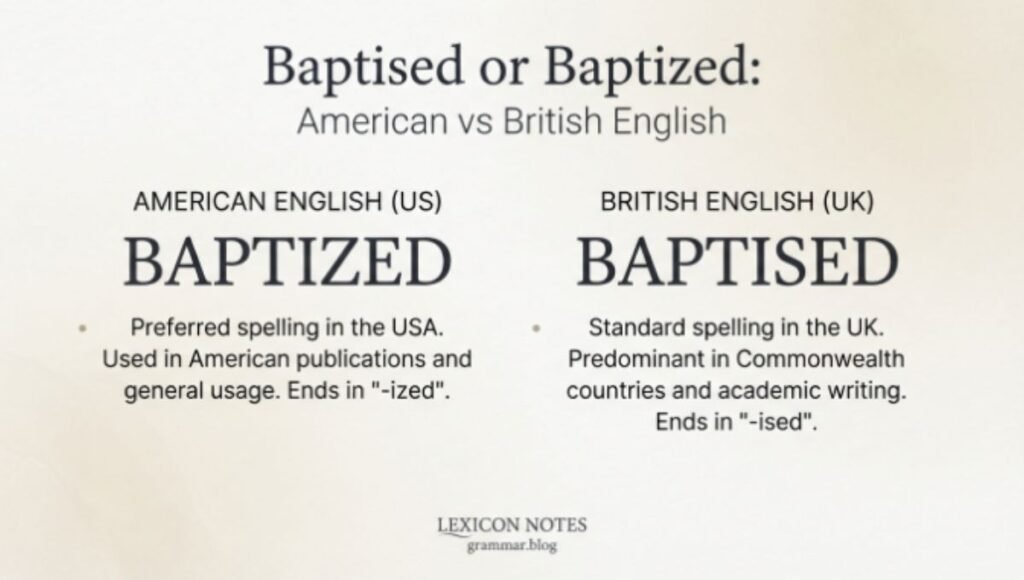
In the baptised or baptized comparison, American English is consistent: baptize, baptized, and baptizing all use “z.” British English, in its most common everyday form, uses baptise, baptised, and baptising with “s” throughout. If you’re writing for an American publication, style guide, or audience, stick with the “z” spelling across every form of the word.
More related Post : Compliment or Complement: 2 Words, 1 Simple Rule for 2026 https://feastinsidar.com/compliment-or-complement/
Grammar Breakdown of “Baptize” and “Baptise”
Both spellings function identically as verbs, and they follow the same conjugation pattern in their respective English varieties.
- Base form: baptize (US) or baptise (UK)
- Past tense: baptized (US) or baptised (UK)
- Present participle: baptizing (US) or baptising (UK)
- Noun form: baptism (spelled the same in both varieties)
- Person performing the act: baptizer (US) or baptiser (UK)
Notice that “baptism,” the noun, doesn’t change between American and British English. Only the verb forms carry the “-ize” versus “-ise” distinction.
Where Does the Word “Baptize” Come From?
The word traces back to the Greek verb “baptizein,” meaning “to dip” or “to immerse.” It passed into Latin as “baptizare,” then into Old French as “baptiser,” before entering Middle English. The religious meaning has stayed remarkably consistent across all of these languages, always centered on immersion or ceremonial washing tied to spiritual initiation, particularly within Christian tradition.
How to Pronounce “Baptize” and “Baptise”
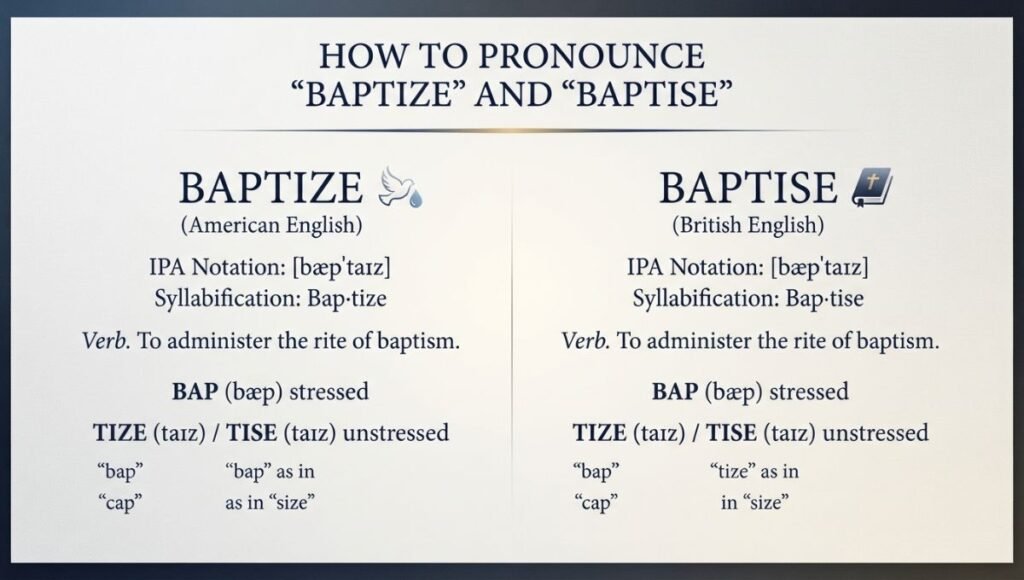
Both spellings are pronounced the same way: “BAP-tyze,” with the stress on the first syllable. The spelling difference between the “z” and “s” versions doesn’t affect pronunciation at all, since the “s” in “baptise” is pronounced like a “z” sound anyway. This is another reason the baptised or baptized question causes confusion. There’s no audible clue pointing you to the correct regional spelling.
Baptised or Baptized: Comparison Table
| Term | Correct? | Region | Use |
| Baptized | Yes | American English (also used in some international contexts) | “He was baptized last Sunday.” |
| Baptised | Yes | British, Australian, and most Commonwealth English | “He was baptised last Sunday.” |
Both spellings are fully legitimate. The right one depends on your audience and the English variety your writing follows, not on grammatical correctness.
How to Use “Baptized” and “Baptised” Correctly in a Sentence
Here are natural examples across different real world contexts:
- Everyday conversation (US): “My nephew is getting baptized next month.”
- Everyday conversation (UK): “My nephew is getting baptised next month.”
- Academic writing (US): “The study examined how families choose when a child is baptized.”
- Formal writing (UK): “The church register recorded the date each infant was baptised.”
- Business or publishing (US): “Our style guide requires American spelling, so always use baptized.”
Whichever spelling you choose, staying consistent throughout the same document matters more than picking one version over the other.
Common Mistakes with Baptised and Baptized
Incorrect: He was baptised in New York last spring, and his cousin was baptized in London the same year. Correct: Choose one spelling and use it consistently throughout the piece, based on your target audience, such as “baptized” for both if writing in American English. Mixing spellings within a single piece of writing is the most common mistake, even though each spelling is correct on its own.
Incorrect: The noun form was written as “baptizm.” Correct: The noun form is “baptism,” spelled the same way in both American and British English. Since only the verb forms change between regions, it’s easy to mistakenly apply the “-ize” or “-ise” pattern to the noun as well.
Incorrect: Assuming “baptised” is a misspelling because it looks unfamiliar. Correct: Recognizing that “baptised” is the standard British spelling, not an error. This assumption is common among readers who are used to seeing only American spelling online.
Related Words and Forms
A few related terms are worth knowing alongside baptised or baptized:
- Baptism: the noun form, spelled the same in both English varieties.
- Baptismal: the adjective form, as in “baptismal font.”
- Christen: a close synonym, often used interchangeably with baptize in casual speech.
- Anoint: a related religious term involving ceremonial application of oil, distinct in meaning but sometimes mentioned alongside baptism.
These related words follow standard spelling in both regions, so they’re worth knowing when writing about the topic more broadly.
Practical Guidance for Choosing the Right Spelling
If you’re writing for a specific publication, website, or client, check their style guide first. Most American publications, including US based blogs and newspapers, expect “baptized.” Most British, Australian, and Commonwealth publications expect “baptised.” When in doubt, match the spelling convention already used in the rest of the document, and stay consistent from start to finish.
FAQs About Baptised or Baptized
Is “baptized” or “baptised” correct?
Both are correct. “Baptized” is standard American English, and “baptised” is standard British English.
Which spelling should I use for a US audience?
Use “baptized” with a “z” for American English readers and publications.
Does the meaning change between baptized and baptised?
No. Both words mean exactly the same thing: to perform or undergo the rite of baptism.
Is “baptism” spelled differently in British English?
No. “Baptism” is spelled the same way in both American and British English. Only the verb forms differ.
Can I mix “baptized” and “baptised” in the same document?
It’s best to avoid mixing them. Pick one spelling based on your audience and use it consistently throughout.
Final Takeaway
The baptised or baptized question isn’t really about right versus wrong, it’s about which English variety you’re writing in. Use baptized for American English and baptised for British English, and keep your choice consistent throughout any single piece of writing.










1 thought on “Baptised or Baptized: 1 Word, 2 Correct Spellings for 2026”