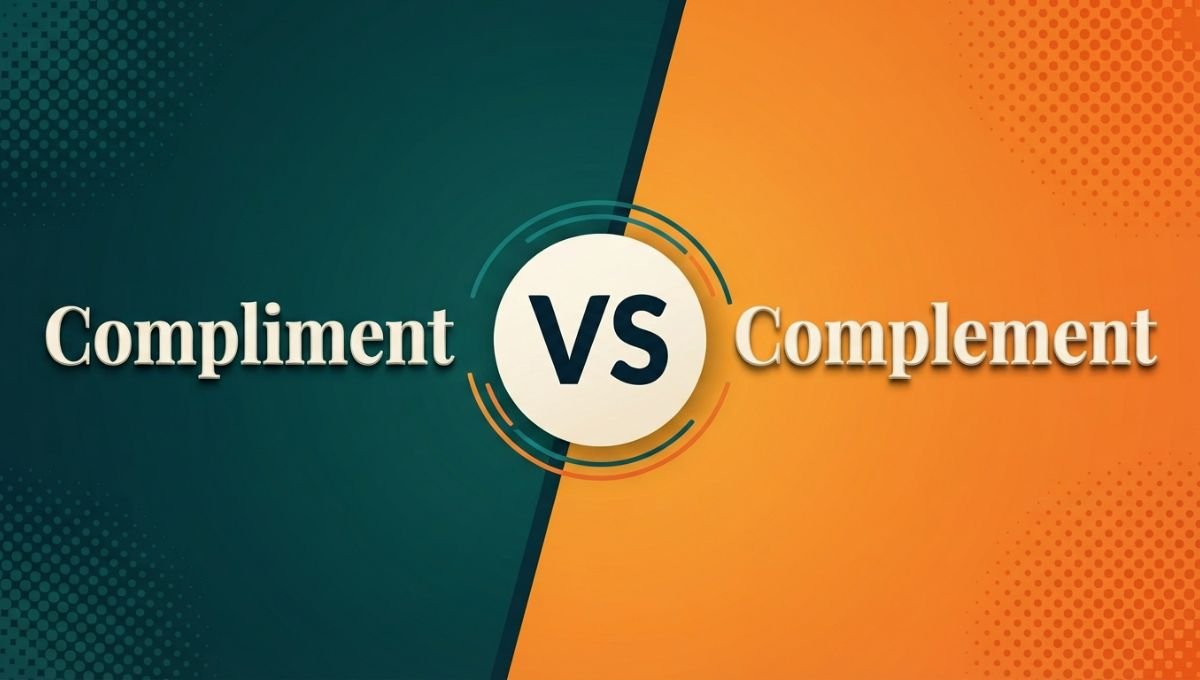
If you’ve ever paused mid sentence wondering whether to write “compliment” or “complement,” you’re dealing with one of English’s most common spelling mix ups. Both words sound identical and share nearly the same letters, which is exactly why compliment or complement trips up so many writers. Here’s the quick answer: compliment means praise, while complement means something that completes or enhances another thing.
Quick Answer: What’s the Difference?
Compliment (with an “i”) is a noun or verb related to praise, like telling someone their work looks great. Complement (with an “e”) is a noun or verb related to completion, like a scarf that complements an outfit. Neither word is a misspelling of the other. They’re two separate, legitimate words with an “i” versus an “e” as the only visual difference, and that single letter changes the entire meaning.
What Does “Compliment” Mean?
Compliment refers to an expression of praise, admiration, or approval. It can work as a noun or a verb.
- As a noun: “She gave him a compliment on his presentation.”
- As a verb: “He complimented her cooking.”
Whenever the sentence involves saying something nice about someone or something, compliment (with an “i”) is the word you want.
What Does “Complement” Mean?
Complement refers to something that completes, enhances, or brings another thing to full measure. It also works as both a noun and a verb.
- As a noun: “The wine was a perfect complement to the meal.”
- As a verb: “The colors complement each other well.”
Complement (with an “e”) is about pairing well or making something whole, not about praise.
Compliment or Complement: The Core Grammar Difference
The distinction in compliment or complement comes down to a single vowel, but the meanings are entirely unrelated. Compliment centers on praise and admiration. Complement centers on completion and enhancement. Since they’re pronounced the same way, spell check is often the only thing catching the error, and even that isn’t always reliable since both are real words.
A simple memory trick: complement has an “e,” just like “complete,” and both words relate to making something whole. Compliment has an “i,” just like the word itself contains an implied compliment when you’re being nice to someone.
Where Do “Compliment” and “Complement” Come From?
Both words share the same Latin root, “complementum,” meaning “that which completes.” They were originally the same word in English, spelled interchangeably for centuries. Over time, English writers began using the two spellings to separate the meanings, with “compliment” settling into the sense of praise sometime in the 1600s, likely influenced by French court etiquette where polite expressions of admiration were called “compliments.” Complement kept the original sense of completion.
How to Pronounce “Compliment” and “Complement”
Both words are pronounced the same way when used as nouns: “KOM-pluh-ment.” As verbs, some speakers place slightly more stress on the final syllable, but the pronunciation stays close enough that sound alone won’t help you choose the correct spelling. This is another reason the compliment or complement confusion is so persistent: your ear genuinely can’t tell them apart.
More related Post : To or Too: The 2 Words Behind “I Would Love To or Too” https://feastinsidar.com/to-or-too/
Compliment or Complement: Comparison Table
| Term | Correct? | Meaning | Use |
| Compliment | Yes | An expression of praise or admiration | “She complimented his speech.” |
| Complement | Yes | Something that completes or enhances | “The tie complements the suit.” |
Both spellings are correct English words. The right one depends entirely on whether you’re talking about praise or completion.
How to Use “Compliment” and “Complement” Correctly in a Sentence
Here are natural examples across different everyday contexts:
- Everyday conversation: “Thanks for the compliment, that really made my day.”
- Workplace communication: “I want to compliment the team on hitting the deadline early.”
- Academic writing: “The two studies complement each other’s findings.”
- Email: “The new logo complements the brand’s existing color scheme.”
- Formal writing: “The chef received compliments for the tasting menu.”
- Business writing: “This software feature complements our current workflow.”
In each case, the choice comes down to meaning: praise calls for compliment, and completion or enhancement calls for complement.
Common Mistakes with Compliment and Complement
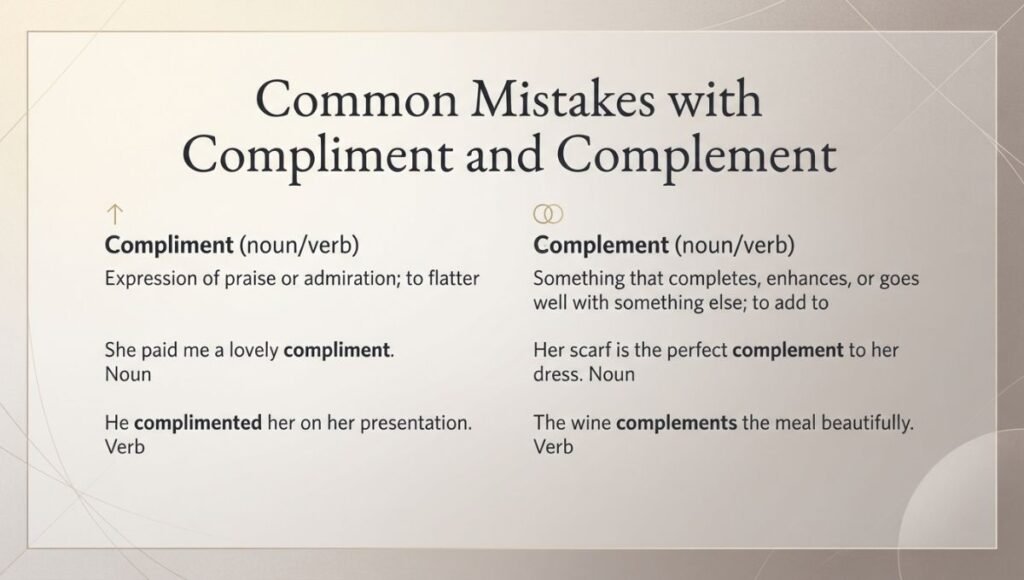
Incorrect: The shoes really complement her on her style. Correct: The shoes really complement her style. This one usually happens from overthinking the sentence. “Complement” already means “enhance,” so no extra preposition like “on” is needed here.
Incorrect: He gave her a nice complement about her presentation. Correct: He gave her a nice compliment about her presentation. Since this sentence is about praise, “compliment” with an “i” is the correct choice.
Incorrect: These flavors compliment each other perfectly. Correct: These flavors complement each other perfectly. This mistake is extremely common in food writing. The flavors aren’t praising each other, they’re enhancing each other, so “complement” is correct.
These mix ups happen to careful writers all the time, since the words look and sound so similar. Once you connect “complement” to “complete,” the difference becomes much easier to keep straight.
Related Words and Forms
A few related terms are worth knowing alongside compliment or complement:
- Complementary: adjective form of complement, meaning things that go well together, like “complementary colors.”
- Complimentary: adjective form of compliment, but with two meanings: expressing praise, or given for free, as in “a complimentary drink.”
- Praise: a close synonym for compliment.
- Enhance: a close synonym for complement.
Notice that “complementary” and “complimentary” carry the same spelling distinction as their base words, so the same rule applies.
A Simple Trick to Remember the Difference
If you’re unsure whether to use compliment or complement, connect the spelling to a related word you already know well. Complement has an “e,” like “complete,” and both are about making something whole. Compliment has an “i,” and you can think of it as something nice you say when someone impresses you. That small connection is usually enough to make the right spelling stick.
Is “Compliment” or “Complement” Ever Interchangeable?
No. Even though they share a Latin origin, modern English treats compliment or complement as two distinct words with two distinct meanings. Using one in place of the other isn’t a stylistic choice or an accepted variation, it changes what the sentence actually communicates, so it’s worth double checking any sentence where the two could be confused.
FAQs About Compliment or Complement
Is it “compliment” or “complement” when praising someone?
It’s “compliment,” with an “i.” Praise and admiration always use this spelling.
What does “complement” mean?
It means something that completes, enhances, or pairs well with something else, such as a side dish that complements a main course.
Can “complement” and “compliment” both be verbs?
Yes. “Compliment” means to praise someone, while “complement” means to complete or enhance something.
Is “complementary” the same as “complimentary”?
No. “Complementary” means things that go well together, while “complimentary” means either praising something or given for free.
How do I remember which spelling to use?
Link “complement” to “complete” since both share an “e” and relate to wholeness, and link “compliment” to praise you’d give someone directly.
Final Takeaway
The compliment or complement question comes down to meaning, not misspelling: use compliment for praise and complement for completion or enhancement. Remembering that “complement” shares its “e” with “complete” is usually all it takes to get this right every time.










1 thought on “Compliment or Complement: 2 Words, 1 Simple Rule for 2026”