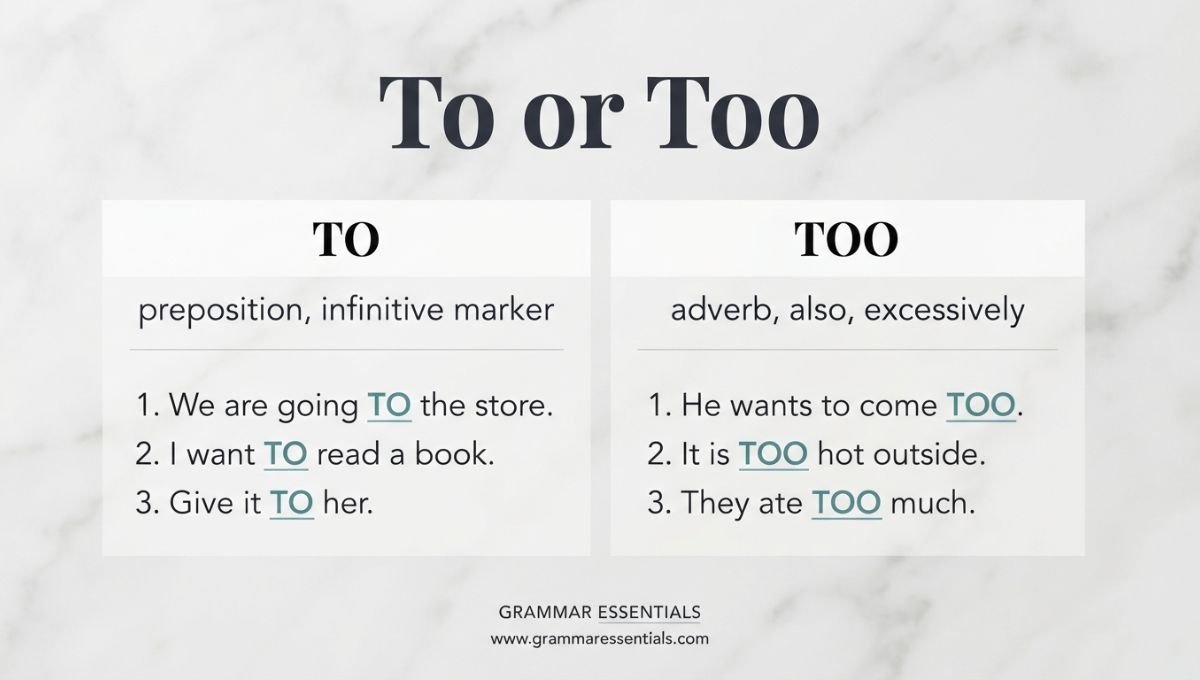
If you’ve ever typed “I would love to” and then paused, wondering if it should actually be “I would love too,” you’re dealing with one of the most common mix ups in English. The confusion around to or too happens because the words sound identical but do completely different jobs in a sentence. Here’s the quick answer: in “I would love to,” the correct word is to, not too.
Quick Answer: “To” or “Too” in “I Would Love To”?
“I would love to” is correct. Here, “to” works as part of an infinitive, standing in for an action that’s already been mentioned or understood, like “I would love to (go)” or “I would love to (join you).” “Too” would only fit if you were adding something with the meaning of “also,” and even then, it needs its own comma and a clear reference point in the sentence.
What Does “To” Mean?
To is most often a preposition or an infinitive marker. As a preposition, it shows direction, distance, or connection: “We’re driving to Chicago.” As an infinitive marker, it sits directly before a verb, or stands in for an implied one: “I want to leave,” or simply “I’d love to.”
This second use is exactly what’s happening in “I would love to.” The verb after “to” is left out because it’s already clear from context, such as replying to “Do you want to come to the party?”
What Does “Too” Mean?
Too is an adverb with two main meanings: “also” and “excessively.” As “also,” it adds something to what was just said: “I’m coming too.” As “excessively,” it describes something beyond a reasonable amount: “This coffee is too hot.”
Notice that “too” always needs something to attach its meaning to. It either echoes an idea already in the sentence (also) or intensifies a quality (excessively). It never stands in for a missing verb the way “to” does.
To or Too: The Core Grammar Difference
The real difference in the to or too debate comes down to function, not sound. To connects ideas, directions, or verbs. Too adds emphasis or repeats a point already made. Since they’re pronounced exactly the same, English learners and native speakers alike sometimes swap them without noticing, especially while typing quickly.
A simple test: if you can replace the word with “also” or “excessively” and the sentence still makes sense, you need too. If the word is followed by a verb, or is standing in for an implied one, you need to.
Why “I Would Love To” Uses “To,” Not “Too”
In “I would love to,” the phrase is completing an unstated verb from earlier context. If someone asks, “Want to grab dinner?”, replying “I would love to” really means “I would love to grab dinner.” The word “to” is doing the job of holding that invisible verb in place.
“I would love too” doesn’t work the same way, because “too” can’t fill in for a missing verb. If you wanted to use “too” here, you’d need to restructure the sentence entirely, such as “I would love that too,” where “that” gives “too” something concrete to attach to.
Where Do “To” and “Too” Come From?
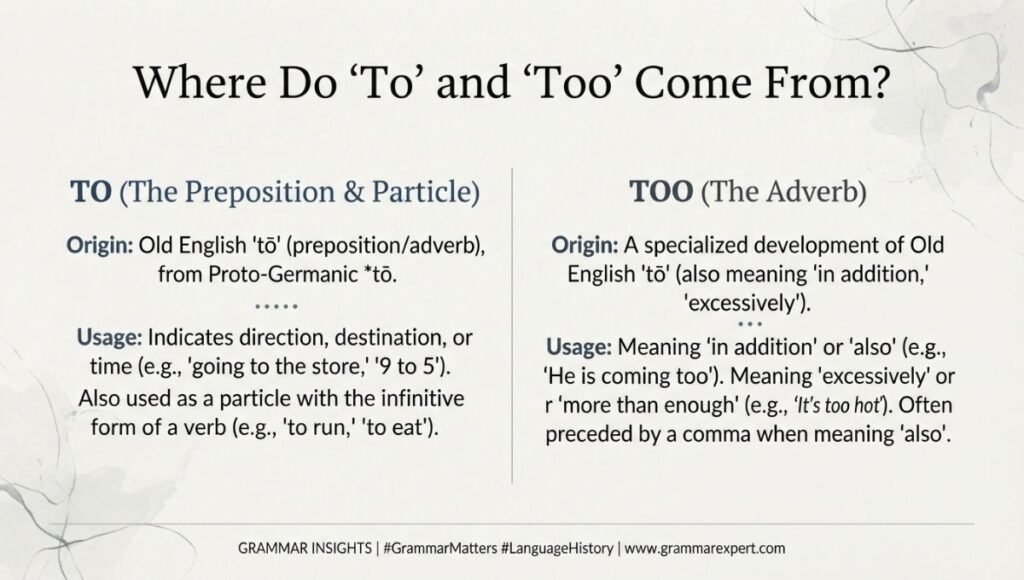
Both words trace back to Old English. To comes from the Old English “tō,” used from the earliest records of the language as a preposition of direction and purpose. Too developed later as a stressed variant of the same root word, gradually splitting off to carry the added meanings of “also” and “excessively.” The extra “o” in “too” became the standard way to visually separate the two meanings once they diverged, even though pronunciation stayed identical.
How to Pronounce “To” and “Too”
Both words are pronounced the same way, “too,” rhyming with “blue” or “shoe.” There’s no reliable pronunciation clue to tell them apart, which is exactly why the to or too confusion is so persistent. The only real way to choose correctly is by checking the word’s job in the sentence, not how it sounds.
To or Too: Comparison Table
| Term | Correct? | Meaning | Use |
| To | Yes | Direction, connection, or infinitive marker | “I would love to,” “walk to school,” “want to try” |
| Too | Yes | Also, or excessively | “I would love that too,” “it’s too late” |
Both words are legitimate. The right choice depends entirely on what the sentence needs, not on one being more correct than the other.
How to Use “To” and “Too” Correctly in a Sentence
Here are natural examples across different everyday settings:
- Everyday conversation: “I would love to, but I have plans tonight.”
- Workplace communication: “I’d love to join the call, and I think Sam would too.”
- Academic writing: “The researchers hoped to replicate the results, and they did so too.”
- Email: “I would love to schedule a follow up meeting next week.”
- Casual texting: “Same here, I want that too.”
In each case, “to” appears right before an implied or stated verb, while “too” always echoes something already mentioned in the sentence.
Common Mistakes with To and Too
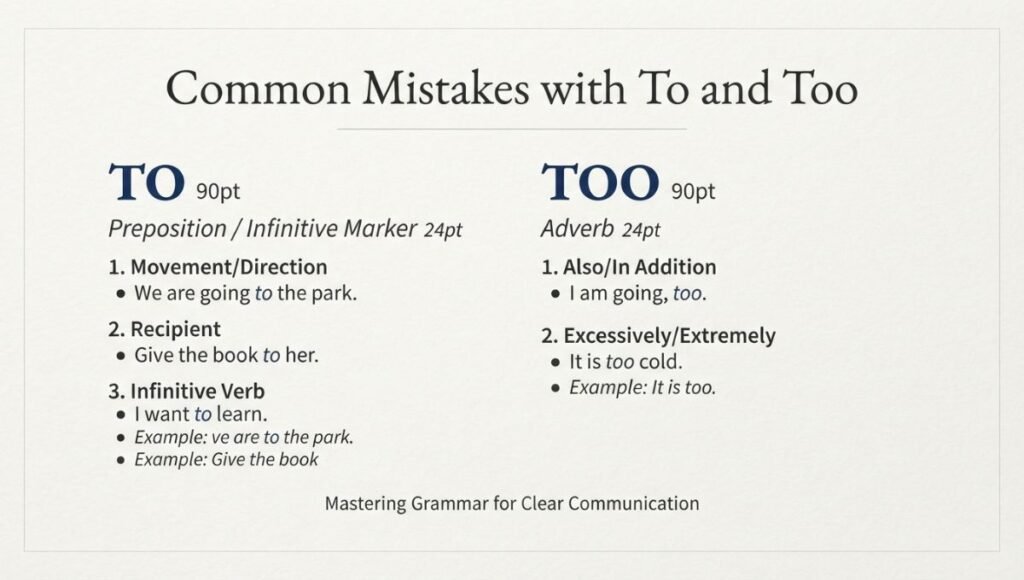
Incorrect: I would love too see the new exhibit. Correct: I would love to see the new exhibit. Here, “to” is needed because it directly precedes the verb “see.”
Incorrect: She wants to come to, if that’s okay. Correct: She wants to come too, if that’s okay. This sentence needs “too” because it means “also,” adding her to a group already mentioned.
Incorrect: It’s to late to change the plan now. Correct: It’s too late to change the plan now. “Too” is correct here because it means “excessively,” describing lateness beyond a reasonable point.
These slips are extremely common, even among confident writers, since the words sound identical and autocorrect doesn’t always catch the difference.
More related Post :Surprise or Suprise: The 1 Correct Spelling to Use in 2026 https://feastinsidar.com/suprise-or-surprise/
Related Words and Forms
A few related terms are worth knowing alongside to or too:
- Two: the number 2, a third homophone in this same sound group.
- Also: a direct synonym for “too” in its “additionally” sense.
- Toward: built from the same root as “to,” used for direction.
- Overly: a close synonym for “too” in its “excessively” sense.
Keeping these related words in mind helps clarify why English has three words that sound alike but serve entirely different purposes.
A Simple Trick to Remember the Difference
If you’re unsure whether to use to or too, try this: read the sentence without the word entirely. If it still needs an action or destination, use “to.” If the sentence works fine without it and you’re just adding emphasis or repeating a point, use “too,” and remember its extra “o” as a reminder of “also” adding one more thing.
FAQs About To or Too
Is it “I would love to” or “I would love too”?
It’s “I would love to.” The word “to” completes the implied verb, such as “I would love to (join).”
What is the difference between “to” and “too”?
“To” shows direction or connects to a verb. “Too” means “also” or “excessively.”
Can “too” ever be correct after “would love”?
Yes, but only with a direct object first, as in “I would love that too.”
Is “to” or “too” used before a verb?
“To” is used before a verb, forming an infinitive like “to run” or “to help.”
Why do people confuse to and too so often?
Both words sound exactly the same when spoken, so the mix up usually happens in writing, not speech.
Final Takeaway
The to or too question comes down to function: use “to” before a verb or destination, and “too” when adding “also” or describing something excessive. For the common phrase “I would love to,” “to” is always the correct choice, and that one rule will settle most mix ups you’ll ever run into.











1 thought on “To or Too: The 2 Words Behind “I Would Love To or Too””