If you’ve ever typed a word quickly and then stared at it wondering if something looks off, you already understand why the surprise or suprise question comes up so often. The two words look almost identical, but only one of them is real. Here’s the direct answer to surprise or suprise: surprise is the correct spelling, and suprise is a common misspelling that should be avoided in any writing.
Quick Answer: Which Spelling Is Correct?
Surprise is the only standard, dictionary recognized spelling. It means an unexpected event, or the feeling caused by something unexpected. Suprise is not a word in standard English. It is simply surprise with the letter “r” missing, usually caused by fast typing or mishearing the pronunciation. If you remember nothing else from this article, remember that surprise always keeps both r’s.
What Does “Surprise” Actually Mean?
Surprise can work as a noun, a verb, or an adjective, depending on how it sits in a sentence.
- As a noun: “The party was a total surprise.”
- As a verb: “Her answer surprised the whole class.”
- As an adjective: “He gave her a surprise gift.”
In each case, the word points to something sudden or unexpected, something the person did not see coming. That flexibility across parts of speech is part of why the word shows up so often in everyday writing, and part of why the surprise or suprise mix up happens so frequently.
Why Do People Write “Suprise” Instead of “Surprise”?
This mistake almost always comes down to speed, not knowledge. When people type fast, the “r” in the middle of the word gets dropped, and “surprise” quietly becomes “suprise” without the writer noticing. Autocorrect on some phones and browsers doesn’t always catch it either, especially in casual messages.
There’s also a pronunciation factor. Many US English speakers say the word quickly, almost as “s’prise,” and the first r gets swallowed in speech. That’s fine when you’re talking, but it can carry over into writing if you’re not paying attention.
Surprise vs Suprise: The Grammar Breakdown
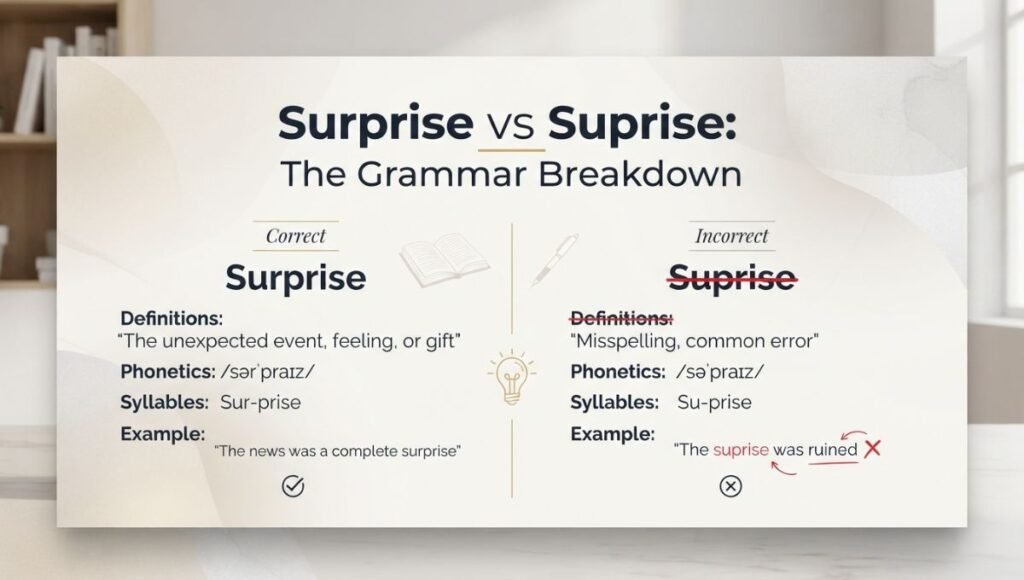
There isn’t really a grammar debate here in the way there is with words like “affect” and “effect.” One spelling is correct and the other isn’t a recognized word at all. Still, it helps to understand the structure of “surprise” so the correct spelling sticks.
The word breaks down as: sur- (from Latin, meaning “over” or “beyond”) plus prise (related to an older word for “to seize” or “to take”). Together, the original sense was something like “to be seized suddenly,” which lines up nicely with how we use the word today for something unexpected.
Knowing that structure is a handy way to remember the spelling, since neither part of the word drops the middle “r.”
Where Does the Word “Surprise” Come From?
Surprise entered English from the Old French word “surprise,” the past participle of “surprendre,” meaning to overtake or catch unawares. That French word came from the Latin roots mentioned above. English borrowed the spelling directly from French centuries ago, which is exactly why the middle “r” is there, tied to that “sur-” prefix, and why dropping it (as in suprise) breaks the word’s actual history and structure.
More related post :Pricey or Pricy: The 2026 Guide to the One Correct Spelling https://feastinsidar.com/pricey-or-pricy/
How to Pronounce “Surprise” Correctly
Surprise is pronounced “sur-PRYZE,” with the stress on the second syllable. In relaxed, everyday speech, US English speakers often soften the first syllable so it sounds closer to “s’prize,” but the spelling doesn’t change just because the pronunciation gets casual. That’s an important distinction in the surprise or suprise conversation: how a word sounds when spoken quickly is not a reliable guide to how it should be spelled.
Surprise or Suprise: Comparison Table
| Term | Correct? | Meaning | Common Use |
| Surprise | Yes | An unexpected event or the feeling it causes | Standard noun, verb, and adjective in all contexts |
| Suprise | No | Not a recognized word | Misspelling of surprise, should always be corrected |
How to Use “Surprise” Correctly in a Sentence
Here are a few natural examples across different settings, showing how the word fits into everyday US English:
- Everyday conversation: “That ending caught me by surprise.”
- Workplace communication: “Let’s keep the announcement a surprise until the meeting.”
- Academic writing: “The study’s results were a surprise to the researchers.”
- Email: “I have a small surprise for the team this Friday.”
- Formal writing: “The committee expressed surprise at the sudden policy change.”
Each of these sentences works because “surprise” is doing a clear job: naming an unexpected event, describing a reaction, or setting up something unannounced. None of them would make sense with “suprise,” since that spelling simply doesn’t exist as a word readers recognize.
Common Mistakes with Surprise and Suprise
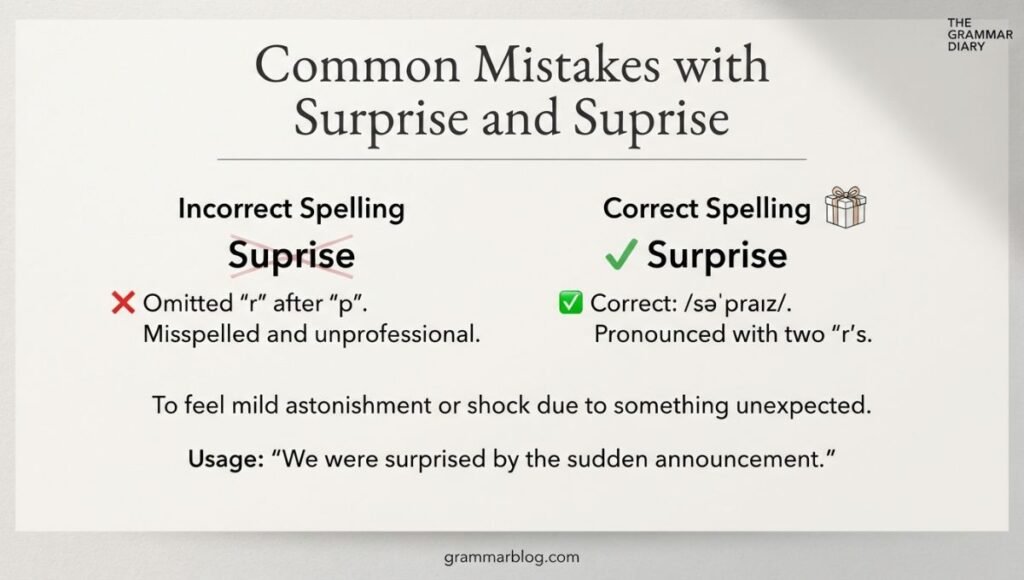
Here are a few real patterns that trip people up, along with quick corrections.
Incorrect: She had a big suprise for her sister. Correct: She had a big surprise for her sister. The middle “r” was dropped during typing, which is the single most common error with this word.
Incorrect: I was suprised by the news. Correct: I was surprised by the news. The same missing “r” carries over into the past tense verb form, so it’s worth double checking any conjugated form of the word too.
Incorrect: It’s not suprising that ticket sales went up. Correct: It’s not surprising that ticket sales went up. The adjective form “surprising” follows the same rule: keep both r’s, every time.
Mistakes like these are extremely common, even among fluent writers, so there’s no need to feel embarrassed if you’ve made one. The fix is simple once you know the rule.
Related Words and Forms of “Surprise”
Once you have the base spelling locked in, these related forms follow the same pattern and are worth knowing:
- Surprised (past tense verb, adjective): “I was surprised by the turnout.”
- Surprising (present participle, adjective): “That’s a surprising result.”
- Surprisingly (adverb): “Surprisingly, the plan worked.”
- Unsurprised / unsurprising (negation): “The outcome was unsurprising.”
Every one of these keeps the same “sur-” structure, so if you remember the root spelling, the related forms are easy to get right too.
3 Simple Tricks to Never Misspell Surprise Again
If the surprise or suprise mistake keeps happening in your writing, try one of these memory tricks:
- Break it into two familiar chunks: “SUR” plus “PRISE.” Saying it in two pieces slows down your fingers just enough to catch the missing letter.
- Think of the phrase “sudden and real”: both start with the same sound as the “sur” in surprise, and it reinforces that the word has that full first syllable.
- Use spell check deliberately: most spell checkers flag “suprise” instantly. If you’re unsure while typing quickly, pause and let the tool confirm it before you send an email or publish a post.
Is “Suprise” Ever Acceptable?
No. Unlike words with legitimate regional or stylistic variants, suprise has no accepted use in any dictionary, style guide, or formal context. It isn’t a British versus American English difference, and it isn’t an informal shorthand. It is simply an error, so there’s no situation, casual or formal, where it should be used on purpose.
FAQs About Surprise or Suprise
Is “surprise” or “suprise” the correct spelling?
Surprise is correct. Suprise is a common misspelling with the middle “r” missing.
What does “surprise” mean?
It refers to an unexpected event or the feeling of being caught off guard by something you didn’t anticipate.
Why do so many people misspell “surprise” as “suprise”?
It usually happens from typing quickly or from a casual pronunciation that softens the first syllable, which leads writers to skip the letter “r” by accident.
How do I use “surprise” correctly in a sentence?
Use it as a noun, verb, or adjective depending on context: “The gift was a surprise,” “She surprised him,” or “It was a surprise party.”
Is “suprise” acceptable in casual writing or texting?
No. Even in informal messages, suprise is still a misspelling and should be corrected to surprise.
Final Takeaway
The surprise or suprise question has a clean, simple answer: surprise is correct, and it’s the only spelling worth using in any context, formal or casual. Keep both r’s in place, remember the “sur-” root, and the mistake becomes easy to avoid for good.










1 thought on “Surprise or Suprise: The 1 Correct Spelling to Use in 2026”