Confused about what “put” actually means beyond “to place something somewhere”? You’re not alone. The put meaning most people learn first is only one of dozens of ways this tiny word works in English, and that gap is exactly why so many learners get stuck. The short answer: “put” is an irregular verb that means to move, place, express, or apply something, and its exact sense always depends on the word that follows it.
What Does “Put” Mean? (Quick Answer)
Here’s the direct put meaning you came here for: “put” is a verb that means to move or place something in a specific position, condition, or state. For example, “I put the keys on the table” means you moved the keys to that spot. But “put” also combines with prepositions (put off, put up, put through) to create dozens of separate meanings that have nothing to do with physical placement.
That’s the whole trick to this word. Learn the core meaning first, then treat each phrasal verb as its own mini-vocabulary word.
Why Is “Put” So Confusing to Define?
“Put” shows up on almost every list of the most common English verbs, and high-frequency words tend to pick up extra jobs over centuries of use. Native speakers rarely notice because context does the heavy lifting for them.
For learners, though, the same word can describe placing a cup on a shelf, expressing an opinion, investing money, or even estimating someone’s age. Dictionaries list over 20 distinct senses for “put” as a standalone verb, and that number grows past 50 once you count phrasal verbs.
“Put” as a Verb: Grammar and Forms
“Put” is one of English’s irregular verbs, which means it does not follow the normal “-ed” pattern for past tense.
| Form | Word | Example |
| Base form | put | I put the mail on the desk every day. |
| Past tense | put | She put the mail on the desk yesterday. |
| Past participle | put | The mail has been put on the desk already. |
| Present participle | putting | He is putting the mail on the desk right now. |
| Third person singular | puts | He puts the mail on the desk every morning. |
Notice that the base form, past tense, and past participle are all identical: put. This trips up a lot of writers who instinctively want to write “putted,” which is only correct in one narrow context (golf, covered below).
How to Pronounce “Put” Correctly
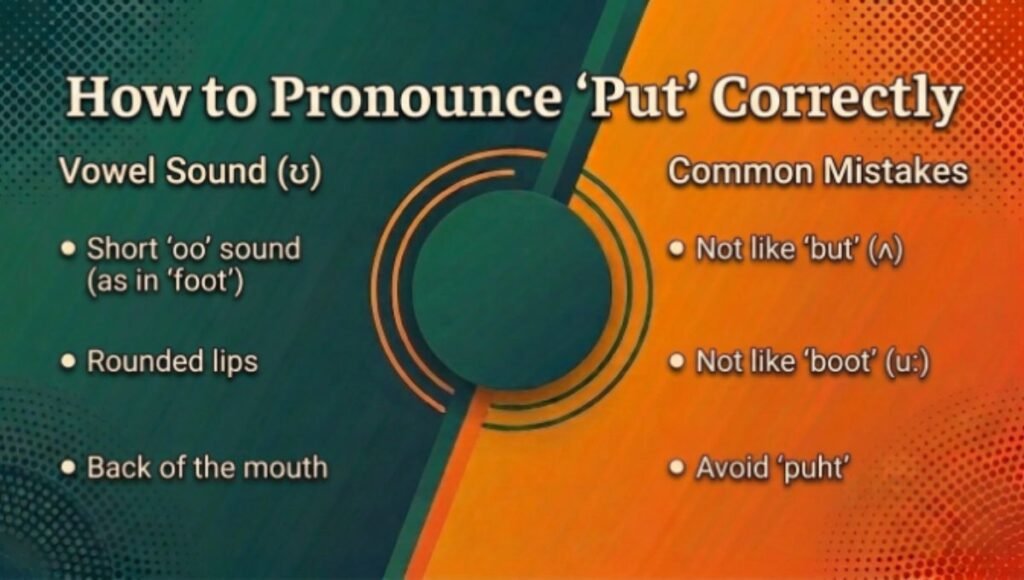
“Put” is pronounced /pʊt/, rhyming with “foot” and “soot,” not with “cut” or “but.” The vowel sound is short and comes from the back of the mouth. English learners whose first language uses a more open vowel sound often overcorrect and make “put” rhyme with “cut,” which changes the word entirely in fast speech.
The Core Meaning: To Place Something Somewhere
The most basic put meaning is physical placement. You use it any time an object moves from one location to another by someone’s action.
- “Put the groceries in the fridge before they spoil.” (everyday conversation)
- “Please put your signature at the bottom of page three.” (formal writing)
- “I put my phone on silent during the meeting.” (workplace communication)
In each case, something physical moves into a new position because of a deliberate action.
More related Post :Take Effect or Take Affect? The 1 Correct Phrase Explained https://feastinsidar.com/take-effect-or-take-affect/
Figurative and Idiomatic Meanings of “Put”
Once you move away from physical objects, “put” starts describing abstract actions. These are the meanings that confuse learners most because nothing is literally being moved.
To express or word something: “Let me put this another way.” Here, “put” means to phrase or state an idea.
To submit or propose: “The manager put the idea to the board.” This means the idea was formally presented.
To estimate: “I’d put her age at around forty.” This means to guess or judge a value.
To apply or invest: “They put a lot of effort into the proposal.” Effort isn’t a physical object, but the sentence still uses “put” to describe applying that effort somewhere.
To bet or wager: “He put fifty dollars on the home team.” Money changes hands figuratively here, tied to a bet rather than a location.
Common Phrasal Verbs With “Put”
This is where the real complexity lives. Each combination below is its own vocabulary item with a distinct meaning.
| Phrasal Verb | Meaning | Example |
| Put off | To postpone | We put off the meeting until Friday. |
| Put up with | To tolerate | I can’t put up with the noise anymore. |
| Put on | To wear, or to pretend | She put on her coat and left. |
| Put out | To extinguish, or to inconvenience | Firefighters put out the blaze quickly. |
| Put through | To connect, or to make someone endure | Can you put me through to billing? |
| Put down | To write, or to criticize | Put down your name on the sign-up sheet. |
| Put across | To communicate clearly | He struggled to put his point across. |
| Put away | To store, or to eat a lot | She put away the winter clothes. |
Notice how far these meanings drift from the original sense of physical placement. “Put up with” has nothing to do with placing anything anywhere, yet it’s one of the most common idioms in spoken English.
“Put” in Business and Finance
In financial markets, “put” is also a noun. A put option gives an investor the right to sell an asset at a fixed price within a set timeframe. Traders shorten this to simply “a put,” as in “she bought a put on the stock.” This usage is specialized, but it appears often enough in business writing and news articles that it deserves a mention.
“Put” in Sports: The Shot Put
The shot put is a track and field event where athletes throw (or “put”) a heavy metal ball as far as possible. Here, “put” functions almost like a noun phrase referring to the specific throwing motion used in the event, which is a controlled push rather than a normal throw. This is also where the irregular verb “putted” occasionally shows up in casual speech about the event, though “put” remains the standard past tense even here.
Put vs Putt vs Putt-Putt: What’s the Difference?
These three words sound almost identical, which causes real confusion for learners and even some native speakers.
| Term | Correct? | Meaning | Use |
| Put | Yes | To place or apply something | General verb, used in almost any context |
| Putt | Yes | A golf stroke on the green | Golf specific: “She sank the putt.” |
| Putt-putt | Yes (informal) | Miniature golf | Casual American English: “We played putt-putt on vacation.” |
Putt is a golf-specific term, and it does follow regular past tense rules: “putted.” So “he putted the ball into the hole” is correct, while “he put the ball into the hole” would only make sense if he physically placed the ball there by hand.
Common Mistakes People Make With “Put”
Incorrect: She putted the dishes in the sink. Correct: She put the dishes in the sink. The word “putted” only applies to golf. For every other use, the past tense is simply “put.”
Incorrect: He put up the noise for years. Correct: He put up with the noise for years. “Put up” alone usually means to build or display something (“put up a fence”). Dropping “with” changes the meaning entirely.
Incorrect: I put the presentation across well. Correct: I put the presentation’s main point across well. “Put across” works best with an idea, point, or message, not an entire event or object.
These slips are common, and native speakers make similar mix-ups with less frequent phrasal verbs. Getting the preposition right is really the whole challenge.
Real-Life Examples of “Put” in Sentences
- Academic writing: “The researchers put forward a new theory to explain the results.”
- Email: “Could you put together a quick summary before our call tomorrow?”
- Casual conversation: “Just put your bag down and relax.”
- Formal writing: “The committee has put in place new guidelines effective next quarter.”
- Business writing: “We need to put a number on the projected savings before the meeting.”
Each example uses a different sense of “put,” yet a native speaker reads all five instantly without confusion because the surrounding words supply the missing meaning.
Related Words and Terms
Depending on context, “put” overlaps with words like place, set, position, express, propose, and invest. It also pairs with prepositions to form idioms such as put through, put across, and put up with, and it appears as a standalone noun in specific fields like finance (put option) and sports (shot put).
Frequently Asked Questions About “Put”
What is the basic put meaning in English?
The basic meaning is to move or place something into a specific position, such as “put the book on the shelf.”
Is “put” the past tense of itself?
Yes. “Put” is irregular, so the base form, past tense, and past participle are all spelled the same way: put.
What does “put up with” mean?
It means to tolerate or endure something unpleasant without complaint, as in “I can’t put up with this weather anymore.”
Is “putted” ever correct?
Yes, but only in golf. “Putted” is the correct past tense of “putt,” the golf stroke, not of the general verb “put.”
How do I know which meaning of “put” a sentence uses?
Look at the preposition or object right after “put.” Physical objects usually signal literal placement, while abstract nouns like “idea,” “effort,” or “blame” usually signal a figurative meaning.
Conclusion
The full put meaning picture comes down to one flexible verb doing dozens of jobs depending on what word follows it. Master the core sense of physical placement first, then learn the phrasal verbs one at a time as you encounter them in real sentences. Once you spot the pattern, “put” stops feeling like a confusing exception and starts feeling like one of the most useful words in English.










1 thought on “Put Meaning Explained: 25 Definitions and Uses You Need to Know ”