
You’ve probably typed both “vender” and “vendor” in the same email and paused, unsure which one actually belongs on the page. That hesitation is common, since both spellings show up in casual writing. Here’s the direct answer to the vender or vendor question: “vendor” is the standard, correct spelling in modern American and British English, while “vender” is a rare variant that some dictionaries still list but almost no one uses today.
The Direct Answer: Vender or Vendor?
“Vendor” is correct and should be used in nearly all writing, from business contracts to casual conversation. “Vender” technically appears in a small number of dictionaries as an older or less common variant spelling, but it’s considered outdated and can come across as a typo to most modern readers.
What “Vendor” Actually Means
A “vendor” is a person or company that sells goods or services, often in a business, retail, or contractual setting.
Example: The vendor delivered the office supplies ahead of schedule.
“Vendor” is used constantly in business writing, contracts, event planning, and everyday retail conversations to describe anyone involved in selling.
Why Both “Vender” and “Vendor” Exist
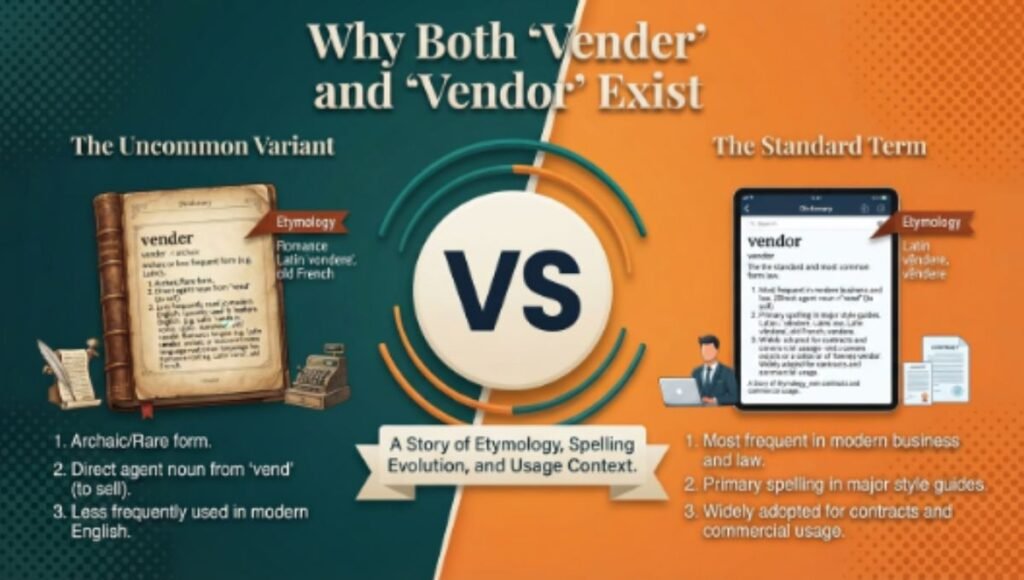
The vender or vendor confusion comes from an old spelling pattern in English. Many agent nouns, meaning words that describe someone who performs an action, once used either “-er” or “-or” endings somewhat interchangeably, especially in earlier printed English. Over time, “vendor” became the standardized spelling, closely following its Latin root, while “vender” faded into rare, mostly historical use.
Is “Vender” Ever Legitimate?
This is where nuance matters. “Vender” isn’t a fabricated mistake the way some misspellings are. A handful of dictionaries, including some older editions, list “vender” as a secondary or variant spelling. However, it’s rarely used in professional, academic, or business writing today, and most style guides and editors treat “vendor” as the only acceptable form in modern contexts.
If you’re writing anything intended for a general audience, a business document, or formal communication, “vendor” is the safer and more widely accepted choice.
Comparing “Vender” and “Vendor” Side by Side
| Term | Correct? | Meaning | Use |
| Vendor | Yes (standard) | A person or company that sells goods or services | The vendor confirmed the delivery date. |
| Vender | Rare variant | Same meaning, but outdated | Generally avoided in modern writing |
The Grammar Behind “Vendor”
“Vendor” is a noun, specifically an agent noun that describes someone who performs the action of selling.
Part of speech: noun Plural form: vendors Related verb: vend (to sell, especially in a formal or public setting) Formality: appropriate for both formal and informal writing
Example (singular): The vendor set up early to prepare for the farmers market. Example (plural): Several vendors competed for the same contract.
Where Does the Word “Vendor” Come From?
“Vendor” traces back to the Latin verb “vendere,” meaning “to sell.” It entered English through legal and commercial French and Latin usage, which explains why “vendor” kept the “-or” ending common in many Latin-derived agent nouns, similar to words like “actor,” “director,” and “creditor.”
How to Pronounce “Vendor” Correctly
“Vendor” is pronounced /ˈvɛn.dər/, with the stress on the first syllable. The ending sounds like “der,” the same sound found in words like “ladder” or “border.”
More related Post: Thier or Their? 5 Reasons This Spelling Trips Up Even Careful Writers https://feastinsidar.com/thier-or-their/
Real Life Examples of “Vendor” in Everyday Use
Everyday conversation: The vendor at the farmers market always saves us the best tomatoes.
Workplace communication: Please confirm the vendor’s invoice before Friday’s meeting.
Academic writing: The report analyzes vendor selection criteria used by small businesses.
Email: We’ve finalized our agreement with the new vendor for office supplies.
Business writing: The company plans to switch vendors after reviewing quarterly performance.
Casual writing: That food truck vendor makes the best tacos in town.
Each of these examples uses “vendor,” the spelling expected in both professional and casual American English.
Common Mistakes People Make With This Word
Incorrect: We signed a contract with the vender last week. Correct: We signed a contract with the vendor last week. “Vender” reads as a spelling error to most modern audiences, even though it technically appears in a few dictionaries as a rare variant.
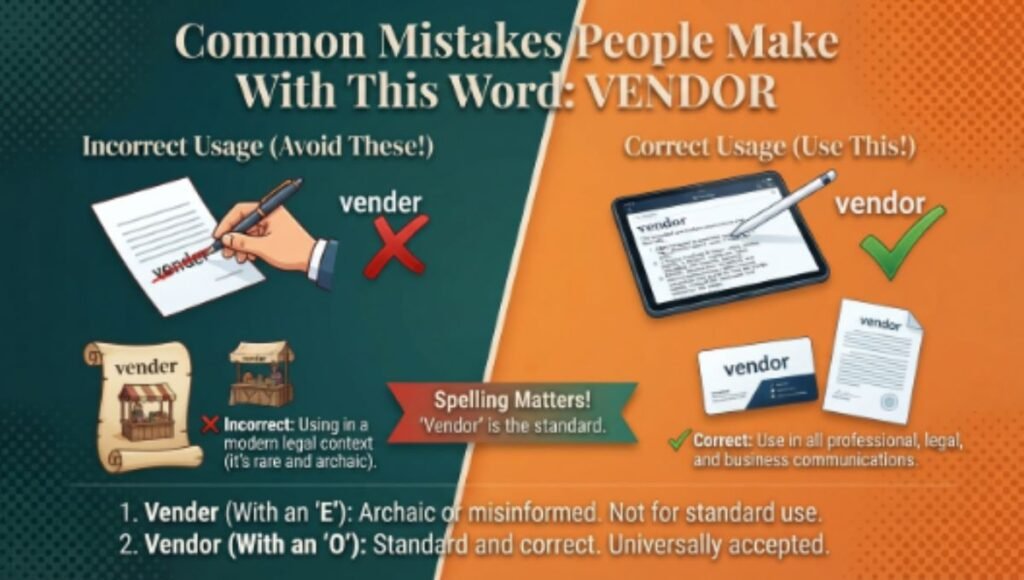
Incorrect: The venders at the trade show were very helpful. Correct: The vendors at the trade show were very helpful. The plural form should follow the standard spelling, “vendors,” not “venders.”
Incorrect: Please contact our vender for updated pricing. Correct: Please contact our vendor for updated pricing. In business communication, “vendor” is expected and helps maintain a professional, polished tone.
Related Words and Terms
Since vender or vendor often comes up alongside similar business vocabulary, here are a few related terms:
- Vend (verb: to sell, especially publicly or formally)
- Vendee (a person who buys from a vendor)
- Supplier (a related term, often used interchangeably with vendor)
- Seller (a general term for anyone who sells)
- Merchant (a person or business involved in trade)
A Simple Trick to Remember the Correct Spelling
Since “vendor” comes from the Latin “vendere,” think of other Latin-based “-or” agent nouns you already know, like “actor” or “creditor.” Connecting “vendor” to that same family of words can help the “-or” ending stick in your memory.
Frequently Asked Questions
Is “vender” a real word?
It appears in a small number of dictionaries as a rare variant spelling, but it’s considered outdated and is rarely used in modern English.
What does “vendor” mean?
A vendor is a person or company that sells goods or services, often used in business, retail, and contract related contexts.
Which spelling should I use in professional writing?
Always use “vendor” in professional, academic, or business writing, since it’s the standard and widely recognized spelling.
What is the plural form of “vendor”?
The plural form is “vendors,” following the standard spelling rather than “venders.”
Where does the word “vendor” come from?
“Vendor” comes from the Latin verb “vendere,” meaning “to sell,” which explains its “-or” ending.
Final Takeaway
When it comes to vender or vendor, the standard and expected spelling in modern English is vendor. While “vender” technically exists as a rare variant in a few dictionaries, sticking with “vendor” keeps your writing clear, professional, and instantly recognizable to any reader.











2 thoughts on “Vender or Vendor? 5 Facts That Settle the Spelling Question”