You typed a sentence, stared at the word, and second guessed whether it should be “thier” or “their.” That hesitation happens to almost everyone at some point, since this word breaks a spelling rule most of us learned in school. Here’s the direct answer: “their” is the correct spelling. “Thier” is simply a common misspelling with no legitimate use in standard English.
The Direct Answer: Thier or Their?
“Their” is correct. “Thier” is not a real word in standard English. It’s a spelling error that happens because “their” seems to break the familiar “i before e” pattern many people memorize early in school. Understanding why the mix up happens makes it much easier to remember the correct spelling for good.
What “Their” Actually Means
“Their” is a possessive pronoun used to show that something belongs to more than one person, or to a person whose gender is unspecified. It answers the question “whose?”
Example: The students packed their backpacks before leaving. Example: Someone left their umbrella by the door.
“Thier,” on the other hand, has no meaning at all. It’s not a word, a variant spelling, or an accepted informal form. It’s purely a typo or memory slip.
Why So Many People Write “Thier” Instead of “Their”
The confusion around thier or their comes from a spelling rule taught in elementary school: “i before e, except after c.” Many learners apply that rule automatically without realizing “their” is one of several common exceptions. Since “e” comes before “i” in “their,” it feels like it should be reversed, which leads directly to the mistake.
Comparing “Thier” and “Their” Side by Side
| Term | Correct? | Meaning | Use |
| Their | Yes | Possessive pronoun showing ownership | Their car, their idea, their house |
| Thier | No | Not a word | Never correct in any context |
There is no situation, formal or informal, where “thier” is the accepted spelling. This is one of the rare cases in English where only one form is ever correct.
The Grammar Behind “Their”
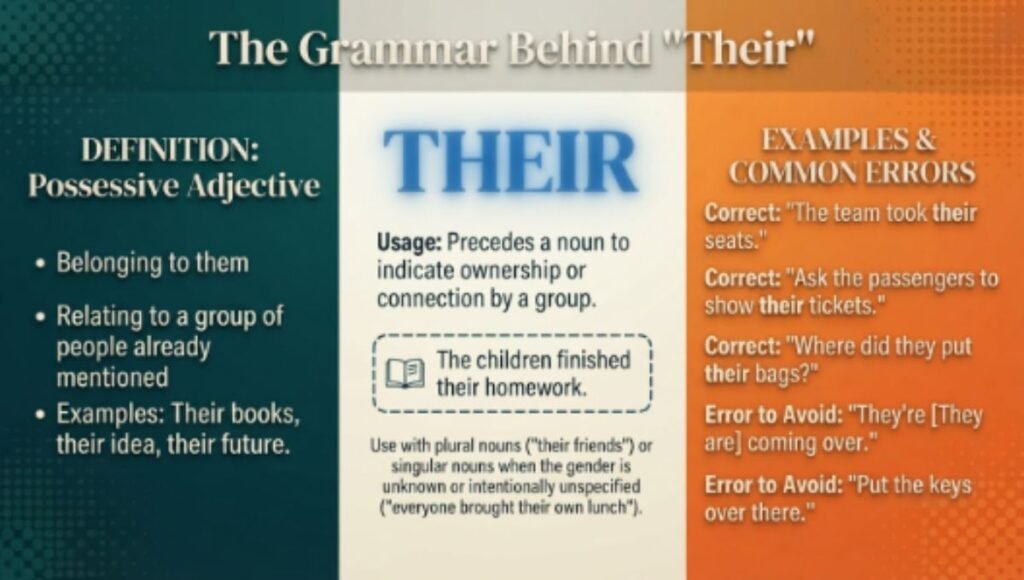
“Their” belongs to the category of possessive pronouns, alongside words like “his,” “her,” “its,” “our,” and “your.” It always comes before a noun to show ownership.
Part of speech: possessive pronoun (sometimes called a possessive adjective) Function: shows that something belongs to a group or an unspecified individual Number: used with plural subjects, or as a gender-neutral singular pronoun
Example (plural): The employees updated their resumes. Example (gender-neutral singular): Each customer should bring their receipt.
That singular, gender-neutral use of “their” is fully accepted in modern American English, especially when a person’s gender is unknown or irrelevant to the sentence.
More related Post: https://feastinsidar.com/i-was-confused-about-are-you-putting-me-on-meaning-6-things-that-cleared-it-up/
Where Does “Their” Come From?
“Their” developed from Old Norse “þeirra,” brought into English through contact between Old English speakers and Norse settlers. It gradually replaced older Old English possessive forms and settled into the spelling we use today. Its Norse origin also explains why it doesn’t follow the typical Old English or Latin-based spelling patterns that shape the “i before e” rule.
How to Pronounce “Their” Correctly
“Their” is pronounced /ðɛr/, rhyming with “there” and “they’re.” All three words sound identical in standard American English, which adds another layer of confusion since they’re spelled so differently despite sharing a pronunciation.
“Their” vs “There” vs “They’re”: A Quick Distinction
Since these three words sound the same, mixing them up is extremely common, separate from the thier or their spelling issue.
Their: shows possession. Example: Their house is down the street. There: refers to a location or introduces a sentence. Example: The keys are over there. They’re: a contraction of “they are.” Example: They’re coming to dinner tonight.
Keeping these three separate takes practice, but remembering that “their” always relates to ownership helps you catch mistakes quickly.
Real Life Examples of “Their” in Use
Everyday conversation: My neighbors just repainted their fence.
Workplace communication: Please have the team submit their reports by Friday.
Academic writing: Researchers analyzed the participants and their responses over six months.
Email: Thank you for sending their contact information.
Business writing: The company updated their return policy last quarter.
Casual writing: I can’t believe they forgot their tickets at home.
Each sentence uses “their” correctly to indicate ownership by a group or an unspecified individual.
Common Mistakes People Make With “Their”
Incorrect: The kids left thier jackets at school. Correct: The kids left their jackets at school. “Thier” is simply a spelling error. Reversing the “e” and “i” creates a non-word.
Incorrect: Everyone should bring there own laptop. Correct: Everyone should bring their own laptop. This mistake confuses “their” (possession) with “there” (location), a different but related error.
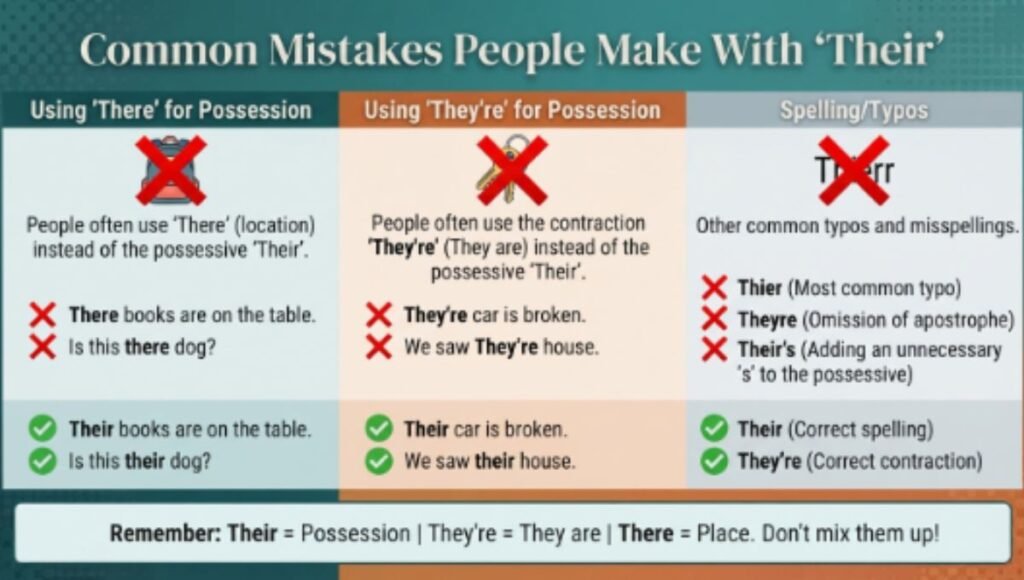
Incorrect: Their coming over later tonight. Correct: They’re coming over later tonight. This swaps “their” with “they’re,” the contraction for “they are.”
A Simple Trick to Remember the Correct Spelling
One easy memory trick: think of the word “heir,” which appears inside “their” (t-HEIR). An heir inherits or owns something, which mirrors the possessive meaning of “their.” This small connection can help the correct spelling stick.
Related Words and Common Confusions
Since thier or their is often searched alongside other homophones, it helps to recognize related terms:
- There (location)
- They’re (contraction of “they are”)
- Theirs (possessive pronoun without a noun, as in “the choice is theirs”)
- Its vs it’s (a similar possessive versus contraction mix up)
- Your vs you’re (another common homophone pair)
Recognizing these patterns helps you avoid similar mistakes across different word groups.
Frequently Asked Questions
Is “thier” ever correct?
No. “Thier” is always a misspelling. The correct spelling in every context is “their.”
What does “their” mean?
“Their” is a possessive pronoun showing that something belongs to more than one person, or to someone whose gender isn’t specified.
How do I remember thier or their is spelled correctly?
Remember that “their” contains the word “heir,” which relates to ownership and inheritance, matching the possessive meaning of “their.”
Is “their” used for both plural and singular subjects?
Yes. “Their” is standard for plural subjects and is also widely accepted as a gender-neutral singular pronoun in modern English.
What’s the difference between “their,” “there,” and “they’re”?
“Their” shows possession, “there” refers to a place, and “they’re” is a contraction of “they are.” They sound identical but serve different grammatical roles.
Final Takeaway
When it comes to thier or their, only one spelling exists in standard English: their. Remembering the hidden word “heir” inside it is a simple way to lock in the correct spelling for good, so you never have to pause and second guess it again.











1 thought on “Thier or Their? 5 Reasons This Spelling Trips Up Even Careful Writers”