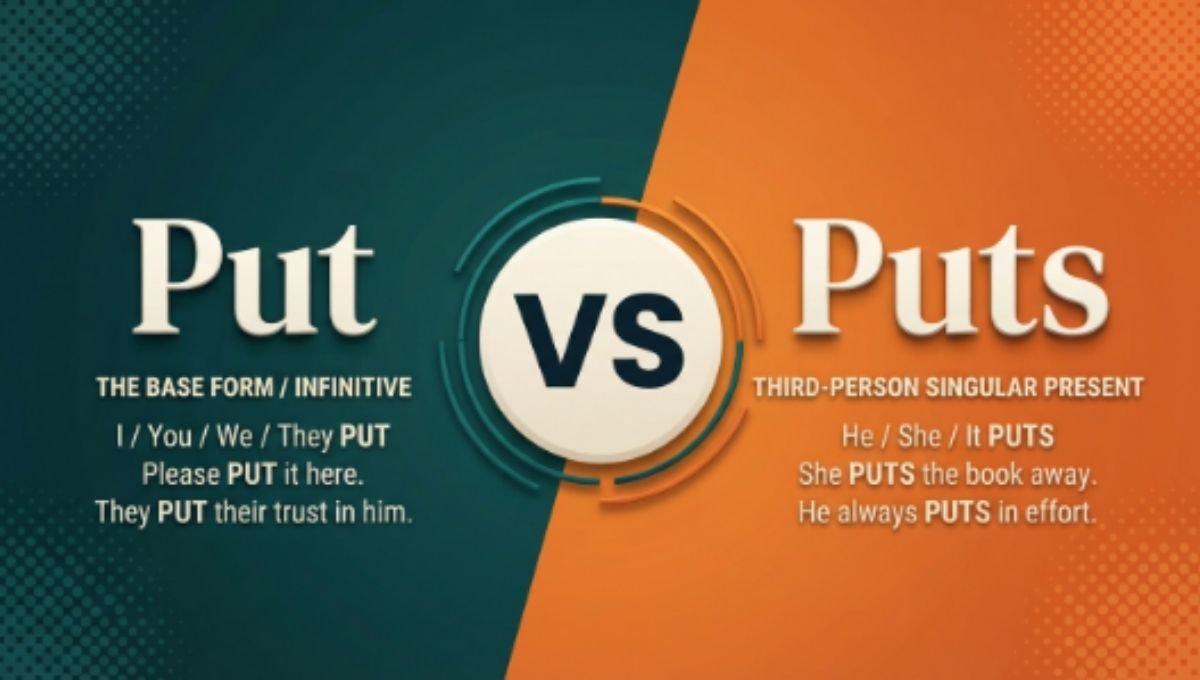
You are halfway through a sentence and suddenly unsure whether it needs put or puts. This happens because put is an irregular verb that barely changes form, so the usual rules feel like they do not apply. Here is the quick answer: both put and puts are correct, and which one you need depends entirely on the subject of your sentence, not on spelling or meaning.
Put or Puts, Which One Is Correct?
Both forms are correct English. This is not a case of one right word and one wrong word. Put is used with I, you, we, they, and plural nouns. Puts is used with he, she, it, and singular nouns, but only in the present tense. Choosing correctly is a matter of subject verb agreement, not spelling.
Why Does English Have Both Put and Puts?
Most English verbs add an “-s” in the present tense only when the subject is third person singular (he, she, it, or a singular noun). Put follows this same pattern. The confusion around Put or Puts usually comes from the fact that put barely changes at all in its other forms, which makes the one place it does change feel unfamiliar.
What Does Put Mean?
Put is a verb meaning to place, set, or position something in a specific location or state. It can also describe expressing something in words, as in “put it simply,” or assigning a value, as in “put a price on it.” The meaning stays identical whether you are using put or puts; only the subject determines which spelling is grammatically correct.
Subject-Verb Agreement: When to Use Put vs Puts
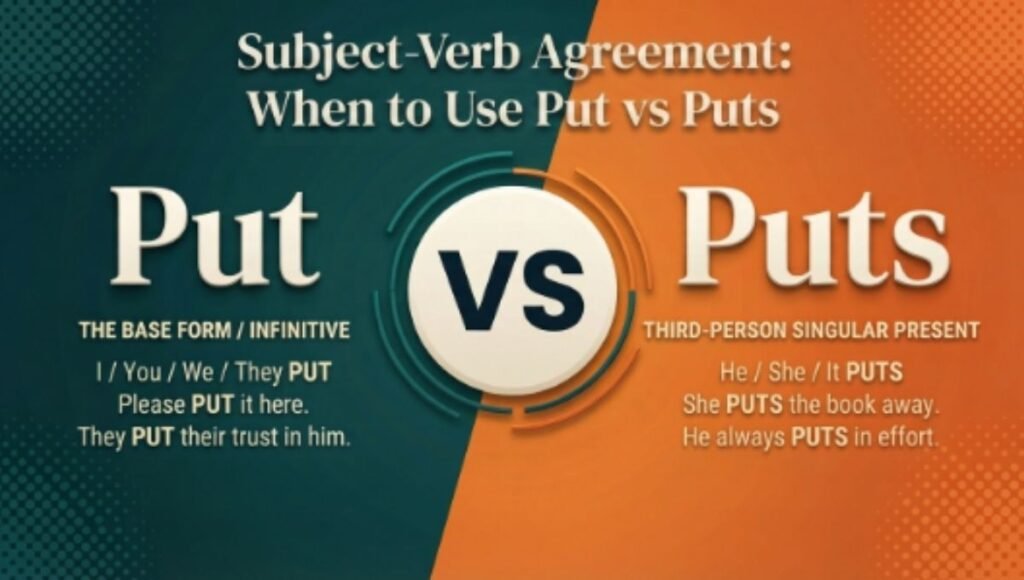
This is the rule that actually resolves the confusion every time, and it works the same way no matter what the rest of the sentence looks like.
- Use put with I, you, we, they, and any plural subject: “They put the boxes in the garage.”
- Use puts with he, she, it, and any singular subject: “She puts the boxes in the garage.”
This is standard subject verb agreement, the same rule that makes “walk” become “walks” for third person singular subjects. Put is unusual only because it does not change in any other tense, which makes this one shift stand out more than it does with regular verbs.
Put as an Irregular Verb: Present, Past, and Past Participle
Here is where put behaves differently from most English verbs. Put is irregular, meaning its past tense and past participle do not follow the usual “-ed” pattern.
- Present tense (except third person singular): put
- Present tense (third person singular): puts
- Past tense: put
- Past participle: put
Notice that put stays the same in the present (for most subjects), past, and past participle. Puts only ever appears in the present tense, and only with third person singular subjects. This is a major reason the two forms trip people up: readers expect a past tense form like “putted,” but standard English does not use one for this verb. Other irregular verbs with an unchanged past tense include “cut,” “hit,” and “set,” so put is far from the only exception to the regular “-ed” pattern.
Read more :Poopie or Poopy: Here’s What I Found https://feastinsidar.com/poopie-or-poopy/
How Do You Pronounce Put and Puts?
Put is pronounced with a short “u” sound, rhyming with “foot” or “book,” not with “cut” or “shut.” Puts adds a simple “s” sound at the end, pronounced PUTS, with the same short vowel carried through. Neither word changes stress or vowel sound between the two forms.
This pronunciation is consistent across American and British English. Unlike some verbs that shift meaning or spelling across regions, put and puts function identically on both sides of the Atlantic, both in grammar and in sound.
Formal and Informal Usage of Put and Puts
Put and puts appear just as often in casual conversation as they do in formal writing, which is unusual for a verb this common. There is no informal variant or shortcut spelling to worry about, and no difference in how the words are treated in academic versus everyday contexts. The only variable that ever matters is the subject of the sentence.
This consistency is part of what makes the rule reliable once you learn it: there are no exceptions carved out for tone, register, or writing style.
Put or Puts: Side by Side
| Form | Correct? | Used With | Tense |
| Put | Yes | I, you, we, they, plural nouns | Present, past, past participle |
| Puts | Yes | He, she, it, singular nouns | Present tense only |
How to Use Put and Puts in a Sentence
Seeing both forms in real, natural sentences makes the distinction easier to apply without thinking twice, especially across different everyday and professional contexts.
- Everyday conversation: “I put my phone on the counter every morning.”
- Everyday conversation (singular subject): “My sister puts her phone on the counter every morning.”
- Workplace communication: “The team puts together a status report every Friday.”
- Business email: “Please put the invoice on hold until we confirm the amount.”
- Academic writing: “The author puts forward a compelling argument in the second chapter.”
- Formal writing: “The committee put the proposal to a vote last week.” (past tense, same spelling as present for non-third-person subjects)
Common Mistakes With Put and Puts
Incorrect: She put the folder on my desk every afternoon. Correct: She puts the folder on my desk every afternoon. Since “she” is a third person singular subject in the present tense, the verb needs the “-s” ending.
Incorrect: The manager put reports together every quarter, but this time she puted it early. Correct: The manager puts reports together every quarter, but this time she put it early. Put does not become “puted” in the past tense; it stays as put in every tense except third person singular present.
Incorrect: They puts the schedule online on Mondays. Correct: They put the schedule online on Mondays. “They” is a plural subject, so it takes put, not puts, even though the sentence is present tense.
Related Verb Forms: Putting and Put Together
Two related forms show up often alongside these two verb choices, and knowing them rounds out your understanding of how put behaves in longer phrases.
| Related Form | Function | Example |
| Putting | Present participle, used in continuous tenses | “He is putting the tools away.” |
| Put together | Phrasal verb meaning to assemble or organize | “We put together a new schedule.” |
| Puts together | Third person singular version of the phrasal verb | “She puts together a new schedule every month.” |
Notice that “put together” follows the exact same subject verb agreement rule as put alone, since “together” is just an addition to the base verb.
Quick Rule to Remember Put vs Puts
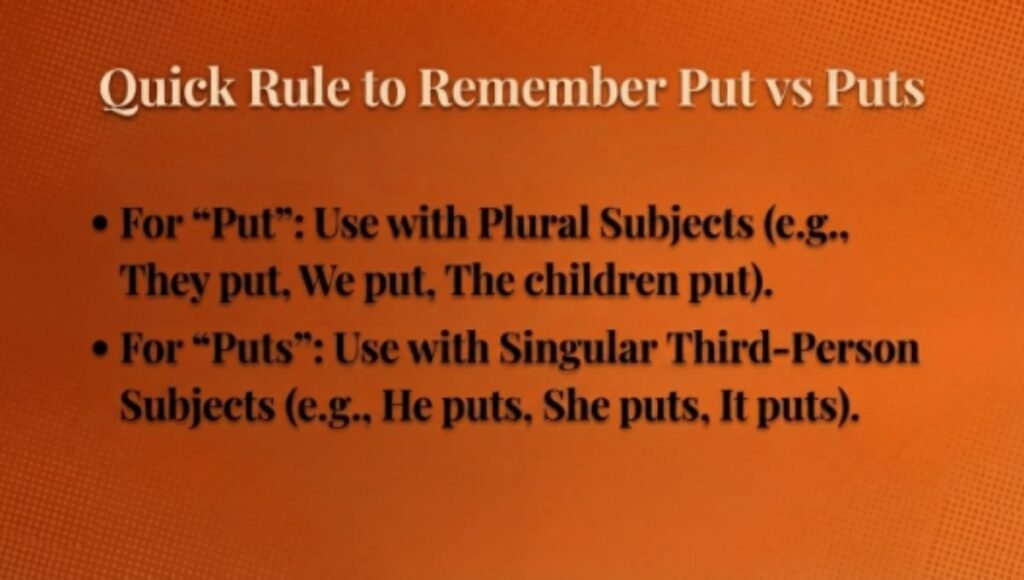
If you get stuck mid-sentence, ask one question: can you replace the subject with “he” or “she” and have the sentence still make sense? If yes, use puts. If the subject is I, you, we, they, or anything plural, use put. This single test resolves the decision nearly every time without needing to memorize a longer rule.
Frequently Asked Questions
Is it put or puts for he?
Use puts with “he” in the present tense, since “he” is a third person singular subject: “He puts his keys on the table.”
Is it put or puts for they?
Use put with “they,” since “they” is treated as plural in English even when it refers to one person: “They put their keys on the table.”
What is the past tense of put?
The past tense of put is also put. It is an irregular verb that does not change between present (for most subjects), past, and past participle, which is different from regular verbs that add “-ed.”
Is puted a real word?
No. Puted is not a correct English word. Put is irregular and never takes the “-ed” ending in the past tense.
Does put or puts change based on formal versus informal writing?
No. The choice between put and puts depends only on the subject of the sentence, not on how formal or casual the writing is.
Can put ever be used with a singular subject?
Yes, but only in the past tense. Since put stays the same in the past regardless of subject, a sentence like “She put the box down yesterday” is correct even though “she” is singular, because the sentence is not in the present tense.
Conclusion
The Put or Puts question comes down to one rule: match the verb to the subject, using puts for he, she, it, and singular nouns, and put for everything else, including the past tense. Once that subject verb agreement rule clicks, choosing between the two forms becomes automatic, and you can move on to the rest of your sentence without a second thought.










1 thought on “Put or Puts? 4 Rules That Make the Right Choice Automatic”