
You typed the word, stared at it for a second too long, and now you are not sure if it should have one “t” or two. This mix up happens because English spelling rules for adding “-ing” are not obvious unless someone has explained them to you. Here is the short answer to Puting vs Putting: putting (with two t’s) is the only correct spelling in standard English. “Puting” is a common misspelling, not an accepted variant.
Which Spelling Is Correct: Puting or Putting?
Putting is correct. Puting is incorrect. There is no context in standard American or British English where “puting” is an accepted spelling, whether you are talking about placing an object somewhere or referring to the golf term.
This is not a case of two acceptable options like “color” and “colour.” It is a straightforward spelling rule, and once you see the rule, the Puting vs Putting question stops being confusing.
Why Do People Misspell Putting as Puting?
Most people who write “puting” are not being careless. They are unconsciously applying a different spelling rule, one that works for words like “hope” (which becomes “hoping”). Since “put” and “hope” both end in a single consonant, it feels natural to treat them the same way and just add “-ing.”
The problem is that “put” and “hope” belong to two different spelling categories, and mixing them up is where the Puting vs Putting confusion usually starts.
What Does Putting Mean?
Putting is the present participle (the “-ing” form) of the verb put, meaning to place, position, or set something somewhere. It functions in two main grammatical roles: as part of a continuous verb tense (“I am putting the box down”) and as a gerund, where it acts like a noun (“Putting things off is a bad habit”). In both roles, the spelling never changes, which is one of the reasons the Puting vs Putting question comes up so often. Learners sometimes assume a gerund might follow different spelling rules than a continuous verb form, but English treats them identically here.
Examples of its core meaning:
- “She is putting the dishes away.”
- “Putting the report off any longer isn’t an option.”
The Doubling Rule: Why Put Becomes Putting
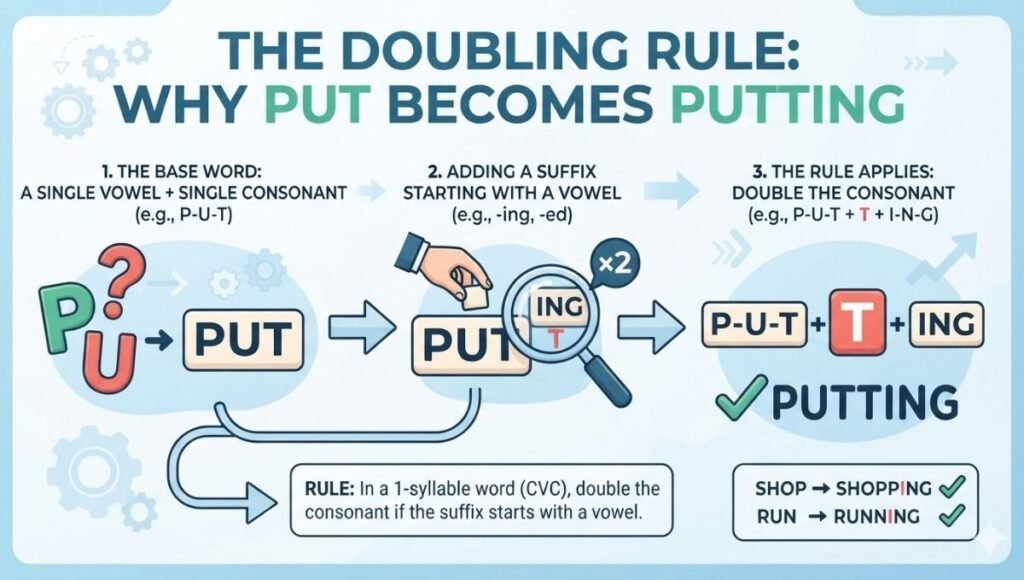
Here is the actual grammar rule behind the correct spelling. In English, a one syllable verb that ends in a single vowel followed by a single consonant (a pattern spelling teachers call CVC, for consonant, vowel, consonant) doubles that final consonant before adding a suffix that starts with a vowel, like “-ing” or “-ed.”
Break down the word put: p (consonant), u (vowel), t (consonant). That is a textbook CVC pattern, so the final “t” doubles: put + t + ing = putting.
This is the exact same rule that turns:
- sit into sitting
- run into running
- stop into stopping
The rule also explains why some short verbs do not double their final letter. A word like “start” ends in two consonants (r and t), not a single vowel plus single consonant, so it simply becomes “starting” with no doubling. A word like “hope” ends in a silent “e,” so English drops that “e” before adding “-ing” instead of doubling anything, giving you “hoping.” Put does not fit either of those patterns. It fits the CVC pattern exactly, which is why doubling is required rather than optional.
Puting skips the doubling step entirely, which is why it looks and sounds wrong to a trained eye.
Read more :Time Flies or Time Flys? I Found the Definitive Answer in 2026 https://feastinsidar.com/time-flies-or-time-flys/
How Do You Pronounce Putting?
Putting is pronounced PUT-ing, with a short “u” sound, the same vowel sound as in “put,” “foot,” or “book.” It does not rhyme with words like “cute” or “muting.”
That short vowel sound is actually a clue to the correct spelling. Doubling the consonant after a short vowel is a common signal in English that the vowel stays short, while a single consonant after a vowel often signals a long vowel sound instead.
Puting vs Putting: Side by Side
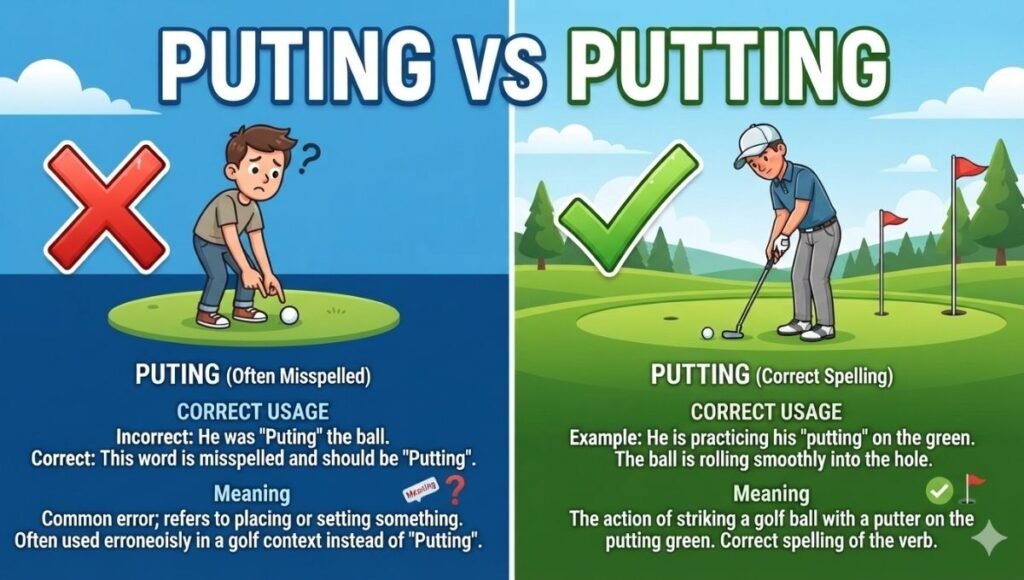
| Term | Correct? | Meaning | Use |
| Putting | Yes | Present participle of “put”; placing or positioning something | Standard spelling in all contexts, including golf |
| Puting | No | Not a recognized English word | Common misspelling; avoid in any writing |
Is Puting Ever Correct in English?
No. Puting does not appear in Merriam-Webster, Oxford, or any other major English dictionary as a standard word. It is not a regional variant, an informal spelling, or an alternate form. It is simply a misapplication of the doubling rule.
If you see “puting” in something you are reading, treat it as a typo, not as evidence that the spelling is flexible.
How to Use Putting in a Sentence
Seeing the correct word in real contexts makes the Puting vs Putting distinction easier to remember, especially since the word shows up constantly in everyday, professional, and academic writing.
- Everyday conversation: “I keep putting my keys in the wrong drawer.”
- Workplace communication: “Are you putting together the slides for Monday’s meeting?”
- Academic writing: “The researcher’s method involves putting theoretical models to a practical test.”
- Formal writing: “The committee is putting forward a revised proposal for review.”
- Business email: “Thanks for putting this together on short notice.”
Putting in Golf: A Special Case
Golfers use “putting” to describe the light stroke used to roll the ball into the hole on the green, as in a “putting green” or “putting stroke.” This comes from the noun “putt,” a short, controlled golf stroke, which follows the same doubling pattern: putt already has a double “t,” and adding “-ing” simply keeps it, giving you “putting.”
It helps to know that “putt” and “put” are two separate words with different meanings, even though they sound alike in casual speech and are easy to confuse in writing. “Put” is the everyday verb for placing something, while “putt” is specific to golf. Both, however, resolve to the identical “-ing” spelling once you add the suffix.
So whether you mean placing an object somewhere or making a golf stroke, the spelling stays the same: putting, never puting.
Common Mistakes With Put, Putting, and Related Words
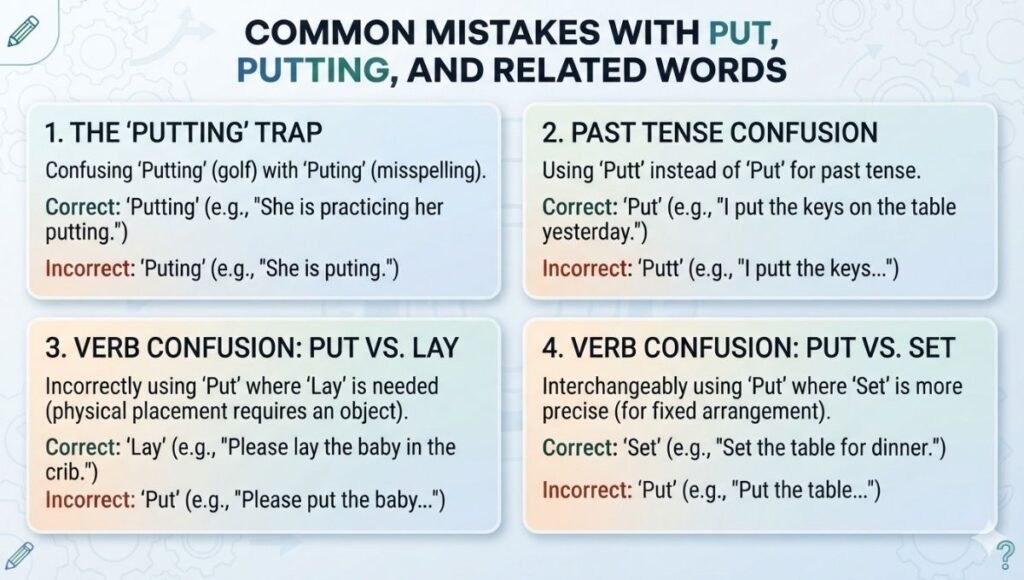
Incorrect: She is puting the groceries on the counter. Correct: She is putting the groceries on the counter. The verb needs the doubled consonant to match the CVC spelling rule.
Incorrect: He was puting off the decision for weeks. Correct: He was putting off the decision for weeks. Even in phrasal verbs like “put off,” the same doubling rule applies to “putting.”
Incorrect: Their puting green needs new grass. Correct: Their putting green needs new grass. The golf related sense of the word follows identical spelling rules to the everyday verb.
Words With Similar Spelling Rules
| Base Word | Correct -ing Form | Same Rule as Putting? |
| Put | Putting | Yes, CVC doubling |
| Sit | Sitting | Yes, CVC doubling |
| Run | Running | Yes, CVC doubling |
| Hope | Hoping | No, drop the silent e |
| Start | Starting | No, ends in two consonants |
Quick Tips to Never Misspell Putting Again
A few habits make the correct spelling automatic over time.
- Say the word out loud and listen for the short “u” sound, which signals a doubled consonant.
- Break the word into consonant, vowel, consonant (p, u, t) before adding “-ing.”
- Compare it mentally to “sitting” or “running,” which follow the identical pattern.
- If a spell checker flags “puting,” trust it rather than assuming it is a stylistic choice.
Once the CVC pattern clicks, the Puting vs Putting question stops being a guessing game and becomes a rule you can apply to dozens of other short verbs without a second thought.
Frequently Asked Questions
Is puting a word?
No. Puting is not a recognized word in English. The correct spelling is always putting.
Why does putting have two t’s?
Putting has two t’s because “put” ends in a single vowel followed by a single consonant (CVC), and English doubles that final consonant before adding “-ing.”
Is putting one word or two?
Putting is one word, spelled p-u-t-t-i-n-g, used as the “-ing” form of “put.”
Does the Puting vs Putting rule apply to golf terms too?
Yes. Whether you mean placing an object or the golf stroke, the correct spelling is always putting, never puting.
What is the correct past tense of put?
The past tense of “put” is also “put.” English treats “put” as an irregular verb that does not change form in the past tense, unlike “putting,” which follows the regular doubling rule for its “-ing” form.
Conclusion
The Puting vs Putting debate has a clear, rule based answer: putting is correct, and puting is a misspelling with no legitimate use in standard English. Remember the short vowel sound in “put,” double that final “t,” and the correct spelling will follow every time.










1 thought on “Puting vs Putting: 3 Rules That Settle the Spelling for Good”