Adding an “s” to make a word plural usually works, so why does “potatos” look wrong the moment you write it? The potatoes or potatos confusion happens because words ending in a consonant plus “o” often break the standard pluralization rule. Once you see the pattern behind it, the potatoes or potatos question becomes simple to settle for good.
Quick Answer: Is It Potatoes or Potatos?
“Potatoes” is the correct plural spelling. “Potatos” is not a recognized word in any English dictionary and is considered a spelling error in every context, formal or informal. Whenever you’re unsure about potatoes or potatos, always choose “potatoes.”
What Does “Potatoes” Mean?
“Potatoes” is the plural noun form of “potato,” referring to more than one of the starchy root vegetable used in countless dishes worldwide. It’s used any time you’re talking about two or more potatoes:
- I bought five potatoes at the market.
- The potatoes need another ten minutes to boil.
The singular form, “potato,” refers to just one of the vegetable.
Why “Potatos” Looks Right, But Isn’t
Most English learners assume every plural noun just needs an added “s,” which works for words like “apple” to “apples” or “chair” to “chairs.” But potato ends in a consonant followed by the letter “o,” and that specific pattern changes how the plural is formed in English. This is exactly why the potatoes or potatos mistake happens so often.
Many nouns ending in a consonant plus “o” add “-es” instead of just “s” to form their plural, and “potato” follows that exact pattern.
The Spelling Rule Behind Potato to Potatoes
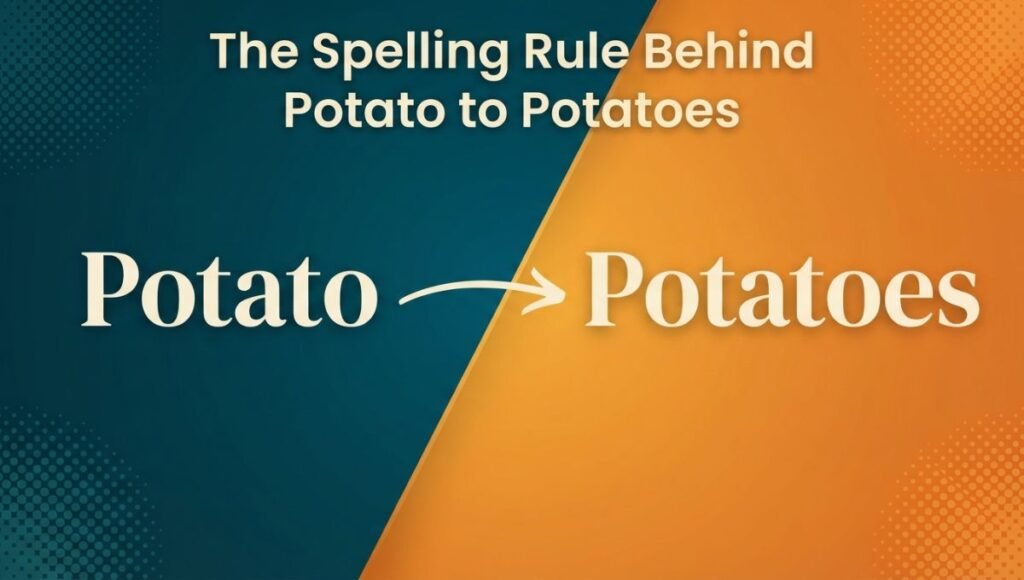
Here’s the rule in plain terms:
When a noun ends in a consonant followed by “o,” add “-es” to form the plural, not just “s.”
So the transformation looks like this:
- potato → potato + es → potatoes
This same rule applies to other common nouns ending in consonant plus “o,” which helps you spot the pattern:
- tomato → tomatoes
- hero → heroes
- echo → echoes
None of these become “tomatos,” “heros,” or “echos” in standard English. If you remember that “potatoes” belongs to the same word family as “tomatoes” and “heroes,” the correct spelling becomes much easier to recall.
Is This Rule the Same for Every Word Ending in “O”?
Not always, and this is where things get slightly tricky. Some nouns ending in a vowel plus “o” simply add “s,” like “radio” to “radios” or “video” to “videos.” Others ending in a consonant plus “o” only add “s” as well, like “photo” to “photos” or “piano” to “pianos.” There’s no single rule that covers every “o” ending word, which is exactly why potatoes or potatos trips people up. For “potato” specifically, the accepted and dictionary confirmed plural is “potatoes.”
Potato, Potatoes: The Singular and Plural Forms
Since English learners often want to see the full pattern side by side, here’s a simple breakdown:
| Form | Word | Example |
| Singular | potato | This potato is perfect for baking. |
| Plural | potatoes | These potatoes are perfect for baking. |
There is no alternate accepted plural. Unlike some grammar debates where two forms are both correct, the potatoes or potatos question has only one right answer.
More related Post: Finaly or Finally: 5 Simple Facts to Fix This Common Mistake (2026) https://feastinsidar.com/finaly-or-finally/
Is “Potatos” Ever Acceptable?
No, not in standard English. “Potatos” does not appear in any major dictionary and is not used in formal, academic, or professional writing. It’s simply a common misspelling, often caused by applying the standard “add an s” rule without accounting for the “-es” pattern that applies to words like “potato.”
Grammar Breakdown: Noun and Possessive Forms
“Potato” and “potatoes” change form depending on how they’re used in a sentence.
Singular possessive: the potato’s skin (one potato, something belongs to it)
Plural possessive: the potatoes’ texture (more than one potato, something belongs to them collectively)
Plural noun (no possession): the potatoes (simply referring to more than one potato)
This distinction matters because “potatos” sometimes gets mistakenly used in place of the plural form, when the correct spelling always includes the extra “e.”
Where “Potato” Comes From
The word “potato” comes from the Spanish word patata, which itself derived from a word in the Taino language, an indigenous language of the Caribbean, referring to the sweet potato. As Spanish explorers brought the vegetable back to Europe, the word entered English in the late 16th century and eventually settled into its current spelling. The “-es” plural ending follows a broader historical pattern in English where certain words ending in “o” adopted the “-es” form over time.
How to Pronounce “Potatoes”
“Potatoes” is pronounced puh-TAY-tohz, with three syllables and stress on the second syllable. There’s no pronunciation debate tied to potatoes or potatos, since “potatos” isn’t a real word to pronounce differently in the first place.
Potatoes or Potatos: Quick Comparison Table
| Term | Correct? | Meaning | Use |
| Potatoes | Yes | Plural of potato, more than one root vegetable | Standard spelling in all writing, US and UK English |
| Potatos | No | Not a recognized word | Common misspelling, never appears in dictionaries |
“Potatoes” in Real Sentences
Everyday conversation: “Can you grab some potatoes from the store on your way home?”
Workplace communication: “The catering order includes roasted potatoes as a side dish.”
Academic writing: “The study examined crop yields for potatoes grown in varying soil conditions.”
Email: “Please confirm the quantity of potatoes needed for Saturday’s event.”
Business writing: “The farm supplies potatoes to several regional grocery chains.”
Casual writing: “I made way too many potatoes for dinner tonight.”
Each of these sentences uses “potatoes” correctly, and none of them would work with “potatos” in place of it.
Common Mistakes With Potato and Potatoes
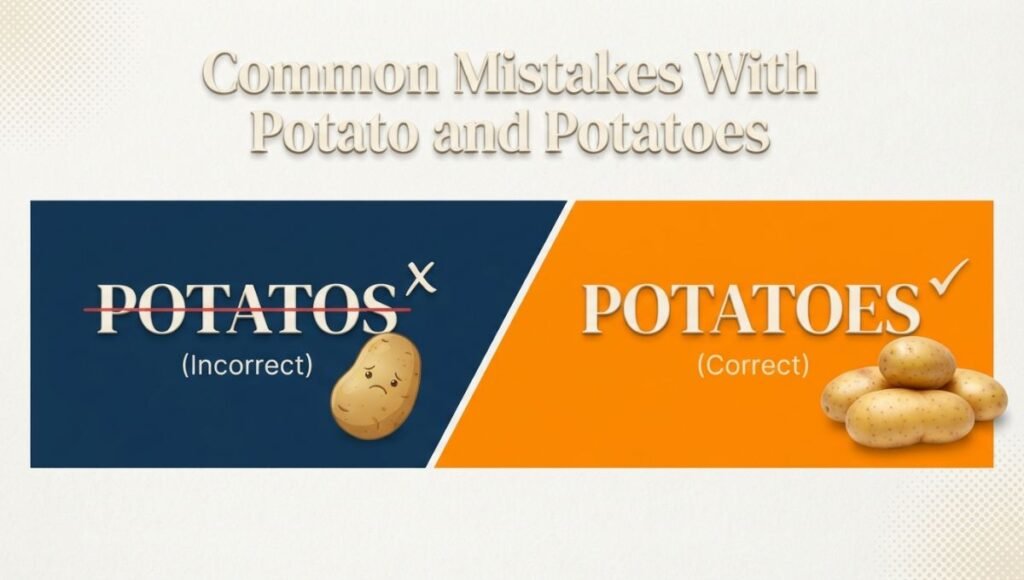
Incorrect: I bought five potatos at the store.
Correct: I bought five potatoes at the store.
This is the classic potatoes or potatos mistake, caused by applying the standard “add an s” rule without accounting for the “-es” ending.
Incorrect: The recipe calls for two potatoe.
Correct: The recipe calls for two potatoes.
This mistake drops the final “s” while also misspelling the singular form, so both the singular and plural need correcting here.
Incorrect: She peeled the potato’s for dinner.
Correct: She peeled the potatoes for dinner.
Here the writer mistakenly added an apostrophe, which is only used for possession, not for forming a plural.
Related Words and Terms
A few related terms are useful for context:
- Tuber: the botanical term describing what a potato actually is
- Starch: the main component that gives potatoes their texture
- Mashed potatoes: a common dish made from cooked, mashed potatoes
- Sweet potato: a different root vegetable, often confused with regular potatoes
- Spud: an informal, casual term for a potato
Knowing these related terms helps you choose the most precise word depending on context, rather than relying on “potato” or “potatoes” for every situation.
How to Remember the Correct Spelling
A simple trick: think of the “consonant plus o” family together, like potato, tomato, and hero. All three become potatoes, tomatoes, and heroes, each adding “-es” instead of just “s.” Once this pattern clicks, the potatoes or potatos question won’t trip you up again.
FAQs About Potatoes or Potatos
Is “potatos” ever correct?
No. “Potatos” is not found in any major dictionary and is considered a spelling error in every context, formal or informal.
Why does “potato” become “potatoes” instead of “potatos”?
Nouns ending in a consonant followed by “o” typically add “-es” to form the plural, and “potato” follows that same pattern as “tomato” and “hero.”
What is the possessive form of “potato”?
For one potato, it’s “potato’s” (as in “the potato’s skin”). For more than one potato, it’s “potatoes'” (as in “the potatoes’ texture”).
Is there a British English difference for “potatoes”?
No. “Potatoes” is spelled the same way in both American and British English, so there’s no regional variation to consider.
How do I use “potatoes” correctly in a sentence?
Use “potatoes” whenever you’re referring to more than one potato, such as “We roasted the potatoes with olive oil and rosemary.”
The Bottom Line
The potatoes or potatos debate has one clear winner: “potatoes” is correct, and “potatos” is a spelling mistake, not an alternate form. Once you remember that nouns ending in a consonant plus “o” often add “-es” rather than just “s,” “potatoes” will stick with you for good.










1 thought on “Potatoes or Potatos: 5 Facts to Nail This Plural Spelling (2026)”