Trying to settle gage or gauge in a sentence, and both spellings look strangely correct? That’s because they are, just not for the same reason. Quick answer: gauge is the standard spelling for a measuring instrument or the act of measuring, while gage is a real but far less common word, tied mainly to an old sense of a pledge or challenge, plus a rare technical variant. The choice between gage or gauge almost always comes down to which meaning you actually need.
Quick Answer: Which Spelling Should You Use?
For nearly every everyday sentence about measuring something, gauge is correct. Use it for a measuring instrument (“a pressure gauge”), a standard of comparison (“a good gauge of success”), or the verb meaning to measure or estimate (“I gauge the risk is low”).
Gage is not a misspelling. It’s a legitimate word with its own history, but it means something different in most cases and only overlaps with gauge in specific technical fields.
What Does Gauge Mean?
Gauge works as both a noun and a verb, and nearly all of its common meanings connect to measurement.
As a noun, gauge refers to:
- A device that measures something, such as a fuel gauge or pressure gauge.
- A standard of measurement, size, or thickness, such as wire gauge or shotgun gauge.
- A general standard used for comparison, such as “a gauge of public opinion.”
As a verb, gauge means:
- To measure something precisely, as in “we gauged the water depth.”
- To estimate or judge, as in “it’s hard to gauge her reaction.”
This is the spelling nearly every dictionary and style guide recommends by default.
What Does Gage Mean?
Gage, historically, refers to something offered as security or a pledge, such as an item given to guarantee a promise or debt. It also has an older, more dramatic meaning: an object, traditionally a glove, thrown down as a formal challenge to combat. Shakespeare uses this sense in “Richard II,” when a character is told to “throw up your gage.”
Both of these meanings are largely archaic today. You won’t hear someone casually mention a gage in modern conversation unless they’re discussing older literature or ceremonial language.
Gage also survives as an accepted, though uncommon, variant spelling of gauge in specialized technical and industrial fields, including mechanical engineering, manufacturing, and electronics. This usage shows up worldwide, not only in the United States, though it remains rare compared to the standard spelling.
Is Gage an American Spelling of Gauge?
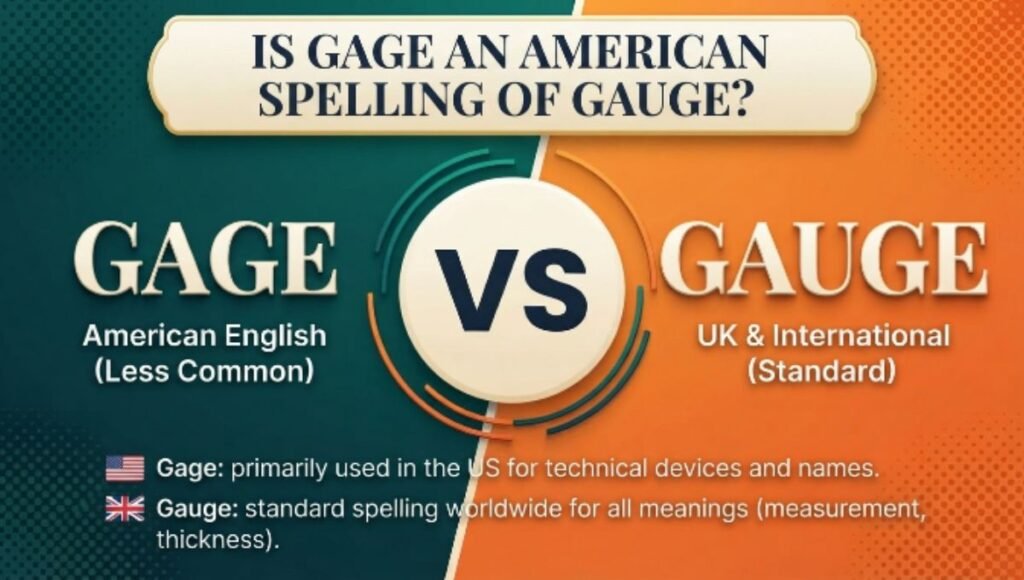
This is a common misconception. Many people assume gage or gauge simply splits along American versus British lines, similar to “color” and “colour.” That’s not accurate.
Merriam-Webster’s research shows that gage as a technical variant appears in specialized industries globally, not as a distinctly American form. The vast majority of American writing, including American dictionaries and style guides, still treats gauge as the correct, standard spelling.
More related Post : Audiodisplayed Meaning: What Does It Mean and How Is It Used? (2026 Guide) https://feastinsidar.com/audiodisplayed-meaning/
Why Do Gage and Gauge Sound the Same?
Both words are pronounced identically: /geɪdʒ/, rhyming with “page” and “cage.” This shared pronunciation is exactly why so many people search gage or gauge in the first place, and why people confuse them in writing. Since spelling isn’t guided by sound alone in English, hearing the word gives you no clue about which spelling fits your sentence.
A Brief Look at Where These Spellings Came From
Both words trace back to Old French. “Gauger,” related to measuring, evolved into the English “gauge” we use today for measurement. Separately, “gage,” from Old French for a pledge, kept its original meaning tied to security and challenge.
During the medieval period, when English spelling wasn’t standardized, both spellings appeared interchangeably for various senses. Over time, gauge became firmly attached to measurement, while gage retained its pledge-related meaning and lingered on as an occasional technical variant.
Grammar Notes: Verb Forms and Spelling Changes
Because both words end in a silent “e,” their verb forms drop that “e” before adding “-ing,” following standard English spelling rules.
| Base Form | Past Tense | Present Participle |
| Gauge | Gauged | Gauging |
| Gage | Gaged | Gaging |
Neither word doubles a consonant or changes its root spelling beyond the standard silent-e drop. If you see “gaugeing” or “gageing,” that’s a spelling error in either case.
Gage or Gauge: A Side-by-Side Comparison
| Term | Correct? | Primary Meaning | Common Use |
| Gauge | Yes, standard | Measuring instrument or the act of measuring | Everyday, technical, and formal writing |
| Gage | Yes, but rare | A pledge or challenge; occasional technical variant of gauge | Literary, historical, and some specialized industries |
When you’re deciding between gage or gauge and you’re not writing about pledges, challenges, or working within a niche technical field that specifically uses “gage,” gauge is almost always the safer choice.
Real-Life Examples Across Different Contexts
Everyday conversation: “Can you check the tire pressure gauge before we leave?”
Workplace communication: “We’ll gauge customer interest before finalizing the product launch.”
Academic writing: “Researchers used the survey results to gauge public trust in local government.”
Technical or engineering context: “The manufacturer specifies a 12-gage wire for this wiring application,” reflecting the accepted industry variant.
Literary or historical reference: “The knight threw down his gage, formally challenging his rival to a duel.”
Business email: “Let’s gauge the team’s bandwidth before committing to the new deadline.”
Common Mistakes People Make
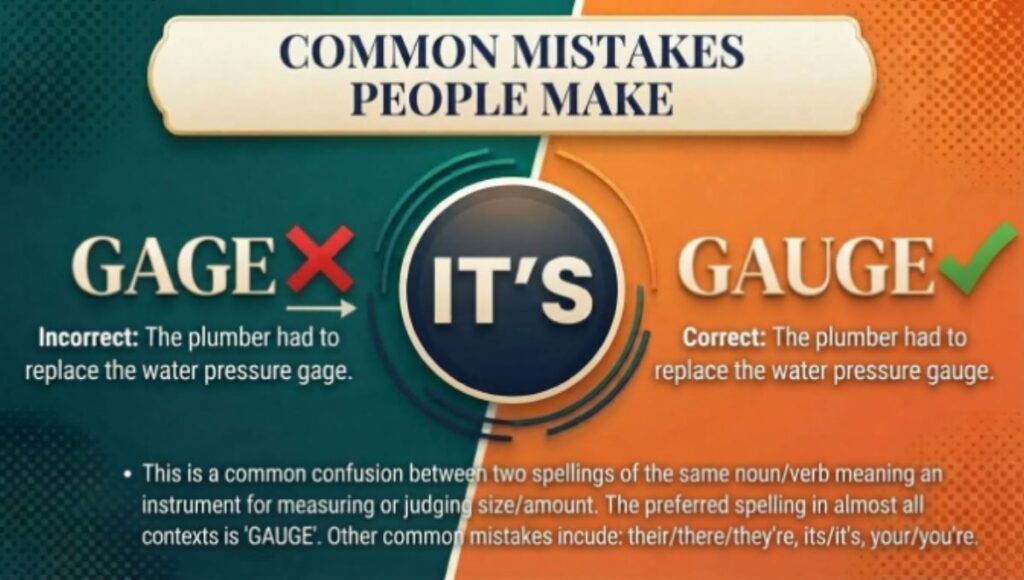
Incorrect: “I can’t guage how she’ll react to the news.” Correct: “I can’t gauge how she’ll react to the news.” This is a simple misspelling of gauge, not an actual use of the word gage. The “au” comes before the “g,” not after.
Incorrect: “He offered his watch as a guage for the loan.” Correct: “He offered his watch as a gage for the loan.” Here, the meaning is a pledge or security, which calls for gage, not gauge.
Incorrect: “The pressure gage is broken,” written in a general consumer product manual. Correct: “The pressure gauge is broken.” Outside of specific technical or industrial writing, gauge remains the expected spelling, even for equipment.
Related Words Worth Knowing
- Greengage, a type of plum, unrelated to measurement but sharing the “gage” spelling
- Engage, a completely different word despite the shared letters
- Wire gauge, a standardized measurement system for wire thickness
- Gauging station, a technical term used in hydrology to measure water flow
How to Remember the Difference
A simple memory trick for gage or gauge: gauge has an “au,” just like “measure” doesn’t, but you can associate the extra letters in gauge with the extra detail involved in measuring something precisely. Gage, being shorter, matches its older, simpler meaning: a single object pledged or thrown down.
If your sentence involves a measuring tool, an estimate, or a standard of comparison, reach for gauge. If it involves an old-fashioned pledge, a challenge, or a specific technical field that has adopted the shorter spelling, gage may be correct instead.
Frequently Asked Questions
Is gage a real word?
Yes. Gage is a legitimate English word, primarily meaning a pledge or a formal challenge, and occasionally used as a technical variant of gauge in specialized industries.
Is gauge the correct spelling for a measuring tool?
Yes. Gauge is the standard, widely accepted spelling for measuring instruments and the act of measuring or estimating, in both American and British English.
Do gage and gauge sound different?
No. They’re pronounced identically, which is a major reason the two spellings get confused in writing.
Is gage just an American spelling of gauge?
No. This is a common myth. Gage as a technical variant appears in specialized fields worldwide, and gauge remains the standard spelling in American English overall.
Which spelling should I use if I’m not sure?
When in doubt, use gauge. It’s correct in the overwhelming majority of everyday, professional, and technical situations.
Final Answer: Gage or Gauge
When you’re deciding between gage or gauge, gauge covers nearly every situation involving measurement, estimation, or a measuring device, while gage is reserved for its older meaning of a pledge or challenge, plus rare technical use. If you remember one thing, remember this: gauge measures, gage pledges.










1 thought on “Gage or Gauge: The Correct Spelling and 3 Real Meanings Explained (2026)”