You are typing quickly, and the word comes out looking almost right, but something feels off. Is it bellow or below? Here is the direct answer: bellow and below are two completely different words with different meanings. Bellow means to shout or roar loudly. Below means in a lower position or underneath something. They are not spelling variants of each other. Bellow or below confusion usually happens because the words look and sound similar, not because they share a meaning.
The Quick Answer: Bellow or Below in One Sentence
Bellow is a verb (or noun) describing a loud, deep shout or roar. Below is a preposition or adverb describing position, meaning underneath or lower than something else. If your sentence is about sound or shouting, use bellow. If your sentence is about location or position, use below.
What Does Bellow Mean?
Bellow is primarily a verb, though it also works as a noun. It means to shout in a deep, loud voice, often out of anger, pain, or the need to be heard over noise.
- Part of speech: verb and noun
- Pronunciation: BEL-oh (rhymes with “yellow”)
- Example (verb): “The coach had to bellow instructions over the crowd noise.”
- Example (noun): “He let out an angry bellow when he stubbed his toe.”
Bellow is also associated with animals, particularly large ones like bulls or elephants, whose loud vocal sounds are commonly described as bellowing.
What Does Below Mean?
Below is primarily a preposition and adverb. It means in a lower position, underneath, or at a lower level than something else.
- Part of speech: preposition and adverb
- Pronunciation: bih-LOH (rhymes with “hello”)
- Example (preposition): “The valley sits below the mountain range.”
- Example (adverb): “Please see the chart below for more details.”
Below is extremely common in both spoken and written English, especially when referring to physical position, rank, or reference within a document.
Bellow or Below: The Core Difference
The clearest way to separate bellow or below is by category: one describes a sound, and the other describes a position.
| Term | Part of Speech | Meaning | Example |
| Bellow | Verb / Noun | A loud, deep shout or roar | “She had to bellow to be heard.” |
| Below | Preposition / Adverb | Underneath or at a lower position | “The store is below the apartment.” |
Because these words describe unrelated concepts, once you know both definitions, the correct choice almost always becomes obvious from context.
A Simple Memory Trick That Actually Works
Try this: bellow contains the word “bell,” and you can picture a loud bell ringing when someone bellows. Below contains the word “low,” which matches its meaning of being in a lower position. Linking bellow to “bell” (sound) and below to “low” (position) gives you an instant way to check which word you need.
More related Post : Couch or Coach: 6 Rules for Telling These Words Apart https://feastinsidar.com/couch-or-coach/
Where the Confusion Comes From
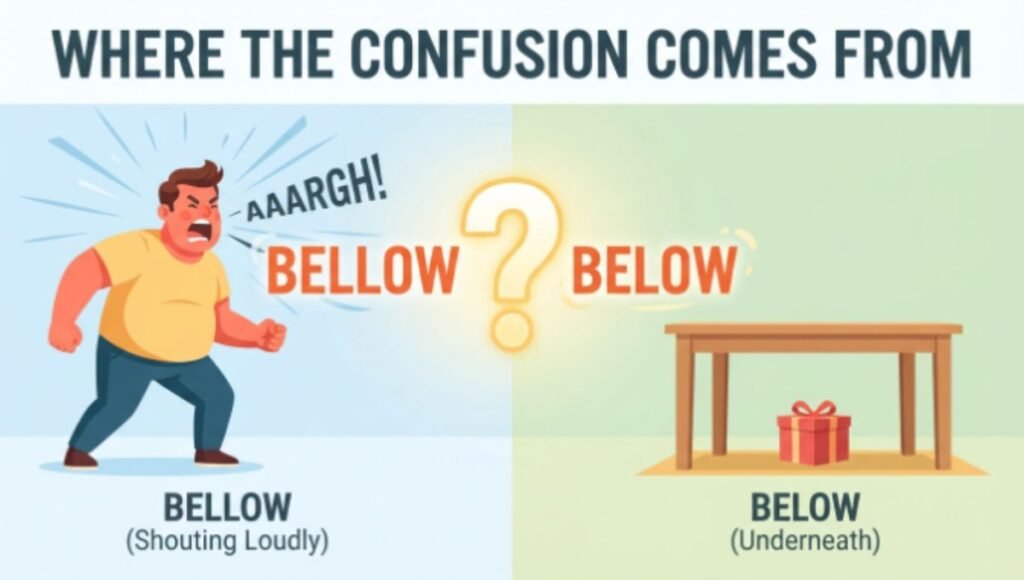
Bellow and below are unrelated in origin, despite the similar spelling. Bellow comes from Middle English belwen, related to Old English bylgan, meaning to roar or bark, and it shares distant roots with the word “bellows,” the device used to blow air into a fire. Below comes from Middle English bilooghe, formed by combining “by” and “low,” directly reflecting its meaning of being positioned lower than something else.
The two words likely get confused because they are close in spelling, both end in similar sounds, and neither one is used constantly enough for most people to build strong instinctive recognition, unlike more frequent word pairs.
Grammar and Usage Notes
A few grammar details help clarify how each word functions in a sentence.
- Verb forms of bellow: bellow, bellowed, bellowing (regular verb conjugation)
- Plural form of bellow (noun): bellows, referring to multiple loud shouts, though “bellows” is also a separate, unrelated noun for the fireplace tool
- Below has no verb form: below never changes form, since it functions only as a preposition or adverb
- Formal versus informal usage: bellow appears in both narrative and descriptive writing, often in fiction or storytelling; below appears constantly in formal, technical, and everyday writing alike, especially in documents, instructions, and reports
Real Life Examples in Different Contexts
Seeing bellow or below used correctly across different situations makes the distinction easier to remember.
Everyday conversation: “Dad had to bellow from the porch to get our attention.”
Workplace communication: “Please find the updated figures below in the attached spreadsheet.”
Academic writing: “The professor’s voice would bellow across the lecture hall when students talked during class.”
Business writing: “Sales figures below target were flagged for review.”
Formal writing: “The report is organized with the summary above and the detailed data below.”
Casual writing: “He let out a huge bellow when his team scored the winning goal.”
In every example, bellow relates to a loud sound, while below relates to position or placement within a space or document.
Common Mistakes with Bellow or Below
A few mix-ups show up regularly, especially when typing quickly or relying on autocorrect.
Incorrect: Please see the information bellow. Correct: Please see the information below. Reason: This sentence refers to position within a document, so below is correct.
Incorrect: He had to below loudly to get everyone’s attention. Correct: He had to bellow loudly to get everyone’s attention. Reason: This sentence describes shouting, so bellow is correct.
Incorrect: The basement is bellow the kitchen. Correct: The basement is below the kitchen. Reason: This describes physical position, so below is the correct word.
Related Terms Worth Knowing
A few related words often appear alongside bellow or below:
- Roar: a near synonym for bellow, often used for animals or very loud human shouts
- Shout: a general synonym for bellow, though less specifically deep or forceful
- Underneath: a near synonym for below, emphasizing direct physical position
- Beneath: a more formal synonym for below, common in literary or elevated writing
- Bellows: an unrelated noun referring to a device used to pump air, often into a fire
How to Choose the Right Word

Use this checklist whenever you are unsure whether to write bellow or below:
- Ask if the sentence describes a loud sound or shout. If yes, use bellow.
- Ask if the sentence describes position, placement, or a lower level. If yes, use below.
- Read the sentence aloud. Words related to volume or shouting signal bellow, while words related to location signal below.
- Watch for autocorrect, since both words are short and easy for spell checkers to swap incorrectly.
- When editing quickly typed documents or emails, double check this pair specifically, since the visual similarity makes it an easy typo to miss.
Frequently Asked Questions
Is it “see bellow” or “see below” in an email?
See below is correct. Bellow never refers to position or placement within a document.
Can “bellow” ever describe something other than shouting?
Bellow can describe any loud, deep sound, including animal roars, but it always relates to sound, never to position or location.
What is the difference between “below” and “beneath”?
Both words describe a lower position, but beneath tends to sound more formal or literary, while below is the more common, neutral choice in everyday and business writing.
Why do bellow and below get confused so often?
The two words are unrelated in origin, but their similar spelling and matching final syllable make them easy to mix up, especially when typing quickly.
The Bottom Line
Bellow or below comes down to a simple distinction: bellow is about sound, and below is about position. Keep that separation in mind, and you will never confuse these two words again.











1 thought on “Bellow or Below: 6 Rules for Telling These Words Apart”