
Typing “finaly” happens fast, especially when you’re rushing through a text or email, but something about it looks incomplete. The finaly or finally confusion is extremely common because our brains often want to add just one “l” out of habit. Here’s the quick fix: the finaly or finally debate has a clear, simple answer once you understand the spelling rule behind it.
Quick Answer: Is It Finaly or Finally?
“Finally” is the correct spelling, always with two l’s. “Finaly” is not a recognized word in any English dictionary and is considered a spelling error in every context, whether formal or casual. Whenever you’re second guessing finaly or finally, remember that “finally” is the only accepted form.
What Does “Finally” Mean?
“Finally” is an adverb meaning at last, after a delay, or as the last item in a sequence. It’s used to show that something happened after waiting, effort, or a series of events:
- We finally arrived after a six hour drive.
- She finally finished the report.
“Finally” can also introduce the last point in a list or explanation, similar to “lastly” or “in conclusion.”
Why “Finaly” Looks Right, But Isn’t
Many English learners assume that adding “-ly” to an adjective always keeps the base word exactly the same, since that pattern works for words like “quick” to “quickly” or “sad” to “sadly.” Based on that logic, “final” plus “-ly” would seem to just need one added letter. But “final” already ends in a single “l,” and when you add the suffix “-ly,” the spelling keeps both l’s together rather than dropping one. This is exactly why the finaly or finally mistake happens so often.
The Spelling Rule Behind Final to Finally
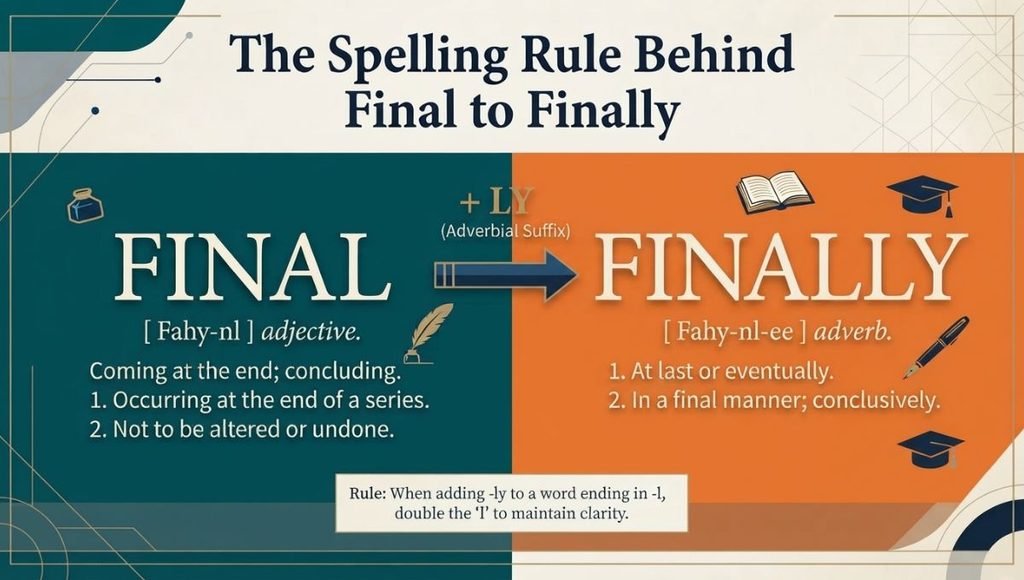
Here’s the rule in plain terms:
When an adjective already ends in “l” and you add the suffix “-ly,” keep both l’s. Don’t drop one to avoid a double letter.
So the transformation looks like this:
- final + ly → finally
This same pattern applies to other adjectives ending in “l,” which helps you see it’s not an isolated exception:
- usual → usually
- careful → carefully
- real → really
None of these lose a letter when the suffix is added. If you remember that “finally” follows the same spelling pattern as “really” and “usually,” the correct spelling becomes much easier to hold onto.
Finaly or Finally: One Correct Form, No Exceptions
Here’s the practical guidance: always use “finally” in every type of writing: emails, essays, business documents, texts, and casual conversation. There is no situation, formal or informal, where “finaly” is considered acceptable.
Unlike some spelling debates where two forms are both valid depending on context, this one has only one correct answer, and it doesn’t change based on tone or setting.
Is “Finaly” Ever Acceptable?
No. “Finaly” does not appear in any major dictionary, style guide, or accepted list of informal spellings. It’s simply a common typing mistake, often caused by typing quickly or misremembering the double letter rule. There’s no regional variation, brand exception, or stylistic use where “finaly” becomes correct.
More related Post: Eying or Eyeing: 5 Facts That Settle Which Spelling to Use (2026) https://feastinsidar.com/eying-or-eyeing/
Grammar Breakdown: Adjective and Adverb Forms
“Final” and “finally” serve two different grammatical roles in a sentence.
As an adjective: This is the final chapter of the book. (describes a noun)
As an adverb: We finally reached the final chapter. (describes a verb, showing when or how something happened)
Notice how both words can appear in the same sentence, each doing a different grammatical job. “Final” describes something directly, while “finally” describes the timing or sequence of an action.
Where “Finally” Comes From
The word “final” comes from the Latin word finalis, meaning “of or relating to an end,” which itself derives from finis, meaning “end” or “boundary.” As English absorbed Latin based vocabulary during the Middle English period, “final” became a standard adjective, and the “-ly” suffix was later added to create the adverb form “finally,” following the same suffixing pattern used across much of English vocabulary.
How to Pronounce “Finally”
“Finally” is pronounced FY-nuh-lee, with three syllables and stress on the first syllable. There’s no pronunciation shortcut or regional variant tied to finaly or finally, since “finaly” isn’t a real word to pronounce differently in the first place.
Finaly or Finally: Quick Comparison Table
| Term | Correct? | Meaning | Use |
| Finally | Yes | At last, after a delay or as a last point | Standard spelling in all writing, US and UK English |
| Finaly | No | Not a recognized word | Common misspelling, never appears in dictionaries |
“Finally” in Real Sentences
Everyday conversation: “I finally cleaned out my garage this weekend.”
Workplace communication: “The team finally resolved the software bug after three days of testing.”
Academic writing: “The researchers finally identified the cause of the anomaly after repeated trials.”
Email: “I’m happy to say the project is finally complete and ready for review.”
Business writing: “After months of negotiation, both companies finally signed the agreement.”
Casual writing: “We finally got tickets to the concert after refreshing the site for an hour.”
Each of these sentences uses “finally” correctly, and none of them would work with “finaly” in place of it.
Common Mistakes With Final and Finally
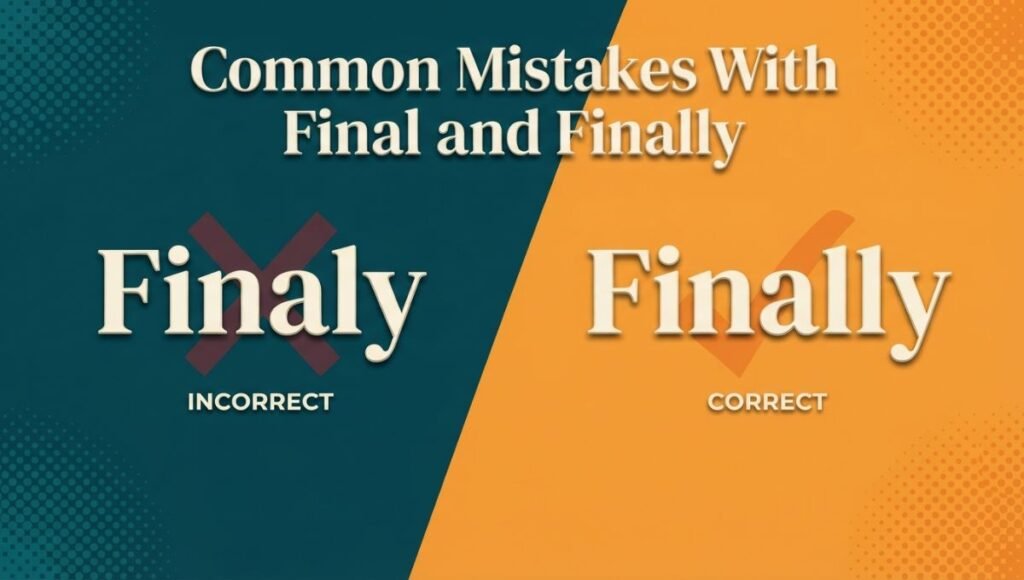
Incorrect: I finaly understood the instructions.
Correct: I finally understood the instructions.
This is a common slip, usually caused by fast typing or a misapplied spelling pattern from simpler “-ly” words.
Incorrect: This is the finally answer.
Correct: This is the final answer.
Here the writer needed the adjective form, not the adverb. “Final” describes the noun “answer,” while “finally” would describe an action.
Incorrect: She final finished her homework.
Correct: She finally finished her homework.
This mistake drops the “-ly” entirely, missing the adverb form needed to describe when the action happened.
Related Words and Terms
A few related terms add useful context:
- Lastly: a synonym often used to introduce a final point
- Eventually: implies a similar sense of delay before something happens
- Finalize: a verb meaning to complete or settle something
- Final: the adjective form, describing something as last or conclusive
- At last: a common phrase with a similar meaning to “finally”
Knowing these related terms helps you choose the most natural word for your sentence instead of relying on “finally” every time.
How to Remember the Correct Spelling
A simple trick: think of “finally” as “final” plus “ly,” with nothing removed and nothing changed. If you can spell “final” correctly, you already have most of the word done, just add the suffix without dropping a letter. This small mental check clears up the finaly or finally question almost instantly.
FAQs About Finaly or Finally
Is “finaly” ever correct?
No. “Finaly” is not found in any major dictionary and is considered a spelling error in every context, formal or informal.
Why does “final” become “finally” instead of “finaly”?
When an adjective already ends in “l,” adding the suffix “-ly” keeps both l’s rather than dropping one, which is why “final” becomes “finally,” not “finaly.”
Is “finally” an adjective or an adverb?
“Finally” is an adverb, describing when or how an action happens. “Final” is the adjective form, describing a noun directly.
Is there a British English difference for “finally”?
No. “Finally” is spelled the same way in both American and British English, so there’s no regional variation to consider.
How do I use “finally” correctly in a sentence?
Use “finally” to show that something happened after a delay or as the last step in a sequence, such as “We finally finished the marathon.”
The Bottom Line
The finaly or finally debate has one clear answer: “finally” is correct, and “finaly” is simply a spelling mistake, not an alternate form. Remember that adding “-ly” to an adjective ending in “l” keeps both letters intact, and you’ll spell “finally” correctly every time going forward.











1 thought on “Finaly or Finally: 5 Simple Facts to Fix This Common Mistake (2026)”