
Confused about advise or advice? You are not alone. These two words sound almost identical, but they play completely different grammatical roles, and mixing them up is one of the most common English writing mistakes. Here is the fast answer: advise is a verb, advice is a noun.
The Quick Answer: Advise Is a Verb, Advice Is a Noun
Advise means to give someone a recommendation or suggestion. It is an action word. Advice is the recommendation itself, the thing you receive or give. If you can replace the word with “recommend” or “suggest,” you need advise. If you can replace it with “guidance” or “tip,” you need advice.
Why People Confuse Advise or Advice
The confusion around advise or advice comes down to pronunciation and spelling similarity. Both words look nearly the same on the page, differing by just one letter, and in casual speech that letter is easy to miss. English also has several other verb and noun pairs that follow the same “s versus c” pattern, which adds to the mix-up.
What Does Advise Mean?
Advise is a verb. It means to offer an opinion or recommendation about what someone should do. It is something you actively do.
- “My accountant advised me to save more for taxes.”
- “The doctor will advise you on the best treatment.”
Notice that advise always involves an action performed by one person toward another. It pairs naturally with a person as the object: you advise someone.
What Does Advice Mean?
Advice is a noun. It refers to the guidance, opinion, or recommendation itself. You cannot “advice” someone, but you can give, receive, offer, or ask for advice.
- “Thanks for the advice, it really helped.”
- “She gave me some great career advice.”
A helpful test: advice is uncountable, like information or furniture. You would not say “an advice” or “advices.” You would say “a piece of advice” or “some advice.”
Advise vs Advice: Key Grammatical Difference
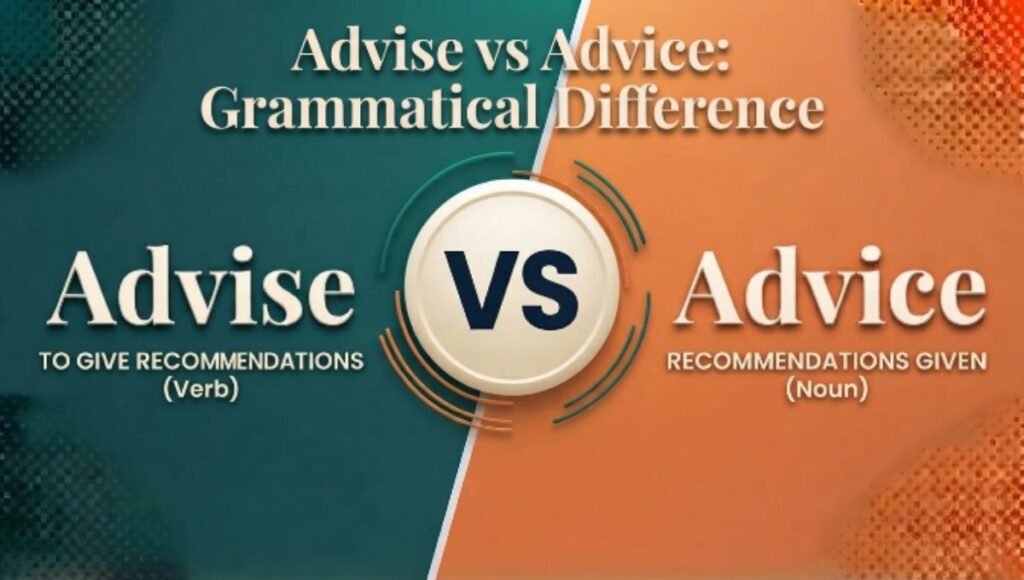
The core difference in the advise or advice debate is part of speech. Advise ends in the letter “s” and functions as a verb, similar to other verbs that end in “-ise” in American spelling conventions, such as “revise” and “devise.” Advice ends in “c” and functions as a noun, similar to “practice” or “notice.”
A simple memory trick: the noun “advice” and the noun “ice” both contain a “c.” Ice is a noun, and so is advice. Meanwhile, the verb advise rhymes with other action verbs like “rise” and “wise.”
How to Pronounce Advise and Advice
Pronunciation is actually the easiest way to tell these words apart in speech, even though the spelling causes trouble in writing.
- Advise is pronounced with a “z” sound at the end: ad-VYZE.
- Advice is pronounced with a soft “s” sound at the end: ad-VYCE.
If you say each word out loud, the ending sound tells you exactly which one you need. This pronunciation difference is a reliable clue whenever you are unsure whether to write advise or advice.
Where Advise and Advice Come From
Both words trace back to the Old French term “avis,” meaning opinion or judgment, which itself came from the Latin phrase “ad visum,” roughly meaning “according to what is seen.” English borrowed the noun form first as “advice,” and later developed the verb “advise” using the same “-ise” pattern common to other French-derived English verbs. This shared origin explains why the words look so similar today, even though they now serve different grammatical purposes.
More related Post: Recieved or Received: The 2026 Guide to the Correct Spelling https://feastinsidar.com/recieved-or-received/
Advise or Advice: Comparison Table
| Term | Part of Speech | Meaning | Example |
| Advise | Verb | To recommend or suggest | “I advise you to wait.” |
| Advice | Noun | A recommendation or suggestion | “That is good advice.” |
How to Use Advise in a Sentence
Since advise is a verb, it needs a subject performing the action and often a person receiving it.
- Everyday conversation: “I would advise against eating that leftover pizza.”
- Workplace email: “Please advise me on the best time to schedule the call.”
- Business writing: “Our legal team advises clients on contract terms before signing.”
- Formal writing: “The committee advised the board to postpone the vote.”
Each of these examples uses advise to describe the act of recommending something, not the recommendation itself.
How to Use Advice in a Sentence
Advice, as a noun, typically follows verbs like give, get, take, offer, or need.
- Everyday conversation: “Can you give me some advice about moving apartments?”
- Academic writing: “The professor’s advice shaped the direction of my thesis.”
- Casual writing: “Honestly, that was the best advice I’ve ever gotten.”
- Formal writing: “The report includes advice on reducing operational costs.”
If you ever find yourself typing “advices” as a plural, stop. Advice does not pluralize that way in standard English.
Common Mistakes With Advise or Advice
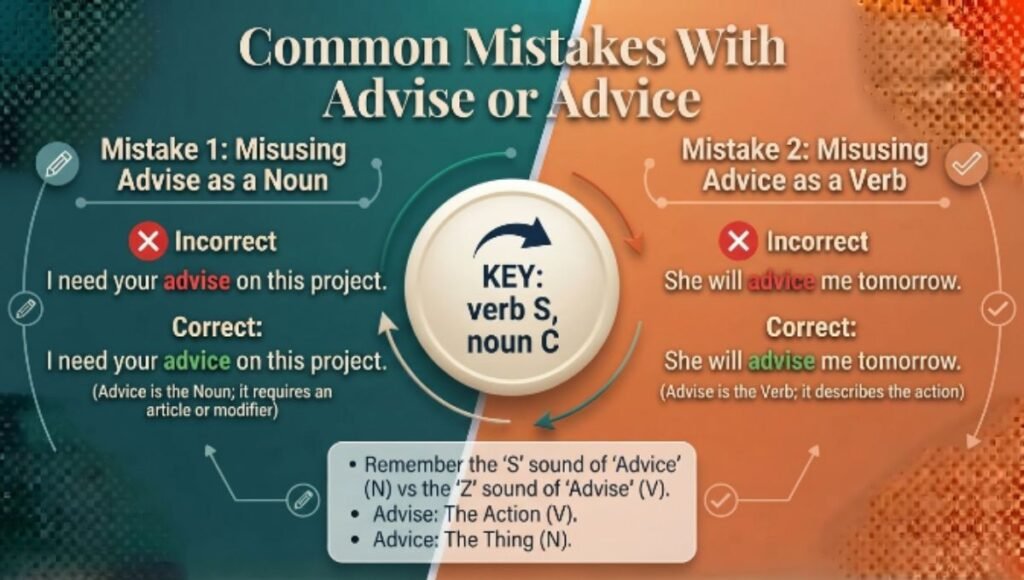
Even experienced writers slip up on advise or advice from time to time. Here are the most frequent errors.
Incorrect: “Can you give me some advise?”
Correct: “Can you give me some advice?”
This sentence needs a noun after “some,” so advice is correct.
Incorrect: “I will advice you to see a specialist.”
Correct: “I will advise you to see a specialist.”
This sentence needs a verb after “will,” so advise is correct.
Incorrect: “She gave great advises to the new hires.”
Correct: “She gave great advice to the new hires.”
Advice does not take a plural “s” form, even when referring to multiple pieces of guidance.
Related Words: Advisable, Advisory, Adviser
Understanding a few related terms makes the advise or advice distinction even clearer.
- Advisable (adjective): worth doing, recommended. “It is advisable to back up your files.”
- Advisory (adjective or noun): providing advice, or a warning notice. “A weather advisory was issued.”
- Adviser or advisor (noun): a person who gives advice. Both spellings are accepted in American English, though “adviser” is slightly more common in formal contexts.
None of these related forms change the core rule: anything built around action is closer to advise, and anything built around the concept of guidance is closer to advice.
Quick Trick to Remember the Difference
If you only remember one rule from this article, remember this: “C” comes before “S” in the alphabet, and advice (noun) comes before advise (verb) in a typical sentence structure, since you usually need the thing (advice) before you can act on it (advise). Alternatively, just recall that “advice” rhymes with “ice,” a noun, and “advise” rhymes with “wise,” an action.
FAQs About Advise or Advice
Is advise or advice correct?
Both are correct, but they are not interchangeable. Advise is a verb meaning to recommend, and advice is a noun meaning the recommendation itself.
Can advice be used as a verb?
No. Advice is always a noun in standard English. Using it as a verb, as in “I advice you,” is incorrect.
Is “advices” a real word?
Not in standard modern English. Advice is an uncountable noun, so the correct plural phrasing is “pieces of advice” or simply “advice.”
What is the British English difference between advise and advice?
There is no difference. Both American and British English use the same rule: advise as the verb, advice as the noun.
How do I remember which one to use?
Say the word out loud. If it ends with a “z” sound, it is the verb advise. If it ends with a softer “s” sound, it is the noun advice.
Conclusion
The advise or advice question comes down to one simple rule: advise is what you do, and advice is what you give. Keep that distinction in mind, check the ending sound when you are unsure, and you will never mix up advise or advice again.











1 thought on “Advise or Advice: What’s the Difference and How to Use Them? (2026 Guide)”