You typed a sentence, stared at the word, and suddenly it looked wrong. That is the practise or practice trap, and almost every English learner falls into it at least once. The confusion happens because English treats this word differently depending on where you live and what job it is doing in the sentence.
Here is the short answer: in American English, “practice” is correct for every use, as a noun and as a verb. In British English, “practice” is the noun and “practise” is the verb. That single rule solves most of the confusion around practise or practice, and the rest of this guide walks through exactly how to apply it.
The Quick Answer to Practise or Practice
If you are writing for a US audience, use practice for everything. “I practice piano” and “my doctor’s practice” both use the same spelling. If you are writing for a UK, Australian, or Canadian audience, split the two: practice is the thing (the noun), and practise is the doing (the verb).
Why This Word Confuses So Many People
The confusion is not really about spelling ability. It is about the fact that one language split a word into two spellings based on grammar, while another language kept a single spelling for both jobs. Learners who study both British and American materials end up seeing conflicting examples, which makes the correct choice feel like a coin flip.
Practice vs Practise: A Side by Side Comparison
| Form | Correct In | Part of Speech | Meaning | Example |
| Practice | American English (both uses); British English (noun only) | Noun (and verb in US) | An activity done repeatedly to improve, or a habitual action | “She goes to soccer practice on Tuesdays.” |
| Practise | British English only | Verb | To perform an activity repeatedly to improve a skill | “She likes to practise the violin every evening.” |
What Practice Actually Means
As a noun, practice refers to a repeated activity meant to build a skill, a habitual way of doing something, or the professional operation of someone like a doctor or lawyer. Think of sentences like “practice makes perfect” or “a dental practice downtown.” In American English, this same spelling also covers the verb form, so “I practice yoga” is completely correct.
What Practise Means (And Where It Applies)
Practise is the British English verb form. It describes the act of performing an activity to improve or maintain a skill. British writers would say “I practise the guitar every day,” reserving practice strictly for the noun, as in “guitar practice.”
If you write only for American readers, you will likely never need the spelling practise at all, and that is perfectly fine.
More related Post: Speach or Speech: Which One Is Correct? (2026 Spelling Guide) https://feastinsidar.com/speach-or-speech/
Grammar Breakdown: Noun vs Verb
The easiest way to remember the British English split is a trick many UK teachers use: advice and advise. Advice is the noun, advise is the verb, and the same c-versus-s pattern applies to practice and practise. If “advise” sounds right in the sentence, “practise” is the verb you want in British English.
In American English, this trick does not apply, because there is no second spelling to distinguish. Practice functions as both parts of speech without changing form.
American English vs British English Usage
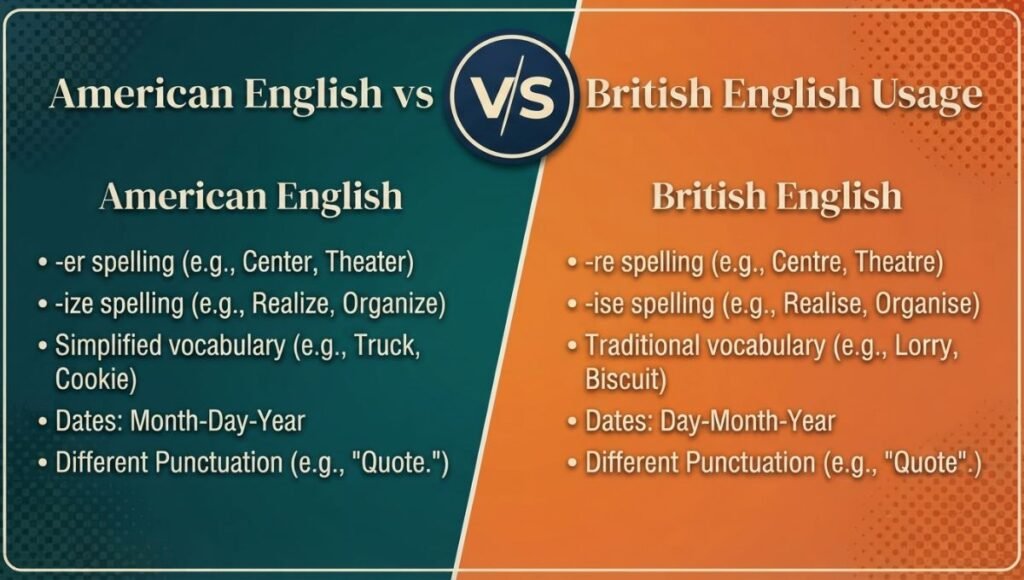
This is the single most important distinction when it comes to practise or practice, so here it is laid out plainly.
American English (US):
- Noun: practice (“a good practice”)
- Verb: practice (“to practice medicine”)
British English (UK, and generally Australian and Canadian English too):
- Noun: practice (“a strange practice”)
- Verb: practise (“to practise medicine”)
If your audience is international, checking your target region before publishing will save you from an easily avoidable error.
Pronunciation: Does It Change?
No. Both practice and practise are pronounced the same way, roughly “PRAK-tiss.” The spelling difference exists only on the page and has no effect on how the word sounds when spoken aloud.
Where the Words Come From
Both spellings trace back to the same root: the Old French “practiser” and the Medieval Latin “practizare,” related to the Greek “praktikos,” meaning “concerned with action.” English inherited a single word, and over time British publishers began separating the noun and verb spellings, following the same c and s pattern already used in pairs like advice and advise, or licence and license. American English later simplified this by standardizing on one spelling for both roles, which is why practice or practice questions rarely trip up US-only writers but frequently confuse UK learners and vice versa.
Real Life Examples in Everyday Use
Everyday conversation (US): “I need to practice my Spanish before the trip.”
Everyday conversation (UK): “I need to practise my Spanish before the trip.”
Workplace email (US): “Our team will practice the presentation twice before the client call.”
Academic writing (UK): “Students are encouraged to practise active recall when studying for exams.”
Business writing (US): “The firm’s legal practice specializes in intellectual property law.”
Formal writing (UK): “It is common practice to practise interview questions with a colleague beforehand.”
That last British example shows both spellings working correctly in a single sentence, which is a great way to see the noun and verb roles side by side.
Common Mistakes With Practise or Practice
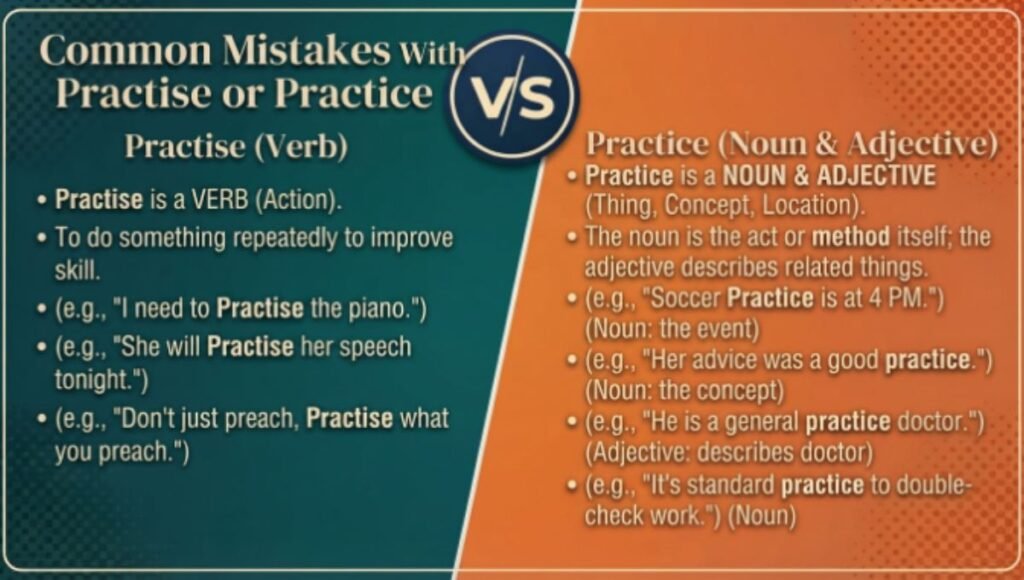
Incorrect: “I practise every day.” (written for a US audience) Correct: “I practice every day.” American English does not use the “practise” spelling at all, so British spelling rules do not transfer over.
Incorrect: “She runs a successful medical practise.” (written for a UK audience) Correct: “She runs a successful medical practice.” The noun always takes the c spelling in British English, even though the verb takes the s spelling.
Incorrect: “He wants to practice medicine.” (written for a UK audience, referring to the verb) This one is actually a gray area. In strict British style guides, “practise medicine” (verb) is correct, but “practice” is increasingly common even in UK writing due to American media influence. Style guides still recommend the traditional split for formal UK writing.
These mistakes are extremely common, even among native speakers, so do not feel discouraged if you have made one before.
More related Post :
Goodnight or Good Night: Stop Making This Common Mistake (2026) https://feastinsidar.com/goodnight-or-good-night/
Related Words and Spelling Patterns
The practice or practise pattern is not unique. English has several similar noun and verb pairs that follow the same c and s logic in British English:
- Advice (noun) and advise (verb)
- Licence (noun) and license (verb)
- Device (noun) and devise (verb)
If you already understand one of these pairs, you can apply the same logic to remember practise or practice in British writing.
Practical Guidance for Writers
If you write for a global audience, the safest approach is to identify your primary readership first. Set your document language to US or UK English in your word processor, and let the built in spell checker help enforce consistency once you have made that choice.
For freelance writers, students, and professionals switching between markets, keeping a simple note in your style guide (“US client: practice for everything” or “UK client: practice as noun, practise as verb”) avoids repeated second guessing on every draft.
Frequently Asked Questions
Is “practise” ever correct in American English?
No. American English uses “practice” for both the noun and the verb, so “practise” is considered a misspelling in US writing.
Is “practice” ever correct in British English?
Yes, but only as a noun. British English reserves “practice” for the noun form and “practise” for the verb form.
How do I remember which spelling to use?
Use the advice and advise trick. If “advise” (the verb) fits the sentence, use “practise” in British English. If “advice” (the noun) fits, use “practice.”
Do practice and practise sound different when spoken?
No, they are pronounced identically. The distinction exists only in spelling.
Which spelling should I use if I am not sure who my audience is?
Default to “practice” for both noun and verb uses, since American spelling conventions have become the more widely used standard online, especially in global digital content.
Conclusion
The practise or practice question comes down to one simple rule: Americans use “practice” everywhere, while British writers split the word into “practice” for the noun and “practise” for the verb. Once you know your audience, the correct choice becomes automatic, and you can write with confidence instead of guessing every time the word comes up.











1 thought on “Practise or Practice: The 2026 Guide to Getting It Right Every Time”