Typing out a sentence about talking in public, and the spelling suddenly looks wrong on the page? The confusion between speach or speech usually comes down to one sneaky vowel pattern that doesn’t follow the rule your brain expects. Quick answer: speech is the only correct spelling in standard English. Speach is simply a misspelling, with no accepted use in any context. Once you see why, speach or speech stops being a question at all.
Quick Answer: Is It Speach or Speech?
Speech, spelled with “ee,” is correct every time, whether you’re talking about a formal address, the general ability to talk, or the sound-based subject studied in linguistics.
Speach doesn’t appear in any standard dictionary as a valid word or accepted variant. It’s a spelling error, not an informal alternative, a regional spelling, or an older historical form still in use today.
What Does Speech Mean?
Speech is a noun with a few related meanings, all connected to spoken language.
- A formal talk given to an audience: “The mayor gave a speech at the ceremony.”
- The general ability or act of speaking: “The injury affected her speech temporarily.”
- A particular style or manner of talking: “His speech was full of local slang.”
- In grammar, “part of speech” refers to a word’s grammatical category, such as noun or verb.
Across all of these meanings, the spelling never changes. It’s always “speech,” regardless of context.
Why Do People Confuse Speach or Speech?
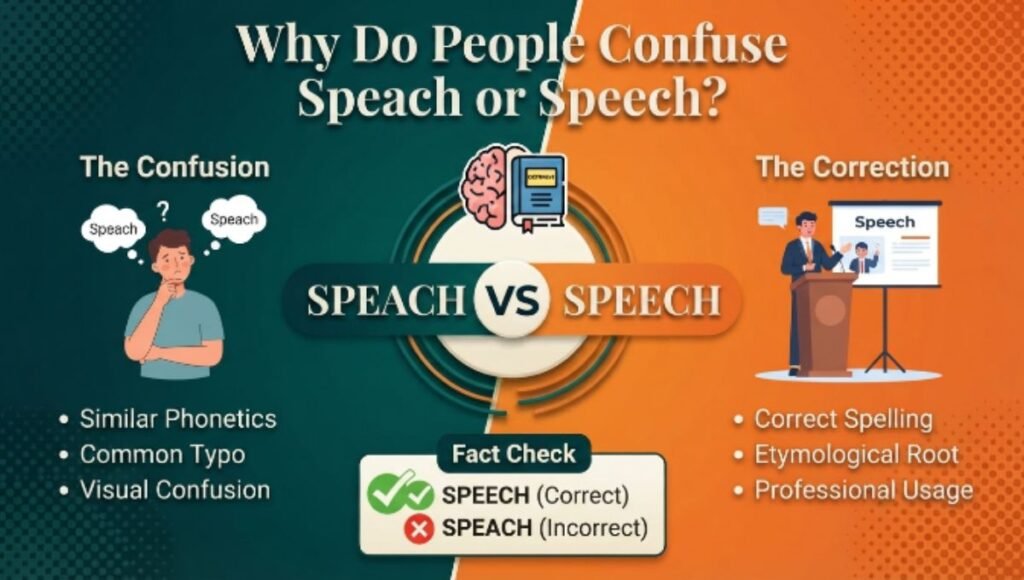
The mix-up between speach or speech happens because English uses several different letter combinations to produce the same long “ee” sound. Words like “teach,” “reach,” “preach,” and “bleach” all use “ea” to make that sound, which trains your brain to expect “ea” whenever it hears it.
“Speech,” however, belongs to a different pattern, one that uses “ee” instead, alongside words like “feel,” “keep,” “sleep,” and “greet.” Since both patterns are common, it’s easy to apply the wrong one by instinct, especially when writing quickly.
Where Does the Word Speech Come From?
Speech traces back to Old English. The verb “specan,” a dialectal variant of “sprecan” (meaning to speak or utter words), gave rise to a related noun form. Over time, through Middle English “speche,” the spelling evolved into the modern “speech” used today.
This history explains why “speech” pairs so closely with “speak,” even though the spelling patterns of the two words don’t match exactly. Both share the same Old English root, just shaped differently by centuries of spelling changes.
How Do You Pronounce Speech?
Speech is pronounced /spiːtʃ/, rhyming with “reach” and “teach,” even though it isn’t spelled the same way. The “ee” combination here produces the same long “ee” sound as the “ea” combination in those other words, which is exactly why the spelling mix-up happens so often.
More related Post: Goodnight or Good Night: Stop Making This Common Mistake (2026) https://feastinsidar.com/goodnight-or-good-night/
Grammar Notes: Part of Speech and Related Forms
Speech is a noun, and it has both countable and uncountable uses depending on the context.
- As an uncountable noun, it refers to the general ability to talk: “Speech develops rapidly in early childhood.”
- As a countable noun, it refers to a specific talk or address, with a regular plural form: “She has given several speeches this year.”
Note that the plural is “speeches,” not “speachs” or any variation involving the incorrect spelling. There’s also no verb form of “speech” itself. The related verb is simply “speak,” which follows its own separate conjugation (speak, spoke, spoken).
Is Speach Ever Correct in Any Context?
Settling speach or speech for good means answering this directly: no, speach is never correct. Unlike some English word pairs where an alternate spelling survives in specific technical fields or older texts, speach has no legitimate use anywhere. It doesn’t appear as a variant in major dictionaries, style guides, or specialized industries. If you see it in writing, it’s a typo or spelling mistake, nothing more.
Real-Life Examples Across Different Contexts
Everyday conversation: “Did you catch his speech at the wedding? It was really moving.”
Workplace communication: “Please review the speech before the presentation tomorrow.”
Academic writing: “The study analyzed patterns of speech development in bilingual children.”
Business writing: “The CEO’s speech outlined the company’s goals for the coming year.”
Formal writing: “The senator’s speech addressed several key policy concerns.”
Casual writing: “I’m so nervous about giving my speech at graduation.”
Common Mistakes People Make
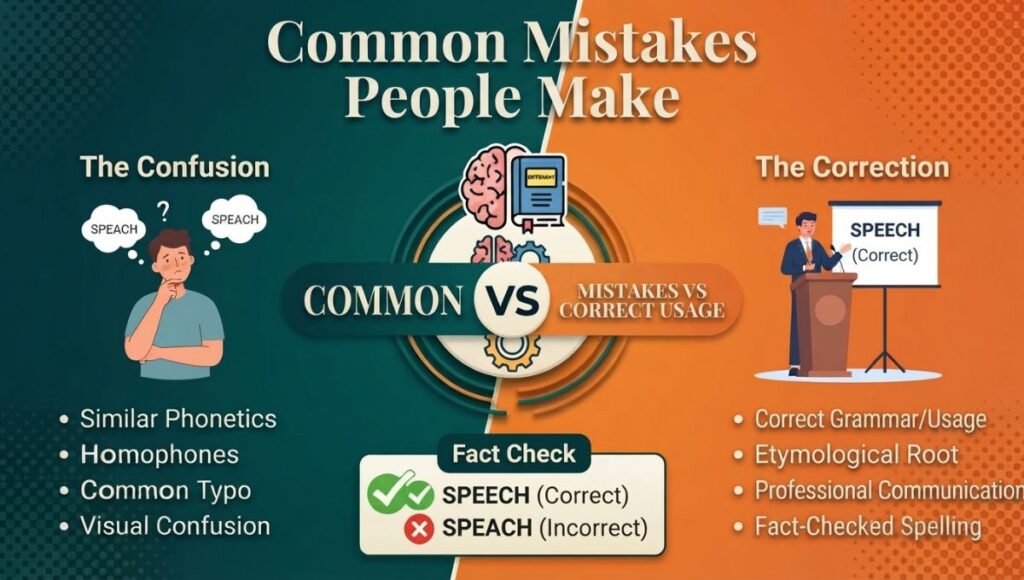
Incorrect: “I have to write a speach for class tomorrow.” Correct: “I have to write a speech for class tomorrow.” This is a straightforward spelling mistake, mixing up the “ea” pattern from words like “teach” with the correct “ee” pattern in “speech.”
Incorrect: “Her freedom of speach is protected by law.” Correct: “Her freedom of speech is protected by law.” Even in fixed phrases like “freedom of speech,” the spelling doesn’t change, so the same rule applies here.
Incorrect: “He gave two speachs at the conference.” Correct: “He gave two speeches at the conference.” The plural follows the correct base spelling, “speech,” plus “-es,” never the incorrect “speach” as a starting point.
Speach or Speech: A Quick Comparison
| Spelling | Correct? | Meaning | Use |
| Speech | Yes | A talk, the ability to speak, or a manner of speaking | All standard writing and speaking contexts |
| Speach | No | Not a real word | Should always be corrected to “speech” |
Related Words Worth Knowing
- Speak, the verb form describing the act of talking
- Speaker, someone who speaks, especially to an audience
- Speechless, an adjective describing someone unable to speak, often from shock or emotion
- Part of speech, a grammar term describing a word’s category (noun, verb, adjective, and so on)
A Simple Trick to Remember the Correct Spelling
Since “speech” comes from “speak,” try connecting the two words visually: both start with “spe,” and neither uses the “ea” pattern found in “teach” or “reach.” If you can spell “speak” correctly, let that guide you toward the “ee” in “speech” as well.
Frequently Asked Questions
Is speach a word?
No. Speach is not a recognized word in any standard English dictionary. It’s simply a common misspelling of speech.
What does speech mean?
Speech refers to the act of speaking, a formal talk given to an audience, or a particular manner of talking.
Why do people spell speech as speach?
The confusion happens because many similar-sounding words, like teach and reach, use “ea” instead of “ee” for the same long vowel sound, leading writers to apply that pattern incorrectly to speech.
What is the plural of speech?
The plural of speech is speeches, formed by adding “-es” to the correct base spelling.
Is speach used in British English?
No. Speach is not an accepted spelling in British English or American English. Speech is standard in both.
Final Answer: Speach or Speech
There’s no real debate hiding behind speach or speech: speech is correct, and speach is simply a spelling error with no legitimate use in any English-speaking context. If you remember that speech pairs with speak, and both skip the “ea” pattern entirely, you’ll spell it correctly every time.










1 thought on “Speach or Speech: Which One Is Correct? (2026 Spelling Guide)”