You type the sentence, pause, and stare at the word. Should it be affect or effect? You are not alone. This is one of the most common mix-ups in English, and it trips up native speakers just as often as learners. The confusion happens because the two words sound almost identical and both relate to change. Here is the short answer: affect is almost always a verb meaning “to influence,” and effect is almost always a noun meaning “a result.” Once you understand that core pattern, affect vs effect stops being a guessing game.
The Quick Answer: Affect vs Effect in One Sentence
If you remember nothing else, remember this: affect is the action, effect is the outcome. The weather can affect your mood (verb), and that mood change is the effect (noun) of the weather. Say the sentence out loud. If you are describing something happening (an action), use affect. If you are naming the result of that action (a thing), use effect.
This rule covers roughly 95 percent of real-world usage. The exceptions come later, and they are far less common than most articles suggest.
What Does Affect Mean?
Affect is primarily a verb. It means to influence, change, or have an impact on something.
- Part of speech: verb (in nearly all everyday use)
- Pronunciation: uh-FEKT (stress on the second syllable)
- Example: “Lack of sleep can affect your concentration.”
Here, affect describes an action: something is changing something else. If you can replace the word with “influence” or “impact” and the sentence still makes sense, affect is the correct choice.
What Does Effect Mean?
Effect is primarily a noun. It refers to the result or outcome of an action.
- Part of speech: noun (in nearly all everyday use)
- Pronunciation: ih-FEKT (also stress on the second syllable, which is part of why the two words sound so similar)
- Example: “The new policy had a positive effect on morale.”
Here, effect names a thing: the outcome itself. If you can replace the word with “result” or “outcome,” effect is the correct choice.
Affect vs Effect: The Core Difference
The simplest way to decide between affect vs effect is by part of speech, not by meaning alone.
| Term | Part of Speech | Meaning | Example |
| Affect | Verb (usually) | To influence or change something | The heat affected the crops. |
| Effect | Noun (usually) | The result of a change | The heat had a serious effect on the crops. |
Notice that both sentences describe the same real-world situation. The difference is grammatical: one describes the action, the other names the outcome of that action.
A Simple Memory Trick That Actually Works

English teachers often recommend the acronym RAVEN: Remember, Affect is a Verb, Effect is a Noun. If RAVEN feels clunky, try this instead: affect starts with A, like Action. Effect starts with E, like End result. Pick whichever trick sticks in your memory, and use it consistently until choosing between affect vs effect becomes automatic.
More related Post : Take Effect or Take Affect? The 1 Correct Phrase Explained https://feastinsidar.com/take-effect-or-take-affect/
Where the Confusion Comes From
Both words trace back to Latin. Affect comes from afficere, meaning “to act upon” or “to influence.” Effect comes from efficere, meaning “to bring about” or “to accomplish.” The two Latin roots were already close in sound and meaning centuries ago, and that overlap carried into modern English. Add near-identical pronunciation, and the mix-up becomes almost inevitable, even for careful writers.
The Exceptions: When Affect Is a Noun and Effect Is a Verb
This is where most articles either oversimplify or overcomplicate things. Here are the two legitimate exceptions, explained plainly.
Affect as a noun is a technical term used mainly in psychology and psychiatry. It refers to a person’s outward display of emotion.
- Example: “The patient displayed a flat affect during the session.”
You will rarely need this usage unless you write in clinical, academic, or psychological contexts. Outside those fields, affect as a noun is uncommon and often confuses general readers.
Effect as a verb means to bring about or cause something to happen. It usually appears in the phrase “effect change.”
- Example: “The new manager was hired to effect change across the department.”
This usage is formal and appears mostly in business, government, and academic writing. It is grammatically correct, not a mistake, but it is far less common than “affect change,” which is actually the wrong phrase, even though it sounds natural. If you mean “cause change to happen,” the correct verb is effect, not affect.
Real Life Examples in Different Contexts
Seeing the words in natural sentences helps the rule stick faster than any definition alone.
Everyday conversation: “Skipping breakfast really affects my energy by noon.”
Workplace communication: “The delayed shipment affected three client orders this week.”
Academic writing: “The study examined how sleep deprivation affects memory retention.”
Business writing: “Leadership hopes the restructuring will effect lasting change in team output.”
Formal writing: “The policy took effect on the first of January.”
Casual writing: “Ugh, the rain totally affected our picnic plans.”
In each case, ask whether the word describes an action (affect) or a result (effect), and the correct choice becomes clear.
Common Mistakes with Affect vs Effect
Everyone makes these mistakes at some point. Here are the most frequent ones, along with quick fixes.
Incorrect: The medicine had no affect on her symptoms. Correct: The medicine had no effect on her symptoms. Reason: This describes a result (a noun), so effect is correct.
Incorrect: The loud noise didn’t effect his sleep. Correct: The loud noise didn’t affect his sleep. Reason: This describes an action (a verb), so affect is correct.
Incorrect: New leadership can effect employee morale. Correct: New leadership can affect employee morale. Reason: Unless you specifically mean “cause change” in a formal sense, affect (verb) is the natural choice here.
Incorrect: Please describe the affects of climate change. Correct: Please describe the effects of climate change. Reason: “Effects” here is a plural noun referring to multiple results, a very common phrase in academic and news writing.
Related Terms Worth Knowing
A few related words and phrases often appear alongside this topic:
- Side effect: an unintended secondary result, usually medical
- Special effects: visual or audio techniques used in film and media
- Affected: past tense of the verb affect, or an adjective meaning artificial (“an affected accent”)
- In effect: a phrase meaning “currently active” or “essentially”
- Take effect: a phrase meaning “to become active or valid”
Recognizing these fixed phrases helps you avoid overthinking sentences where the correct word is already locked in by convention.
Quick Reference: How to Choose Between Affect vs Effect
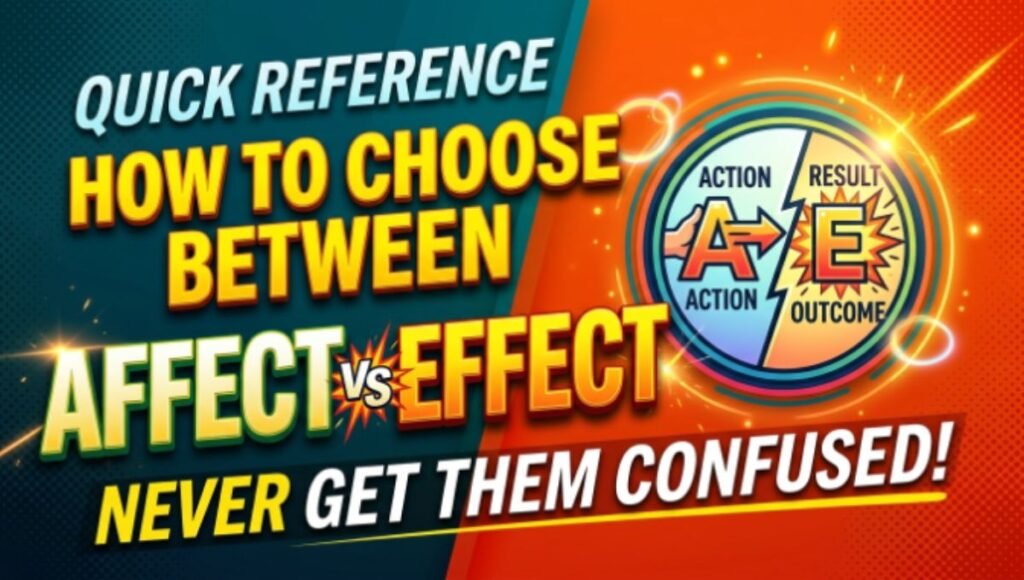
Use this checklist whenever you are unsure:
- Ask if the word describes an action or a result.
- Try replacing it with “influence” (if it fits, use affect).
- Try replacing it with “result” or “outcome” (if it fits, use effect).
- Remember that affect is a verb about 95 percent of the time.
- Remember that effect is a noun about 95 percent of the time.
- If you are in a psychology context and mean “emotional expression,” consider affect as a noun.
- If you mean “bring about change” in a formal setting, consider effect as a verb.
American English vs British English
The rules for affect vs effect are the same in both American and British English. There is no regional difference in spelling, meaning, or usage. Some formal British writing may lean slightly more toward “effect change” as a verb phrase, but this is a style preference, not a grammar rule specific to one dialect.
Frequently Asked Questions
Is “affect” or “effect” correct in “how does this affect me”?
Affect is correct here because the sentence describes an action or influence, not a result.
What is the difference between “effects” and “affects”?
Effects (plural noun) refers to multiple results or outcomes. Affects (verb, third person singular) means “influences,” as in “This decision affects everyone.”
Can “affect” ever be a noun?
Yes, but only in psychology or psychiatry, where it describes a person’s visible emotional expression. In everyday writing, affect should stay a verb.
Can “effect” ever be a verb?
Yes. “Effect” as a verb means to cause something to happen, most often seen in the phrase “effect change.” This usage is formal and less common than the noun form.
Is “in effect” the same as “affect”?
No. “In effect” is a fixed phrase meaning “currently active” or “essentially,” and it always uses effect, never affect.
The Bottom Line
Choosing between affect vs effect comes down to one dependable pattern: affect is the verb, effect is the noun. Keep that rule in mind, watch for the two formal exceptions if you write in psychology or business contexts, and you will get it right almost every time.