If you have typed “shiney” into a search bar and paused, wondering if it looked wrong, you are not alone. The word shows up misspelled constantly, in text messages, product listings, and even song titles. The correct spelling is “shiny,” not “shiney.” There is no legitimate version of “shiney” in standard English, formal or informal.
The Quick Answer: Which Spelling Is Correct
“Shiny” is the only correct spelling recognized by every major American and British dictionary. “Shiney” is a common misspelling that likely comes from how the word sounds when spoken. English speakers hear the long “e” sound at the end and assume it needs an “e” before the “y,” similar to words like “money” or “honey.” But “shiny” follows a different pattern, one shared with words like “funny,” “sunny,” and “happy.”
Why People Confuse Shiney and Shiny
The confusion is almost entirely phonetic. When you say “shiny” out loud, the ending sounds like it could be spelled several ways. Add to that the fact that some surnames and brand names do use “Shiney” as a stylized spelling, and it is easy to see why the mistake spreads. Autocorrect does not always catch it either, especially in casual typing.
What Shiny Actually Means
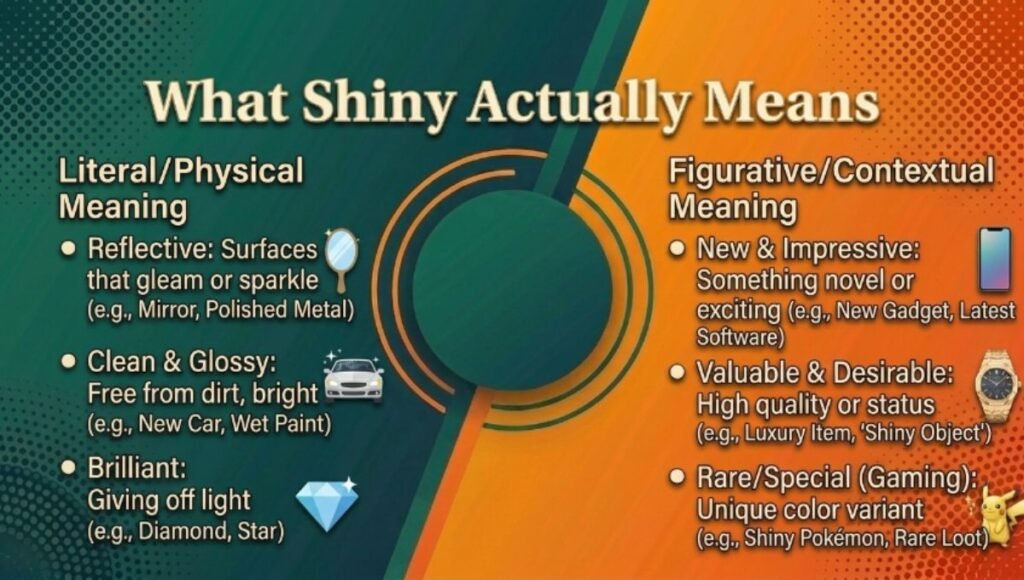
Shiny is an adjective that describes something reflecting light, having a bright or polished surface, or appearing new and glossy. It can also describe something exciting or highly anticipated, as in “shiny new gadget,” where the word carries a sense of novelty rather than literal shine.
Common definitions include:
- Reflecting light brightly (a shiny coin, shiny hair)
- Smooth and polished in appearance (shiny shoes)
- New, exciting, or desirable, often used informally (a shiny new phone)
Shiny: Grammar Breakdown
Understanding the grammar helps explain why the spelling works the way it does.
Part of speech: Adjective
Base word: Shine (verb)
Suffix rule: When adding “-y” to a one syllable word ending in a silent “e,” the “e” is dropped. Shine becomes shiny, the same way that “spice” becomes “spicy” and “grace” becomes “gracy” in the linguistic pattern, though “gracy” is not an actual word, so the comparison only illustrates the spelling rule, not real usage.
Comparative form: Shinier
Superlative form: Shiniest
Adverb form: Shinily (rarely used)
Noun form: Shininess
There is no verb form of “shiny” itself since the verb is “shine” or “to shine.”
Shiny vs Shiney: Side by Side Comparison
| Term | Correct? | Meaning | Common Use |
| Shiny | Yes | Reflecting light, glossy, or exciting | Standard adjective in all contexts |
| Shiney | No | Misspelling of shiny | Sometimes used as a stylized name or surname |
| Shinier | Yes | Comparative form of shiny | Comparing two shiny things |
| Shiniest | Yes | Superlative form of shiny | Describing the most shiny item in a group |
The one exception worth noting is that “Shiney” does appear as a legitimate proper noun. It shows up as a surname and occasionally as a brand or product name. In those specific cases, “Shiney” is not a spelling error because it is functioning as a name, not the adjective. Outside of proper nouns, “shiney” has no correct use in a sentence.
More related Post : Is “Good Morning” One Word? The 1 Simple Rule to Remember https://feastinsidar.com/is-good-morning-one-word/
Where the Word Shiny Comes From
Shiny traces back to the Old English word “scinan,” meaning to give off light or to shine. Over centuries, this evolved into the Middle English “shinen,” and the adjective form “shiny” developed by adding the common “-y” suffix used to turn nouns and verbs into descriptive adjectives, a pattern seen in words like “sunny” from “sun” and “cloudy” from “cloud.”
The spelling has remained consistent for a long time, which is part of why “shiney” never gained acceptance. Historical texts and early dictionaries consistently use “shiny,” not the alternate spelling.
How to Pronounce Shiny Correctly
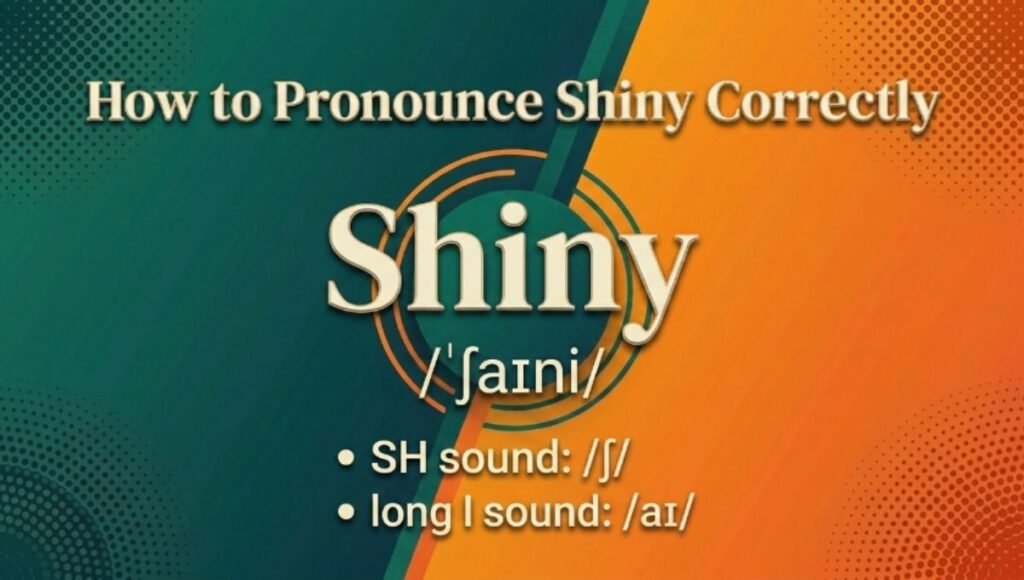
Shiny is pronounced “SHY-nee,” with two syllables. The stress falls on the first syllable. The “y” at the end creates the same long “e” sound found in words like “funny” or “happy,” which is exactly why the misspelling happens so often. The sound gives the impression that an “e” belongs before the “y,” even though it does not.
Using Shiny Correctly in a Sentence
Here are natural examples across different settings.
Everyday conversation: “Your car looks so shiny after that wash.”
Workplace communication: “The new lobby floors are shiny enough to see your reflection.”
Academic writing: “The specimen displayed a shiny, metallic surface under the microscope.”
Email: “Attached are photos of the shiny finish we discussed for the product packaging.”
Business writing: “Customer feedback describes the phone’s shiny casing as one of its most appealing features.”
Casual writing: “I love how shiny my nails look after a fresh coat of top coat.”
Each of these sentences uses “shiny” as a standard descriptive adjective, and any of them would sound wrong if “shiney” were substituted.
Common Mistakes With Shiny and Shiney
Incorrect: “I bought a shiney new laptop.” Correct: “I bought a shiny new laptop.” The extra “e” is unnecessary and not part of standard spelling.
Incorrect: “Her ring is so shiney it catches the light.” Correct: “Her ring is so shiny it catches the light.” The comparative and descriptive forms always follow the “shiny” spelling pattern.
Incorrect: “That’s the shineyest car in the parking lot.” Correct: “That’s the shiniest car in the parking lot.” This mistake combines two errors: the misspelling and an incorrect superlative form. The correct superlative is “shiniest,” formed by changing “y” to “i” before adding “est.”
These slips are common, especially for people learning English or typing quickly, so there is nothing embarrassing about making them. Once you notice the pattern, it becomes easy to remember.
Related Words and Spelling Patterns
Several related terms follow the same logic as shiny:
- Glossy (a near synonym describing a smooth, shiny surface)
- Gleaming (describing something shining brightly)
- Lustrous (a more formal synonym often used in writing about materials or hair)
- Dull (the antonym of shiny)
- Shininess (the noun form)
- Shinier and shiniest (comparative and superlative forms)
Recognizing these patterns can help you spell similar adjectives correctly, since English has many words that follow the same “drop the silent e, add y” rule.
American vs British English Usage
There is no difference between American and British English when it comes to spelling shiny. Both use the same spelling and the same grammar rules. The word is used identically in both varieties of English, which is uncommon for many spelling pairs but makes this particular word easier to remember.
When Shiney Is Acceptable
The only time “Shiney” is considered acceptable is when it functions as a proper noun, such as a surname, a username, or a stylized brand name. For example, someone named “Shiney” or a product marketed under that spelling is not making a grammar mistake, because proper nouns are not bound by standard spelling rules the way common adjectives are. If you are writing a sentence describing an object or quality, however, “shiny” is always the correct choice.
Frequently Asked Questions
Is shiney a real word?
No, “shiney” is not a recognized word in standard English dictionaries. It is a common misspelling of “shiny,” except when used as a proper noun like a surname or brand name.
What does shiny mean?
Shiny means reflecting light brightly, having a smooth and polished appearance, or being new and appealing. It functions as an adjective in a sentence.
How do you spell the comparative and superlative forms of shiny?
The comparative form is “shinier” and the superlative form is “shiniest.” Both drop the “y” and add “i” before the ending, following standard English spelling rules for adjectives ending in “y.”
Why do people misspell shiny as shiney?
The misspelling happens because the ending of “shiny” sounds like it could include an “e,” similar to words like “money” or “honey.” The pronunciation does not match the spelling pattern, which leads to confusion.
Can shiney ever be correct?
Yes, but only as a proper noun, such as a person’s surname or a stylized brand name. As a descriptive adjective, only “shiny” is correct.
Final Takeaway
The spelling question comes down to one simple rule: use shiny, not “shiney,” any time you are describing something bright, polished, or new. The confusion is understandable given how the word sounds, but once you remember that shiny follows the same pattern as words like sunny and funny, the correct spelling becomes second nature.