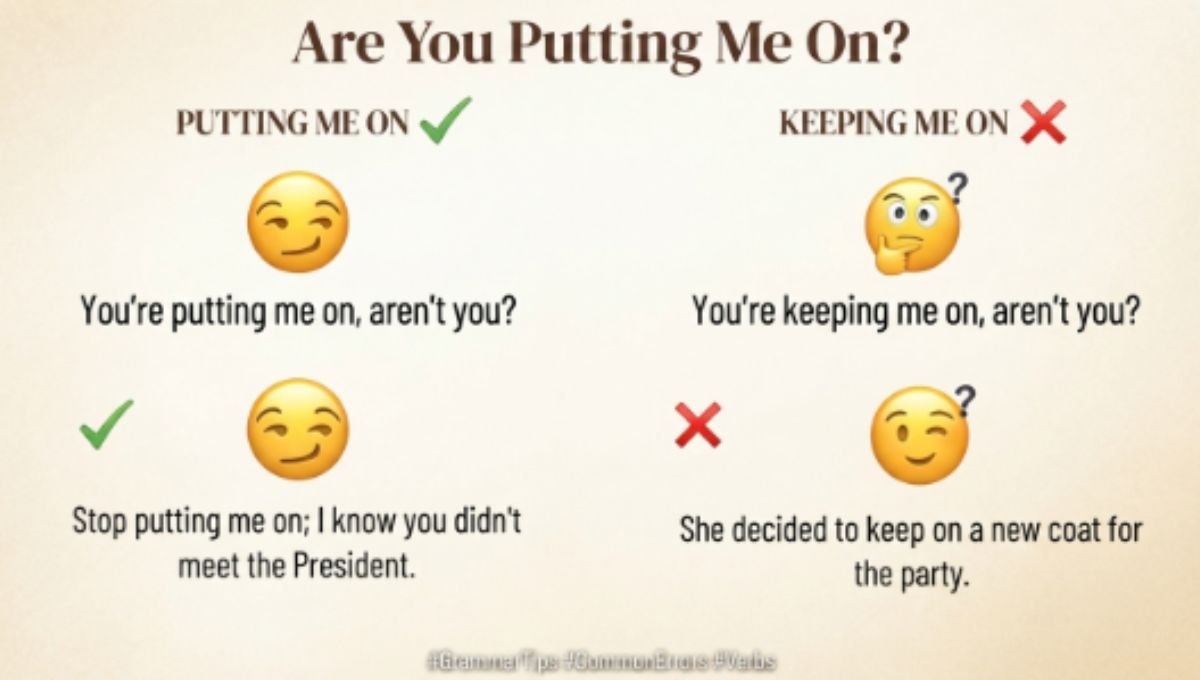
You heard someone say “are you putting me on?” and had no idea if you were being accused of something, complimented, or teased. That confusion makes sense because the phrase doesn’t literally mean what the words suggest. The short answer: are you putting me on meaning simply asks “are you joking with me?” or “are you trying to trick me?” It’s an informal way of questioning whether someone is being serious.
The Direct Answer: What Does “Are You Putting Me On” Mean?
“Are you putting me on?” is a casual American English expression that means “are you joking?” or “are you being serious right now?” People say it when something sounds too surprising, unbelievable, or absurd to be true. It’s a way of checking whether the other person is teasing, exaggerating, or genuinely telling the truth.
Why This Phrase Confuses So Many English Learners
The confusion around are you putting me on meaning comes from the verb “put,” which usually describes placing an object somewhere. When “put” combines with “on” and directs at a person instead of a thing, the meaning shifts completely. Nothing is physically being placed on anyone. Instead, “putting someone on” describes playing a trick on their perception of reality.
Breaking Down the Grammar: “Put” Plus “On” Plus “Me”
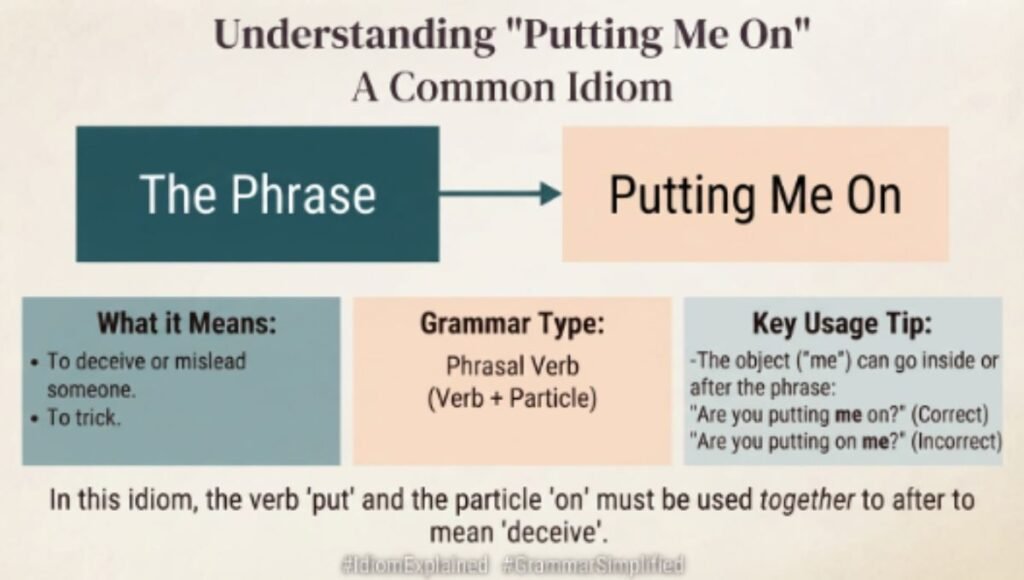
This expression is built from a phrasal verb: “put on,” combined with an object pronoun. Phrasal verbs often carry meanings that have nothing to do with their individual words, and “put on” is a great example.
Put on (literal): to place clothing or an object onto something. Example: She put on her jacket before leaving.
Put on (idiomatic, used on a person): to deceive, joke with, or tease someone. Example: Are you putting me on, or is this actually true?
Both uses are grammatically correct. The difference lies entirely in context and whether the object is a physical item or a person’s belief.
Where Did “Putting Someone On” Come From?
The idiomatic use of “put on” meaning to deceive or joke with someone dates back to American slang from the mid-20th century, gaining wider popularity through casual conversation and entertainment culture in the 1950s and 1960s. Over time, it settled into everyday speech as a lighthearted way to question whether someone is exaggerating or fooling around.
How to Pronounce This Phrase Naturally
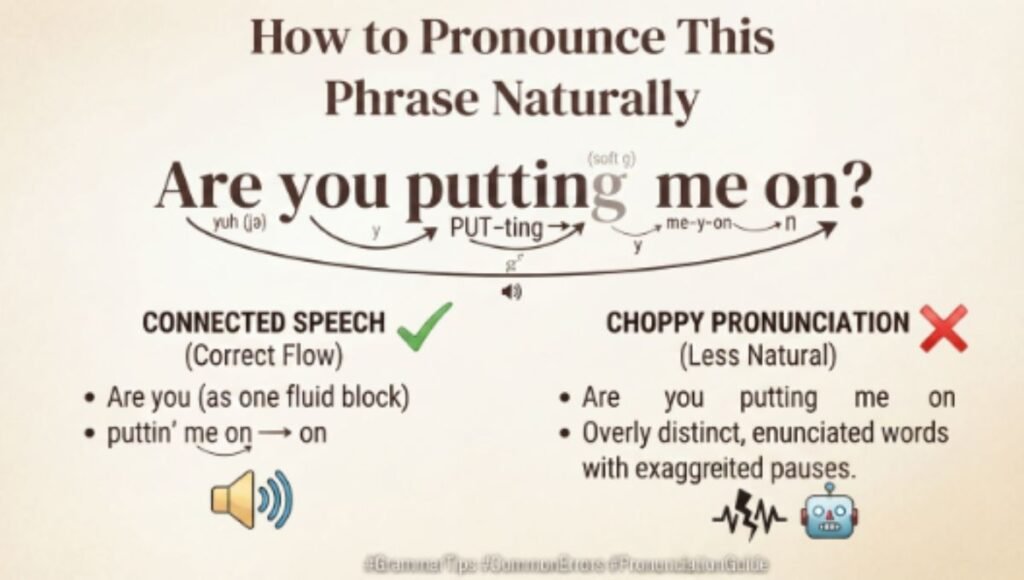
There’s no unusual pronunciation here, but native speakers often blend the words together in casual speech, saying something closer to “are you puttin’ me on” in relaxed conversation. In writing, especially formal writing, the full phrase “putting me on” is standard.
When and How to Use “Are You Putting Me On”
This phrase works best in informal, conversational settings. It’s common between friends, family members, and coworkers who have a casual relationship. It generally isn’t used in formal writing, academic work, or professional emails, since it reads as too casual for those contexts.
| Setting | Appropriate? | Why |
| Casual conversation | Yes | Common and natural among friends |
| Text messages | Yes | Fits informal, quick exchanges |
| Workplace chat with close coworkers | Sometimes | Depends on relationship and tone |
| Formal emails | No | Too casual for professional writing |
| Academic writing | No | Idiomatic slang doesn’t fit formal register |
Real Life Examples of “Are You Putting Me On”
Everyday conversation: “You won the lottery? Are you putting me on?”
Casual text message: “Wait, the concert got canceled? Are you putting me on right now?”
Workplace chat (informal team): “You’re telling me the client approved the whole budget without changes? Are you putting me on?”
Storytelling among friends: “He said he swam with sharks on vacation. Are you putting me on?”
Reacting to surprising news: “She’s moving to another country next month? Are you putting me on?”
Each example shows the phrase reacting to something that feels too surprising or unusual to accept at face value right away.
Similar Phrases That Mean the Same Thing
If are you putting me on meaning still feels unfamiliar, these related expressions carry a nearly identical sense:
- Are you kidding me?
- Are you pulling my leg?
- Are you serious?
- Are you messing with me?
- Is this a joke?
All of these ask the same underlying question: is the other person telling the truth, or are they teasing.
More related Post: 6 Key Put and Keep Differences Every English Learner Should https://feastinsidar.com/put-and-keep-difference/
Common Mistakes People Make With This Phrase
Incorrect: Are you putting on me? Correct: Are you putting me on? The object pronoun “me” goes between “put” and “on,” not after the full phrase.
Incorrect: Are you putting me on that? Correct: Are you putting me on? Adding an extra object after “on” changes the sentence into a literal, confusing statement instead of the idiomatic question.
Incorrect: She put on me a story about her trip. Correct: She put me on with a story about her trip. When using the past tense with a person as the object, “me” still comes right after “put.”
Formal Alternatives When “Putting Me On” Feels Too Casual
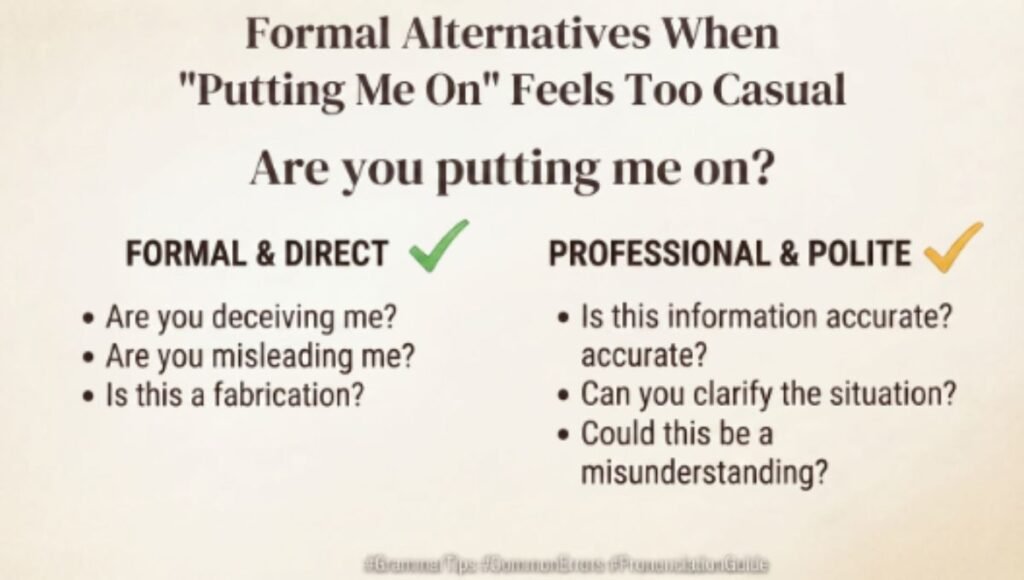
In professional or formal situations, swap the phrase for something more neutral:
- “Are you being serious?”
- “Is this accurate information?”
- “Can you confirm this is true?”
These alternatives communicate the same doubt without sounding overly casual in a work or academic setting.
How This Phrase Differs From “Put Me On”
Some people confuse “are you putting me on” with the newer slang phrase “put me on,” which has a completely different meaning. “Put me on” (often used in music or pop culture slang) means to introduce someone to something good, like a song, trend, or opportunity.
Example: “Put me on to that new artist you were talking about.”
This is unrelated to the idiomatic “putting someone on” that means joking or deceiving. Context makes the difference clear, since one involves sharing something valuable and the other involves questioning honesty.
Frequently Asked Questions
What does “are you putting me on” mean?
It means “are you joking with me?” or “are you being serious?” It questions whether someone is telling the truth or teasing.
Is “putting someone on” the same as lying?
Not exactly. It usually implies playful teasing or exaggeration rather than serious, harmful deception.
Is this phrase formal or informal?
It’s strictly informal and best suited for casual conversations, not professional or academic writing.
Can “put on” mean something else?
Yes. “Put on” can literally mean wearing clothing, or in modern slang, “put me on” can mean introducing someone to something new and good.
How do I respond if someone asks “are you putting me on”?
You can simply clarify with “No, I’m serious” or “Yes, I was just joking,” depending on your intention.
Final Takeaway
Understanding are you putting me on meaning comes down to recognizing it as a casual way of asking “are you serious?” or “are you joking?” Once you separate this idiomatic use from the literal meaning of “put on,” the phrase becomes easy to use and just as easy to understand the next time someone asks it.










1 thought on “I Was Confused About “Are You Putting Me On” Meaning: 6 Things That Cleared it Up”