You saw the name Minnie somewhere, maybe on a family tree, a baby name list, or a Disney character’s credit, and now you are stuck wondering what it actually stands for. That confusion is normal: Minnie almost never appears as a formal legal name on its own, which is exactly why the Minnie meaning is hard to pin down from context. The short version: the Minnie meaning traces back to several longer names, most often Minerva or Wilhelmina, used as an affectionate nickname.
What Does Minnie Mean?
Minnie is a feminine given name that functions mainly as a nickname, not a formal name in its own right. It is most commonly used as a shortened, affectionate form (linguists call this a hypocorism) of longer names such as Minerva, Wilhelmina, Winifred, or Margaret. On its own, Minnie does not carry a separate dictionary definition. Its meaning depends entirely on which full name it is standing in for.
That is the answer in one paragraph. The rest of this article walks through where that meaning comes from, how to pronounce it, and how to actually use the name correctly.
Is Minnie a Full Name or Just a Nickname?
Today, Minnie can be either. Historically, it started strictly as a nickname, the way “Liz” stands in for “Elizabeth.” Over the past century, though, enough parents have used Minnie as a standalone first name that it now appears on birth certificates in its own right, separate from any longer name.
So if someone asks whether Minnie is “real,” the honest answer is: it is real either way. It began as a diminutive and has since become an independent name option. Understanding that shift is central to grasping the full Minnie meaning, because the same three letters can point to two different naming traditions depending on the era and the family.
What Names Is Minnie Short For?
This is where most of the confusion starts, because Minnie is not tied to just one source name. It has served as a nickname for:
- Minerva, the Roman goddess of wisdom
- Wilhelmina, the feminine form of William
- Winifred, a name of Welsh origin
- Margaret, from the Greek word for “pearl”
- Mary, Miriam, and Maria
- Winona, a name of Dakota Sioux origin
- Hermione, Jasmine, Naomi, Miranda, and Amelia
Because so many different names shortened to “Minnie,” you cannot always assume which full name a specific person’s Minnie originally came from without asking or checking records.
Where Does the Name Minnie Come From?
The Minnie meaning shifts depending on the source name behind it, so it helps to look at the two most common origins separately.
From Minerva: Minerva comes from the ancient Roman goddess associated with wisdom, strategy, and craft. The name traces back through Latin to a Proto-Italic root connected to “intelligence” and “understanding.” When Minnie stands in for Minerva, it inherits that association with wisdom and thoughtfulness.
From Wilhelmina: Wilhelmina is the feminine version of the Germanic name William, built from elements meaning “will” or “desire” and “protection.” When Minnie shortens Wilhelmina, its underlying sense leans toward “resolute protector” rather than “wisdom.”
Both origins are well documented and equally legitimate. Neither is more “correct” than the other; the actual meaning simply depends on family history and naming choice.
Read More: Time Flies or Time Flys? I Found the Definitive Answer in 2026
How Do You Pronounce Minnie?
Minnie is pronounced MIN-ee, with a short “i” sound in the first syllable, rhyming with “skinny” or “Ginny.” This pronunciation is consistent across American and British English, so there is no regional split to worry about here.
Minnie vs Minerva vs Wilhelmina: What Is the Difference?
Readers often want to know whether these names are interchangeable or genuinely different. Here is a quick comparison:
| Name | Formality | Meaning | Typical Use |
| Minnie | Informal or standalone | Depends on source name (wisdom or protection) | Nickname or given first name |
| Minerva | Formal | Wisdom, intelligence, understanding | Formal first name |
| Wilhelmina | Formal | Resolute protector | Formal first name |
Use Minnie in casual, everyday, or affectionate contexts. Use Minerva or Wilhelmina on legal documents, formal introductions, or anywhere a full given name is expected.
Personality Traits Associated With the Name Minnie
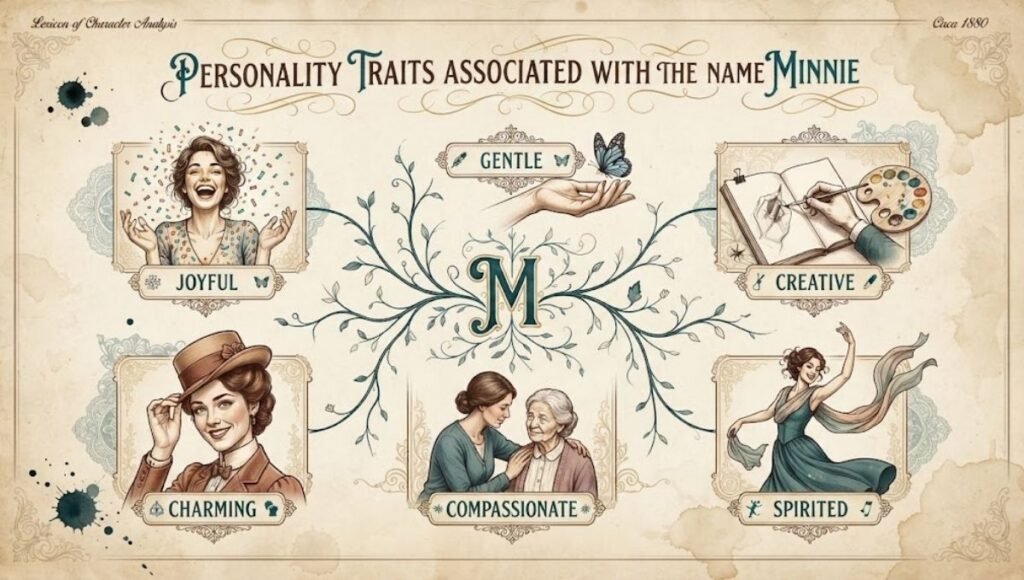
Baby name sites and naming communities often attach personality traits to names based on tradition and popular perception rather than science. For Minnie, the traits commonly mentioned include warmth, cheerfulness, and approachability, likely influenced by decades of the name showing up on friendly, down to earth characters and relatives.
Treat these traits as folklore, not fact. No name determines a person’s personality; these associations exist because of cultural patterns, not linguistic rules.
How Popular Is the Name Minnie Today?
Minnie was common as a given name and nickname in the late 1800s and early 1900s, a period when shortened, affectionate names were especially fashionable in the United States and United Kingdom. Its use declined through the mid-20th century as longer, more formal names came back into style.
In recent years, Minnie has seen renewed interest alongside a broader trend of parents choosing vintage, “grandma-core” names for babies. It remains far less common than names like Emma or Olivia, but it has moved from rare to modestly trendy in that revival wave. This gradual comeback is part of why so many people are searching for the Minnie meaning right now: they are hearing the name again and want to know the story behind it before they use it themselves.
How to Use Minnie in a Sentence
Seeing the name in context makes the Minnie meaning easier to apply correctly.
- Everyday conversation: “My grandmother’s name was Minnie, but everyone just called her Min.”
- Workplace communication: “Please loop in Minnie from accounting before you finalize the invoice.”
- Academic writing: “The letters exchanged between Minnie and her sister offer insight into rural life in 1910.”
- Formal writing: “Minerva Josephine Carter, known to family and friends as Minnie, was born in 1887.”
Each example works because Minnie is treated as a proper noun, capitalized, and used the way any first name would be used in that setting.
Common Mistakes People Make With the Name Minnie
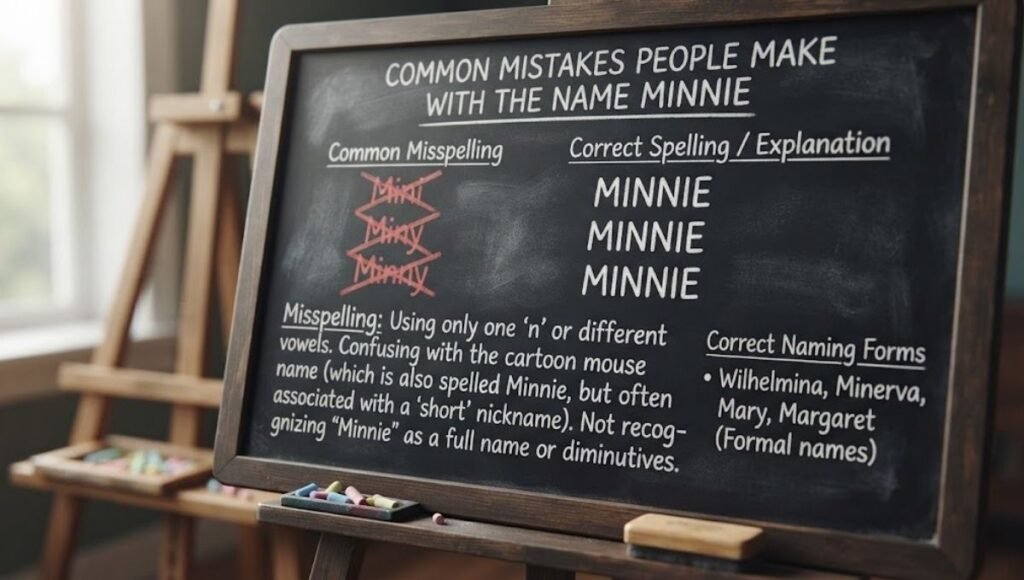
Incorrect: She introduced herself as minnie during the interview. Correct: She introduced herself as Minnie during the interview. Names are always capitalized in English, including nicknames like Minnie.
Incorrect: His full legal name is Minnie, so Minerva must be a nickname for it. Correct: His full legal name is Minerva, and Minnie is the nickname for it. Minnie is historically the shortened form, not the source name, even though it can now stand alone on official records.
Incorrect: Minnie only means “mouse,” referring to the cartoon character. Correct: Minnie predates the cartoon character and comes from names like Minerva or Wilhelmina. The Disney character borrowed an already existing given name; it did not create the meaning.
Names Related to Minnie
Once you understand the Minnie meaning, it helps to see how it connects to nearby names and spellings, since a few of them are easy to confuse at a glance.
| Related Term | Relationship to Minnie |
| Minerva | Full name Minnie often shortens |
| Wilhelmina | Full name Minnie often shortens |
| Winifred | Alternate full name source |
| Margaret | Alternate full name source |
| Min, Minny | Informal spelling variations |
| Mini | Unrelated word, different spelling and meaning |
Minnie Mouse and Other Famous Minnies
Minnie Mouse, introduced by The Walt Disney Company, is likely the most recognizable bearer of the name today, which is why many people assume the name started with the cartoon. It did not. Minnie was already an established given name decades before the character debuted.
Other notable people named Minnie include actress Minnie Driver, singer Minnie Riperton, and comedian Minnie Pearl. Each of these examples shows the name functioning as a standalone first name rather than strictly a nickname, which is another reminder that the Minnie meaning is broader than any single pop culture reference.
Frequently Asked Questions
Is Minnie a real name?
Yes. It started as a nickname for names like Minerva and Wilhelmina, but it is also used today as an independent given name.
What does the name Minnie mean in English?
The Minnie meaning has no separate English dictionary entry on its own. Its meaning comes from the full name it shortens, most often “wisdom” (from Minerva) or “resolute protector” (from Wilhelmina).
Is Minnie short for Minerva or Wilhelmina?
It can be short for either, along with several other names such as Winifred, Margaret, and Mary. The specific source depends on the individual and their family naming history.
How do you spell Minnie correctly?
The standard spelling is M-I-N-N-I-E. “Minny” and “Miny” appear in some records, but Minnie is the accepted modern spelling.
Is Minnie only associated with Minnie Mouse?
No. The Disney character uses an existing name that had been in common use since the 1800s, well before the cartoon existed.
Conclusion
The Minnie meaning is not one fixed definition, and that is exactly why the name has confused so many readers searching for a simple answer. It works as a warm, informal nickname for names like Minerva and Wilhelmina, and it also stands on its own as a first name for anyone who prefers it that way.
The one thing worth remembering: always capitalize it, and know that its meaning simply travels with whichever full name sits behind it.










1 thought on “Minnie Meaning: What This Name Really Means and Where It Comes from”