Genuine vs Sincere: which word fits? Both describe something honest, so they often get swapped. The confusion makes sense, but the words point at different things. “Genuine” describes whether something is real, and “sincere” describes whether a feeling or statement is honestly meant. A genuine diamond is authentic, and a sincere apology is heartfelt. Once you know that split, the Genuine vs Sincere choice gets easy.
Genuine vs Sincere: What Is the Difference?
Genuine means real or authentic. Sincere means honestly felt or meant. “Genuine” answers the question “Is it real?” and “sincere” answers the question “Does the person mean it?”
A genuine antique is not a copy. A sincere apology is not an act.
That is the core of the difference. Objects, documents, and people can be genuine. Only people, feelings, and words can be sincere.
What Does Genuine Mean?
“Genuine” is an adjective with two everyday uses.
Use 1: authentic, not fake. This applies to things you can hold or verify: genuine leather, a genuine signature, a genuine Picasso.
Use 2: natural and without pretense. This applies to people and feelings: genuine curiosity, a genuine smile, a genuine person.
The adverb is genuinely, as in “I’m genuinely surprised.” The noun is genuineness.
Example: “The jeweler confirmed the necklace was genuine gold.”
What Does Sincere Mean?
“Sincere” is also an adjective. It describes a person, feeling, or statement that is honest and free from pretending. If someone is sincere, their words match what they really think or feel.
You will see it with apologies, thanks, condolences, interest, and effort. It always points back to a person’s inner honesty.
The adverb is sincerely, and the noun is sincerity.
Example: “She offered a sincere apology and then fixed the mistake.”
Can You Use Genuine and Sincere Interchangeably?
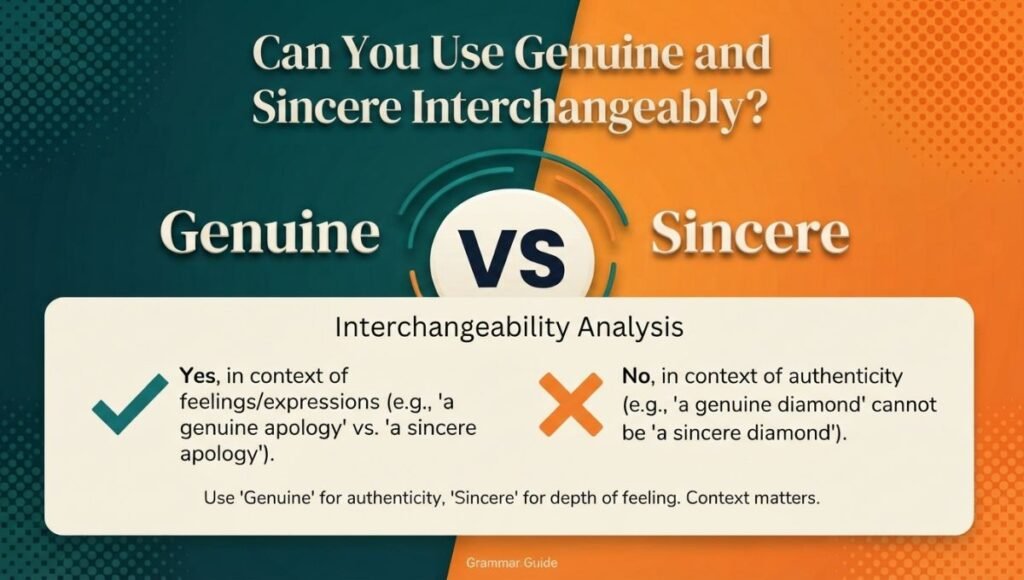
Sometimes, but not always. The Genuine vs Sincere overlap happens mainly with feelings and people.
“Genuine concern” and “sincere concern” both work. So do “genuine interest” and “sincere interest.” In each case, the emotion is real and honestly held.
The nuance is small. “Genuine” stresses that the feeling is real and not faked. “Sincere” stresses that the person honestly means what they say.
Here is a fast test:
- If the noun is a thing (leather, gold, a painting, a ticket), use “genuine.”
- If the noun is a spoken or written expression (an apology, a thank you, a wish), “sincere” is usually the more natural fit.
- If the noun is a feeling or a person, either word may work.
Where Do Genuine and Sincere Come From, and How Are They Pronounced?
Both words come from Latin. “Genuine” comes from genuinus, meaning native, natural, or authentic. “Sincere” comes from sincerus, meaning clean, pure, or whole.
You may have heard a story that “sincere” comes from Latin words for “without wax,” supposedly describing honest sculptors. Language historians treat that as a folk tale, so it is safer to skip it.
Pronunciation differs in stress:
- Genuine: JEN-yoo-in (/ˈdʒɛnjuɪn/), stress on the first syllable
- Sincere: sin-SEER (/sɪnˈsɪr/), stress on the second syllable
- Sincerely: sin-SEER-le
Genuine vs Sincere at a Glance
Here is how the main terms compare:
| Term | Correct? | Meaning | Use |
| genuine | Yes | Real, authentic, not fake | Objects, documents, people, feelings |
| sincere | Yes | Honestly felt or meant | People, feelings, words, actions |
| genuinely | Yes | Truly, in a real way | “I’m genuinely grateful.” |
| sincerely | Yes | Honestly, with real feeling | Email closings, “sincerely sorry” |
| sincere (for objects) | No | Not used for real vs fake items | Avoid: “a sincere gold ring” |
The takeaway: “genuine” can describe almost anything real, while “sincere” is reserved for honest expression.
More related Post: Existence vs Existance: 1 Correct Spelling and 7 Examples https://feastinsidar.com/existence-vs-existance/
What Are the Word Forms of Genuine and Sincere?
Each word has a small family. Here are the standard forms:
| Part of speech | Genuine family | Sincere family |
| Adjective | genuine | sincere |
| Adverb | genuinely | sincerely |
| Noun | genuineness | sincerity |
| Opposite | fake, counterfeit, phony | insincere, insincerely, insincerity |
“Genuine” has no standard prefixed opposite, so writers use words like “fake” or “counterfeit.” “Sincere” does, and that word is insincere.
Both adjectives can take comparisons: “more genuine,” “most sincere.” The spelling is the same in American and British English.
How Do You Use Genuine and Sincere in Sentences?
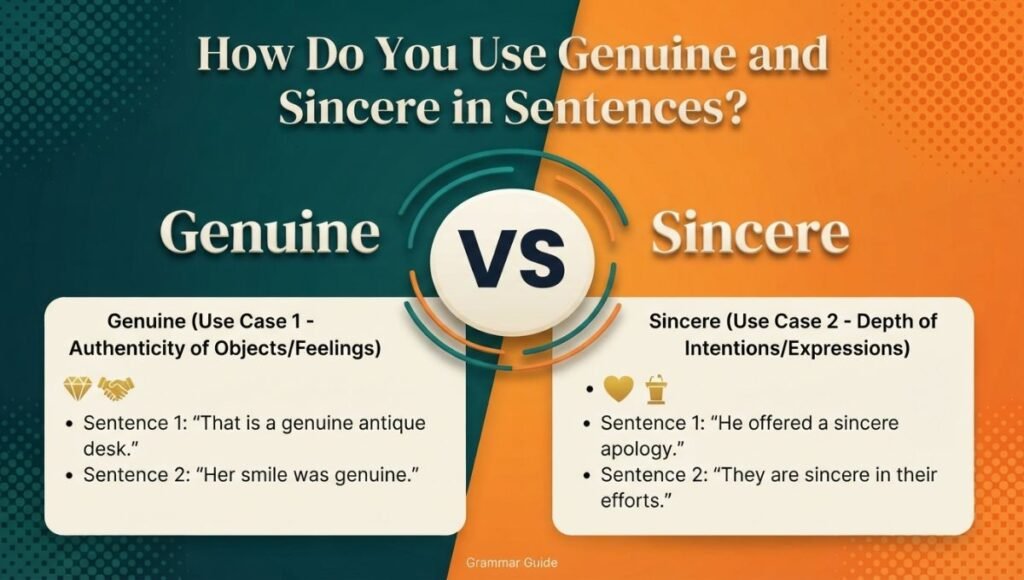
Here are eight examples that show the Genuine vs Sincere split in real situations.
Everyday conversation: “I’m sincerely sorry I missed your call. My phone died.”
Workplace communication: “Thank you for your sincere feedback. It helped the whole team.”
Email: “We appreciate your genuine interest in the position and will contact you by Friday.”
Academic writing: “Participants who showed genuine engagement scored higher on the follow-up test.”
Business writing: “Customers can tell when a brand’s enthusiasm is genuine.”
Formal writing: “The board extends its sincere condolences to the family.”
Casual writing: “That was a genuine hidden gem of a restaurant.”
Objects: “The auction house verified that the painting was a genuine oil on canvas.”
In the academic example, “genuine” describes the engagement itself: real, not just for show. In the formal example, “sincere” describes what the board honestly feels and says. Nobody would write “genuine condolences” wrong, but “sincere” is the traditional choice for expressions like this.
What Mistakes Do People Make With Genuine and Sincere?
These slips are normal, and each has a quick fix.
Incorrect: The seller promised the handbag was sincere leather.
Correct: The seller promised the handbag was genuine leather.
Leather is a material, so the question is whether it is real. Use “genuine.”
Incorrect: Genuinely, Maria
Correct: Sincerely, Maria
“Sincerely” is the standard email and letter closing. “Genuinely” is not.
Incorrect: I appreciate your sincere.
Correct: I appreciate your sincerity.
“Sincere” is an adjective, so it needs a noun after it. The noun form is “sincerity.”
Incorrect: Her genuinly kind gesture surprised everyone.
Correct: Her genuinely kind gesture surprised everyone.
The adverb form is spelled with “ely,” not just “ly.” The same goes for “sincerely.”
Watch out for “disingenuous.” It looks like the opposite of “genuine,” but it actually comes from “ingenuous” (candid, innocent). It means pretending to be more honest or naive than you are: “That was a disingenuous excuse.”
The Genuine vs Sincere mix-up is a normal part of learning English, and even fluent writers pause over it.
What Related Words and Phrases Should You Know?
These terms sit close to “genuine” and “sincere”:
- Synonyms for genuine: authentic, real, legitimate, true, bona fide
- Synonyms for sincere: heartfelt, earnest, honest, wholehearted, candid
- Antonyms for genuine: fake, counterfeit, phony, artificial
- Antonyms for sincere: insincere, dishonest, hypocritical
- Common phrases with genuine: genuine article, genuine leather, genuine interest, genuine mistake
- Common phrases with sincere: sincere apology, sincere thanks, sincerely yours, in all sincerity
Related nouns include authenticity (close to genuine) and earnestness (close to sincere).
How Do You Choose Between Genuine and Sincere?
Use this short guide:
- Check the noun. If it is an object, material, or document, choose “genuine.”
- Check the meaning. If you are describing honest intent behind words or actions, choose “sincere.”
- Check the setting. For apologies, thanks, and condolences, “sincere” is the classic pick.
- Use “genuine” for a feeling that is real and unforced. Genuine happiness and genuine surprise both sound natural.
When you are stuck on Genuine vs Sincere, ask one question: “Am I saying it is real, or am I saying it is honestly meant?” Real points to “genuine,” and honestly meant points to “sincere.”
Quick Answers About Genuine and Sincere
What is the difference between genuine and sincere?
“Genuine” means real or authentic. “Sincere” means honestly felt or meant. A genuine watch is not a fake, and a sincere thank you is not an act.
Are genuine and sincere synonyms?
They overlap when describing feelings or people, as in “genuine concern” and “sincere concern.” They are not interchangeable for objects, because only “genuine” can describe a real item.
Can a person be both genuine and sincere?
Yes. A genuine person is natural and unpretentious, and a sincere person says what they honestly mean. Many people are both.
Which word should I use in an apology?
“Sincere” is the more traditional choice. Example: “Please accept my sincere apology for the delay.”
The One Rule to Remember
Genuine vs Sincere comes down to what you are describing. Use “genuine” when something is real, and use “sincere” when someone honestly means what they say. The takeaway: genuine is about what is real, and sincere is about what is meant.