Existence vs Existance: which spelling is right? Many writers pause here because the word ends with a sound that could be spelled two ways. English has many words that end in -ance or -ence, and the sound gives no clue. The correct spelling is “existence,” with an e. “Existance” is a misspelling. Once you learn the root rule, Existence vs Existance stops being a guessing game.
Existence vs Existance: Which Spelling Is Correct?
“Existence” is the only correct spelling. “Existance” is a common misspelling and has no legitimate use in standard English.
The word ends in -ence, not -ance. This is true in American and British English, in formal and casual writing, and in every dictionary.
If your spellchecker underlines “existance,” trust it. There is no regional variant or alternate form to worry about.
What Does Existence Mean?
“Existence” is a noun. It refers to the state of being real or of being present in the world.
It has three common uses:
- Being real: “Scientists confirmed the existence of the new species.”
- A way of living: “He led a quiet existence in a small town.”
- Presence in a place or system: “The existence of a backup saved the project.”
The word is uncountable in most uses, but it can be countable when it means a way of life: “many different existences.” That plural use is rare and mostly literary.
Why Is Existence Spelled With -ence?
The spelling comes from the verb exist, which came into English from Latin. English nouns built from Latin verbs often take -ence when the Latin root ends in -ere or -ire patterns, and -ance when the root ends in -are.
You do not need to memorize Latin, though. Here is the practical shortcut: the noun keeps the pattern of its verb family. Words in the same family as “exist” use -ence: existence, existent, coexistence, preexistence.
Compare that with words like “importance” or “tolerance,” which follow their own roots. English has no single rule that predicts every -ance or -ence word, so learning word families is the most reliable method.
Where Does the Word Existence Come From?
“Existence” traces back to Latin existere (also spelled exsistere), meaning to stand forth or to come into being. The Latin word is built from ex- (out) and sistere (to stand, to place).
That history gives you a helpful picture: to exist is to stand out into reality. The English noun came to us through Old French and Medieval Latin forms.
The Latin source explains the -e- in the ending, since the noun follows the same pattern as many other words from this root.
How Do You Pronounce Existence?
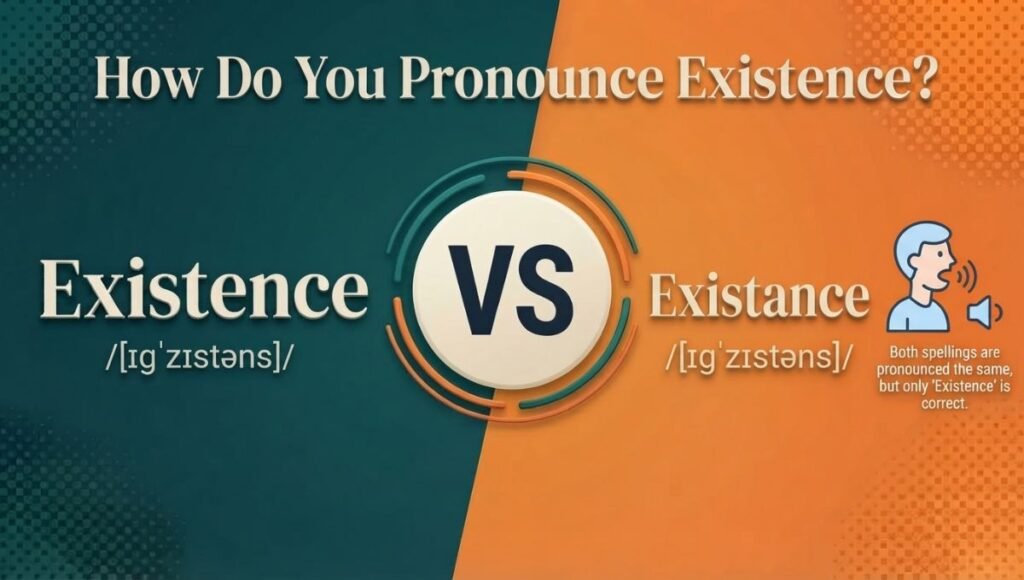
“Existence” is pronounced ig-ZIS-tents (/ɪɡˈzɪstəns/). The stress falls on the second syllable, and the “x” sounds like “gz.”
The ending sounds like “tents,” which is the same for -ence and -ance. That is exactly why the spelling is tricky: your ears cannot tell you which vowel to write.
Since pronunciation does not help, use the word-family method or the memory trick in the next sections.
More related Post: Phib Meaning: 3 Definitions, 1 Key Fact, and 6 Real Examples https://feastinsidar.com/phib-meaning/
Existence vs Existance at a Glance
Here is how the two spellings compare:
| Term | Correct? | Meaning | Use |
| existence | Yes | State of being real or present | All writing, formal and casual |
| existance | No | Misspelling | Never use |
| exist | Yes | Verb: to be real | “Dragons do not exist.” |
| existent | Yes | Adjective: currently existing | Formal writing |
| existant | No | Misspelling | Never use |
The takeaway: every word in the exist family uses an e before the ending.
What Are the Related Forms of Existence?
The word has a full family:
| Part of speech | Word | Example |
| Verb | exist | Problems exist in every system. |
| Verb forms | exists, existed, existing | She existed on very little sleep. |
| Noun | existence | The existence of the file is unclear. |
| Adjective | existent, existing | Existing rules remain in effect. |
| Negative adjective | nonexistent | A nonexistent budget |
| Related nouns | coexistence, preexistence | Peaceful coexistence |
The adjective existent ends in -ent, which matches the -ence noun. That is a useful clue: if the adjective is -ent, the noun is -ence.
How Do You Use Existence in Sentences?
Here are natural examples for different contexts.
Everyday conversation: “I forgot the restaurant’s existence until you mentioned it.”
Workplace communication: “Please confirm the existence of the signed contract before Friday.”
Email: “I was not aware of the existence of this policy. Could you share a copy?”
Academic writing: “The study questions the existence of a single cause for the decline.”
Business writing: “The company’s existence depends on a steady flow of new customers.”
Formal writing: “The committee acknowledged the existence of significant concerns.”
Casual writing: “Honestly, my entire existence revolves around coffee.”
In the email example, “existence of this policy” names the fact that the policy is real. In the business example, “existence” means the company’s continued survival. Both are correct because each names a state of being.
What Mistakes Do People Make With Existence?
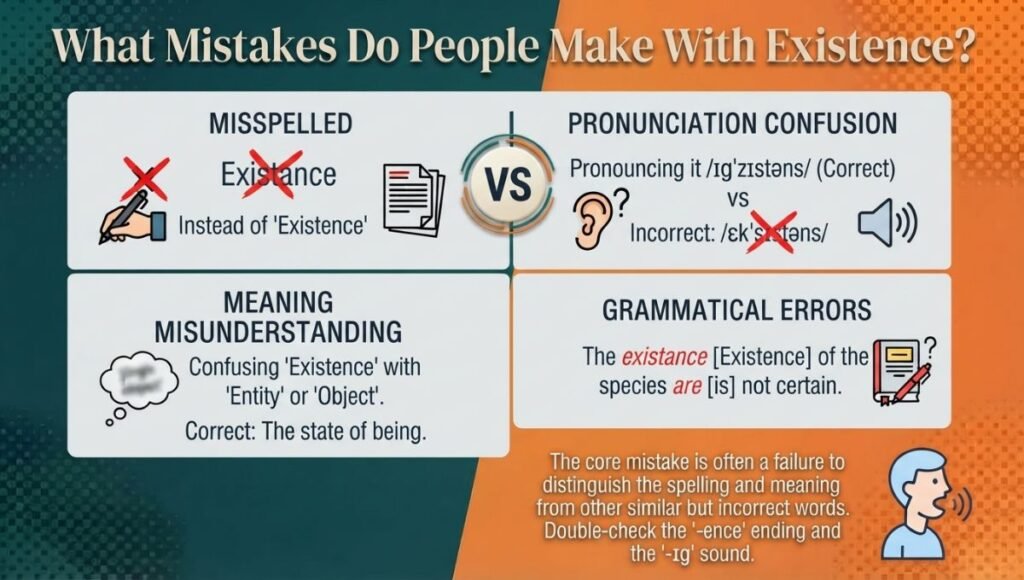
These slips are common, and each has a quick fix.
Incorrect: We debated the existance of free will.
Correct: We debated the existence of free will.
The word ends in -ence. Use the same vowel as “exist” plus “-ent.”
Incorrect: The report describes several existant problems.
Correct: The report describes several existing problems.
The adjective is “existing” or “existent,” never “existant.”
Incorrect: That idea is non existence.
Correct: That idea is nonexistent.
“Nonexistence” is a noun, while “nonexistent” is the adjective. Use the adjective here, and write it as one word.
Incorrect: Her existance was quiet.
Correct: Her existence was quiet.
Same fix: change the -ance ending to -ence.
The Existence vs Existance mistake is normal, and even skilled writers catch it only when they proofread.
What Related Words and Phrases Should You Know?
These terms sit close to “existence”:
- Synonyms: being, reality, life, presence, survival
- Antonyms: nonexistence, absence, nothingness
- Common phrases: in existence, come into existence, bring into existence, struggle for existence, the very existence of
- Related words: existent, existing, existential, existentialism, coexist
Existential is a related adjective meaning “about existence,” as in “an existential question.” It ends in -ial, so it has a different pattern from the noun.
How Can You Remember the Correct Spelling?
Use this short guide:
- Start from the verb. Say “exist,” then add “-ence.”
- Check the adjective. “Existent” ends in -ent, so the noun ends in -ence.
- Try a memory trick. Think of “existence” as containing “tense,” but remember the ending is “-tence,” and the word is about being present. The e in “existence” matches the e in “exist” and “presence.”
- Proofread once for the ending. Search your draft for “-ance” words if you often mix them up.
When you are unsure about Existence vs Existance, look at the verb first. The verb “exist” points to “existence” every time.
Quick Answers About Existence
Is it existence or existance?
It is existence. “Existance” is a misspelling.
What does existence mean?
Existence means the state of being real or present. Example: “Nobody doubted the existence of the bridge.”
Is existance ever correct?
No. There is no regional or alternate spelling that accepts “existance.”
What is the adjective form of existence?
The adjectives are “existent” and “existing.” Example: “The existing plan already covers this issue.”
How do you spell nonexistent?
It is spelled as one word: nonexistent. The noun is “nonexistence.”
The One Rule to Remember
Existence vs Existance has one answer: existence, with an e. Start from the verb “exist” and its adjective “existent,” and the ending follows. The takeaway: if it comes from exist, it ends in -ence.