Spell check accepts both “useable” and “usable,” so which one should you actually type? The useable or usable question exists because English allows two valid spellings for the same word, something that rarely happens this cleanly. Once you know which form is preferred and why, the useable or usable decision becomes an easy one.
Quick Answer: Is It Useable or Usable?
Both “useable” and “usable” are correct spellings, but “usable” is the more common and widely preferred form in American English. “Useable” is a recognized variant, not a mistake, though it appears less frequently in dictionaries, style guides, and everyday writing.
What Does “Usable” Mean?
“Usable” (or “useable”) is an adjective describing something that can be used, is in working condition, or is suitable for a particular purpose. Both spellings carry the exact same meaning:
- The old laptop is still usable, even after all these years.
- Is this coupon useable at any store location?
There is no difference in meaning between the two spellings. The only difference is frequency of use.
Why Two Spellings Exist for the Same Word
Most English words ending in a silent “e” drop that “e” before adding a suffix that starts with a vowel, which is why “hope” becomes “hopeful” and “use” becomes “using.” Based on that pattern, “use” plus “-able” should become “usable.” And it does, that spelling is standard and correct.
But some words allow the silent “e” to stay when dropping it might cause confusion with pronunciation or appearance. “Useable” keeps the “e” visible, which some writers feel preserves a clearer connection to the base word “use.” This is the real reason behind the useable or usable spelling split.
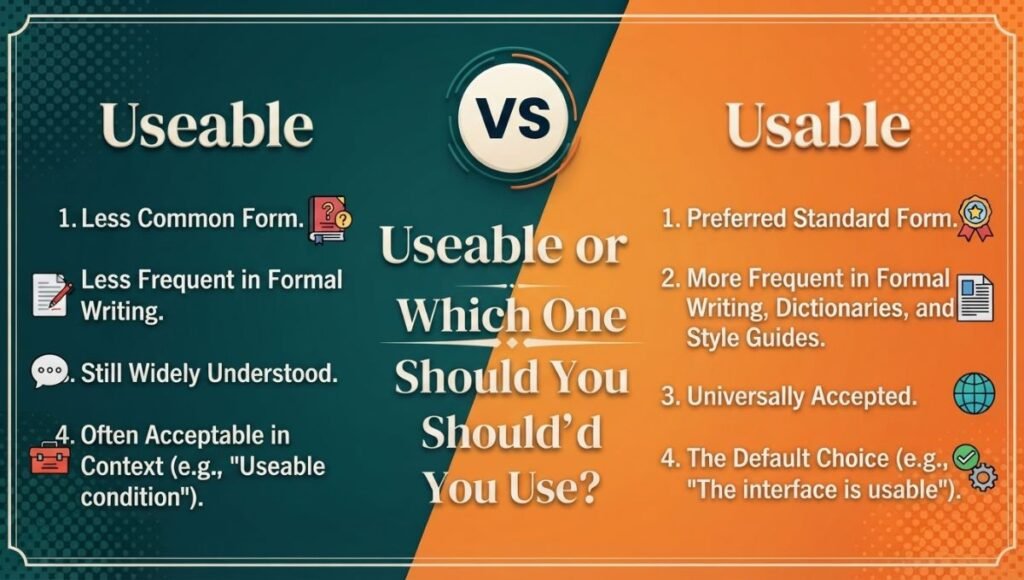
Useable or Usable: Which One Should You Use?
Here’s the practical guidance:
Use “usable” in most everyday writing, business communication, and published content, since it’s the more widely recognized and expected spelling in American English.
Use “useable” only if you’re following a specific style guide or publication that favors it, or if you simply prefer the longer form. It’s grammatically valid, just less common.
If you’re unsure about useable or usable in a formal document, choose “usable” to match reader expectations.
Is “Useable” Considered Incorrect?
No. “Useable” is not incorrect, and it appears in major dictionaries as an accepted variant of “usable.” It’s simply the less frequently used spelling in American English. Some readers may pause slightly when they see “useable” because “usable” is more familiar, which is a practical reason to default to “usable” in most writing, even though both are technically correct.
Grammar Breakdown: Adjective Forms of “Use”
“Use” functions as both a noun and a verb, and “usable” is the adjective form built from the verb. Here’s how the related forms break down:
| Form | Spelling | Example |
| Verb | use | Please use the side entrance. |
| Noun | use | This tool has many uses. |
| Adjective | usable / useable | The old tool is still usable. |
Only the adjective form has two accepted spellings. The verb and noun forms stay consistent as “use” regardless of which adjective spelling you prefer.
More related Post: Treck or Trek (2026): 5 Simple Facts to Fix This Common Spelling Mistake https://feastinsidar.com/treck-or-trek/
Where “Usable” Comes From
The word “use” comes from the Latin verb uti, meaning to employ or make use of something. As English absorbed Latin based vocabulary, the suffix “-able” was added to create an adjective meaning “capable of being used.” The spelling variation between “usable” and “useable” reflects a broader pattern in English where some words dropped a silent “e” before a suffix, while others kept it, often based on regional preference or evolving style conventions over time.
How to Pronounce “Usable” and “Useable”
Both spellings are pronounced exactly the same way: YOO-zuh-bul, with three syllables. There is no pronunciation difference tied to useable or usable, since the spelling variation exists purely on the page, not in speech.
Useable or Usable: Quick Comparison Table
| Term | Correct? | Frequency | Use |
| Usable | Yes | Most common | Preferred in everyday, business, and published writing |
| Useable | Yes | Less common | Accepted variant, seen occasionally in casual or stylistic writing |
“Usable” and “Useable” in Real Sentences
Everyday conversation: “This old bike is still usable, believe it or not.”
Workplace communication: “The updated software is far more usable than the previous version.”
Academic writing: “Researchers evaluated whether the recovered data remained usable after the system failure.”
Email: “Please confirm whether the attached template is usable on your end.”
Business writing: “Customer feedback showed the app’s interface was not easily usable for new users.”
Casual writing (using the less common spelling): “Is this gift card still useable, or did it expire?”
Both spellings work grammatically in every context above, though “usable” reads more naturally to most audiences.
Common Mistakes With Usable and Useable
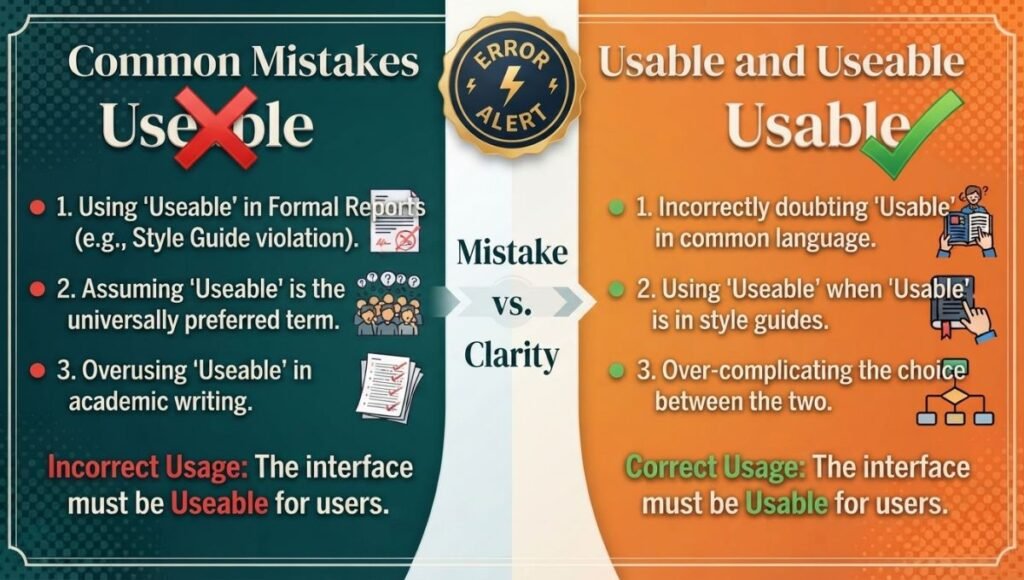
Incorrect: The document is usible for reference.
Correct: The document is usable for reference.
This mistake happens when writers guess at the spelling and land on a version that isn’t valid in either accepted form.
Incorrect: This space is more usable then the last one.
Correct: This space is more usable than the last one.
This isn’t related to the useable or usable spelling itself, but it’s a common companion mistake in comparison sentences.
Incorrect: The old furniture wasn’t very usefull anymore.
Correct: The old furniture wasn’t very usable anymore. (if referring to functionality, not general usefulness)
“Useful” and “usable” are related but distinct, and mixing them up can shift the meaning of a sentence.
Related Words and Terms
A few related terms add useful context:
- Functional: describes something that works as intended, similar to “usable”
- Practical: emphasizes usefulness in a real world context
- Accessible: often used alongside “usable” in design and technology writing
- Unusable: the negative form, describing something that cannot be used
- Ease of use: a common phrase related to how usable something is
How to Remember Which Spelling Fits Best
A simple guideline: when in doubt, drop the extra “e” and go with “usable.” It’s the safer, more recognized choice for nearly any writing situation. Save “useable” for casual writing or specific style preferences, and you’ll navigate the useable or usable choice with confidence every time.
FAQs About Useable or Usable
Is “useable” a misspelling of “usable”?
No. “Useable” is a recognized, dictionary approved variant of “usable,” not a spelling error.
Which spelling is more common, useable or usable?
“Usable” is significantly more common in American English and is the preferred choice for most formal and professional writing.
Can I use “useable” in a school essay or professional document?
You can, since it’s grammatically correct, but “usable” is generally the safer choice because it’s more familiar to readers.
Does British English prefer a different spelling?
Both British and American English accept both spellings, though “usable” remains the more frequently used form in both.
What does “usable” mean in a sentence?
It means capable of being used or in workable condition, as in “The renovated kitchen is fully usable now.”
The Bottom Line
The useable or usable question doesn’t have a single right answer, since both spellings are grammatically valid. Stick with “usable” for most writing situations, and remember that reaching for the more familiar spelling will almost always serve your readers better.







1 thought on “Useable or Usable (2026): 5 Key Facts to Settle This Spelling Question”